
The Rarest Initials in America 2026: 50 Statistics on Rare Initials and Names
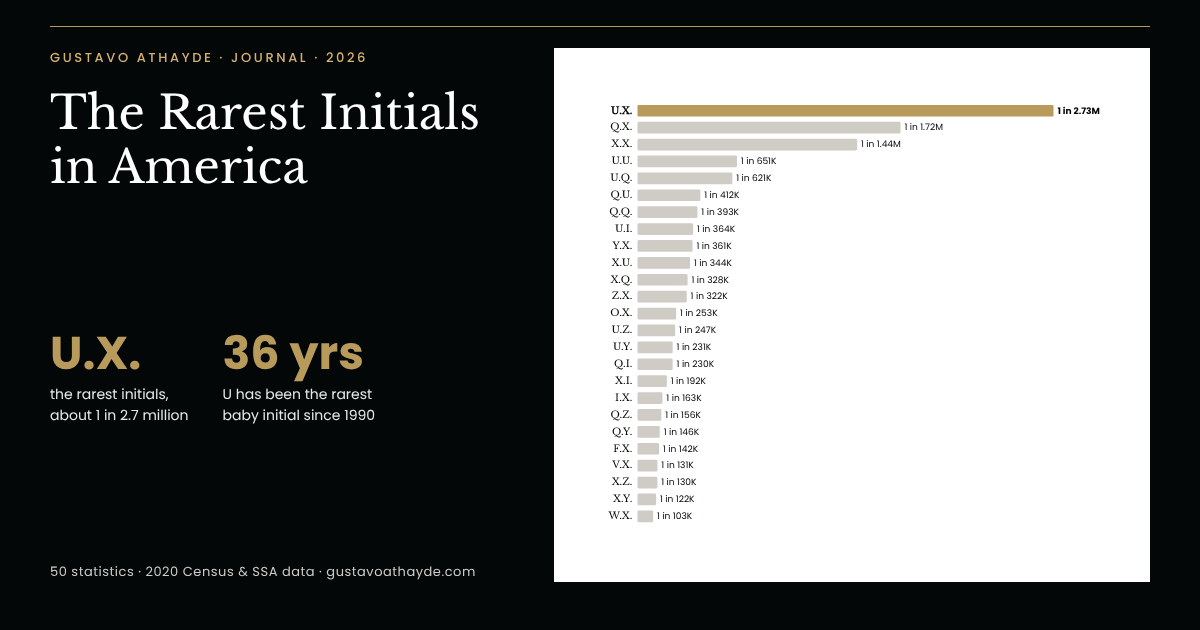
U.X. is the rarest set of initials in America. Only about 1 in 2,725,338 people, roughly 122 Americans, have them. To find the rarest initials, we combined the 2020 Census name files with Social Security baby name data through 2025.
The result is not what most people expect. Neither Q nor Z is the rarest letter. Instead, U is the least common first initial, and X the least common last one. Meanwhile, X names have multiplied among newborns, so the rarest initials of today will not be the rarest of tomorrow.
At a glance
Key takeaways
- U.X. is the rarest pair of initials, at about 1 in 2,725,338 Americans.
- Every one of the 26 pairs rarer than 1 in 100,000 includes a Q, U or X.
- U is the rarest first initial, at 0.064% of Americans; X is the rarest last initial, at 0.057%.
- J.M. is about 33,000 times as common as U.X.
- Order matters: X.Q. is about five times as common as Q.X.
- X names among newborns rose from 72 in 1950 to 11,965 in 2025.
- U has been the rarest baby initial every year since 1990.
- U is the rarest baby initial in 28 of 51 jurisdictions; Q is rarest in Texas and Nevada.
- 79% of married women took their husband’s last name (Pew, 2023), so most initials change at least once.
The rarest initials in America: the full ranking
Initials are rare when both letters are rare. The Census does not publish first and last names together. So the ranking below multiplies the share of each first initial by the share of each last initial.
The 25 rarest initials, charted
SHARE THIS CHART
Copy the code below to embed this chart on your site:
The 25 rarest initials, ranked
Rank Initials About 1 in Est. Americans Rank among 2025 babies 1 U.X. 2,725,338 122 1 2 Q.X. 1,723,095 192 2 3 X.X. 1,438,902 230 3 4 U.U. 651,467 509 4 5 U.Q. 621,274 533 5 6 Q.U. 411,890 805 7 7 Q.Q. 392,801 844 9 8 U.I. 364,405 910 8 9 Y.X. 360,533 919 6 10 X.U. 343,956 964 14 11 X.Q. 328,015 1,010 16 12 Z.X. 322,237 1,029 18 13 O.X. 253,279 1,309 20 14 U.Z. 247,107 1,341 11 15 U.Y. 230,587 1,437 12 16 Q.I. 230,395 1,439 13 17 X.I. 192,395 1,723 29 18 I.X. 163,363 2,029 23 19 Q.Z. 156,233 2,122 19 20 Q.Y. 145,788 2,273 21 21 F.X. 141,603 2,341 10 22 V.X. 130,864 2,533 15 23 X.Z. 130,465 2,541 37 24 X.Y. 121,743 2,723 38 25 W.X. 102,776 3,225 22
Estimate: share of first names with the first letter × share of last names with the second letter (2020 Census), applied to the 2020 resident population of 331,449,281. Baby rank uses 2025 SSA first names with 2020 Census last names.
Pairs rarer than one in a million
- 1.ATELIER ANALYSISU.X. is the rarest set of initials in America: about 1 in 2,725,338 people. That is roughly 122 Americans with a U first name and an X last name (2020 Census). — Gustavo Athayde analysis of U.S. Census Bureau data
- 2.ATELIER ANALYSISOnly three pairs are rarer than one in a million. After U.X. come Q.X. (1 in 1,723,095) and X.X. (1 in 1,438,902), in 2020. — Gustavo Athayde analysis of U.S. Census Bureau data
- 3.ATELIER ANALYSIS26 of the 676 possible pairs are held by fewer than 1 in 100,000 Americans. Moreover, every one includes a Q, U or X (2020). — Gustavo Athayde analysis of U.S. Census Bureau data
- 4.ATELIER ANALYSISJ.M. is about 33,000 times as common as U.X. It is the most common pair in America (2020 Census). — Gustavo Athayde analysis of U.S. Census Bureau data
Order, matching letters and newborns
- 5.ATELIER ANALYSISOrder changes everything. X.Q. occurs in about 1 in 328,015 people, while Q.X. is roughly five times rarer. X is far more common as a first initial (2020). — Gustavo Athayde analysis of U.S. Census Bureau data
- 6.ATELIER ANALYSIS0.83% of Americans have a Q, U or X among their two initials. That is about 2.8 million people (2020). — Gustavo Athayde analysis of U.S. Census Bureau data
- 7.ATELIER ANALYSISThe rarest matching initials are X.X. (1 in 1,438,902), followed by U.U. (1 in 651,467) and Q.Q. (1 in 392,801). By contrast, Y.Y. is about 1 in 30,504 (2020). — Gustavo Athayde analysis of U.S. Census Bureau data
- 8.ATELIER ANALYSISAmong babies born in 2025, U.X. is still the rarest pair, at about 1 in 1,752,304. At that rate, therefore, only about two of the 3.3 million newborns would carry it. X.X., however, is three times as common among 2025 babies. — Gustavo Athayde analysis of Social Security Administration and U.S. Census Bureau data
The rarity map of all 676 pairs
What this means for monograms: a rare pair such as Q.X. or U.Y. is a gift to a designer. Letters that seldom meet have no stock solution, so they invite an original personal monogram or a carefully balanced duogram.
The rarest first initials
First names change with each generation. The rarest first letters show what American parents have, and have not, chosen. U, Q and X sit at the bottom, though each has a name or two that carries the letter.
- 9.ATELIER ANALYSISU is the rarest first initial in America. Only 0.064% of people, about 182,258, have a first name beginning with U (2020). — Gustavo Athayde analysis of U.S. Census Bureau data
- 10.ATELIER ANALYSISQ and X are the next-rarest first initials, at 0.102% and 0.122% of Americans (2020). — Gustavo Athayde analysis of U.S. Census Bureau data
- 11.ATELIER ANALYSISJ is about 196 times as common as U as a first initial. The gap is also wider than for last names (2020). — Gustavo Athayde analysis of U.S. Census Bureau data
- 12.ATELIER ANALYSISU is the rarest first initial for both men and women: 0.078% of men and 0.051% of women. X is also rarer among women (2020). — Gustavo Athayde analysis of U.S. Census Bureau data
The names behind the rarest letters
- 13.ATELIER ANALYSISOnly 177 first names beginning with U, 190 with X and 194 with Q appear in the 2020 Census list of 53,615 first names. By contrast, A has 5,077. — Gustavo Athayde analysis of U.S. Census Bureau data
- 14.ATELIER ANALYSISXavier alone accounts for about 35% of Americans with an X first name, with 119,289 people. Meanwhile, Quinn (66,536) and Uriel (19,855) lead Q and U (2020). — Gustavo Athayde analysis of U.S. Census Bureau data
- 15.Quinn is split almost evenly between men and women. Harley and Emerson also share that pattern (2020 Census). — U.S. Census Bureau
- 16.99% of the 5.2 million different first names in the 2020 Census were reported fewer than 100 times. Most rare names never reach the published tables. — U.S. Census Bureau
Rare letters as first and last initials
Letter First initial (2020) Last initial (2020) Babies 2025 First names listed Last names listed U 0.064% 0.239% 0.100% 177 786 Q 0.102% 0.250% 0.178% 194 424 X 0.122% 0.057% 0.361% 190 44 Y 0.486% 0.674% 0.575% 1,061 1,056 Z 0.544% 0.629% 1.651% 698 2,009 O 0.692% 1.535% 1.967% 696 2,684 I 1.074% 0.426% 2.363% 883 1,224 F 1.238% 3.347% 1.073% 972 5,535 V 1.340% 1.779% 1.555% 952 4,100 W 1.706% 5.466% 2.133% 630 5,193
Census files list names held by 100 or more people; SSA files list names given to five or more babies. Ten letters shown, ordered by first-name share.
The rarest last initials
Surnames move far more slowly than first names, because they pass from one generation to the next. Even so, the 2020 file shows rare last initials growing as American families diversify.
- 17.ATELIER ANALYSISX is the rarest last initial in America. Only 0.057% of people, about 149,763, have an X last name (2020). — Gustavo Athayde analysis of U.S. Census Bureau data
- 18.ATELIER ANALYSISOnly 44 last names beginning with X reach the Census threshold of 100 bearers. By contrast, S has 16,862 (2020). — Gustavo Athayde analysis of U.S. Census Bureau data
- 19.ATELIER ANALYSISXiong is the most common X surname, with 45,183 people. That is about 30% of all X surnames (2020). — Gustavo Athayde analysis of U.S. Census Bureau data
- 20.ATELIER ANALYSISU and Q are the next-rarest last initials, at 0.239% and 0.250%. Meanwhile, Underwood and Quinn lead those letters (2020). — Gustavo Athayde analysis of U.S. Census Bureau data
- 21.ATELIER ANALYSISThe number of Americans with an X surname rose 46.5% between the 2010 and 2020 Census files, from 102,201 to 149,763. Even so, X remained the rarest last initial. — Gustavo Athayde analysis of U.S. Census Bureau and U.S. Census Bureau data
- 22.ATELIER ANALYSISX is about 2.1 times as common as a first initial as it is as a last initial. U is about 3.7 times as common as a last initial. That is why U.X. sits at the bottom (2020). — Gustavo Athayde analysis of U.S. Census Bureau data
Rare initials among newborns, 1880–2025
The Social Security Administration has published names for every year since 1880. That makes it possible to follow the rarest letters for nearly 150 years. The story is one of X rising, U holding on and Q leveling off.
How X overtook U and Q
- 23.ATELIER ANALYSISX was the rarest first initial among U.S. newborns every year from 1880 to 1983, and again in 1989. No X name reached five births until 1886. — Gustavo Athayde analysis of Social Security Administration data
- 24.ATELIER ANALYSISU has been the rarest baby initial every year since 1990. That is 36 years in a row through 2025. — Gustavo Athayde analysis of Social Security Administration data
- 25.ATELIER ANALYSIS11,965 babies born in 2025 received an X name, compared with just 72 in 1950. That is a roughly 166-fold increase. — Gustavo Athayde analysis of Social Security Administration data
- 26.ATELIER ANALYSISX overtook U in 1984 and Q in 2001 as a first initial among newborns. However, U has never caught up. — Gustavo Athayde analysis of Social Security Administration data
- 27.ATELIER ANALYSISThe number of distinct X names given to babies more than tripled, from 62 in 2000 to 207 in 2025. Xavier, Ximena and Xander lead the letter. — Gustavo Athayde analysis of Social Security Administration data
Rare baby initials today
- 28.ATELIER ANALYSISU reached a record 0.100% of births in 2025, its highest share since 1880. Even so, it remains the rarest baby initial. — Gustavo Athayde analysis of Social Security Administration data
- 29.ATELIER ANALYSISQ peaked at 0.224% of births in 2017 and slipped to 0.178% in 2025. Meanwhile, Quinn accounted for about 56% of Q babies in 2025. — Gustavo Athayde analysis of Social Security Administration data
- 30.ATELIER ANALYSISZ rose from 0.033% of births in 1947 to a peak of 1.736% in 2023, a more than fiftyfold increase. — Gustavo Athayde analysis of Social Security Administration data
- 31.None of the 2025 top-10 baby names for boys or girls begins with Q, U, X, Y or Z. Meanwhile, Liam and Olivia led for the seventh straight year. — Social Security Administration
- 32.The top 1,000 names covered 71.51% of U.S. births in 2025, down from 73.25% in 2016. In other words, more parents now choose less common names. — Social Security Administration
Rare initials by state
Each state reaches its own balance of names. Families, traditions and the size of each birth cohort all shape it. In smaller states, the five-birth threshold also means that some rare letters disappear from the published list altogether.
Where U, Y and Q are rarest
- 33.ATELIER ANALYSISU is the rarest first initial for babies in 28 of the 51 jurisdictions in 2025. They include California, New York, Florida and Pennsylvania. — Gustavo Athayde analysis of Social Security Administration data
- 34.ATELIER ANALYSISIn 15 jurisdictions, no U name reached five births in 2025, including South Dakota, North Dakota and Vermont. Small birth totals also make rare letters scarcer. — Gustavo Athayde analysis of Social Security Administration data
- 35.ATELIER ANALYSISQ is the rarest baby initial in Texas and Nevada, the only states where it falls below U. Texas had 350 Q babies and 397 U babies in 2025. — Gustavo Athayde analysis of Social Security Administration data
- 36.ATELIER ANALYSISY is the rarest baby initial in 8 states, including Kansas, Utah, Oregon and South Carolina (2025). — Gustavo Athayde analysis of Social Security Administration data
Where rare letters are most common
- 37.ATELIER ANALYSISNew Mexico has the highest share of babies with X names, at 0.79%. That is about 2.5 times the national rate (2025). — Gustavo Athayde analysis of Social Security Administration data
- 38.ATELIER ANALYSISMontana leads the country in Q names, at 0.49% of births. Wyoming and Vermont follow; the national rate is 0.17% (2025). — Gustavo Athayde analysis of Social Security Administration data
- 39.ATELIER ANALYSISOregon has the highest share of U names, at 0.29% of births. That is roughly 4 times the national rate (2025). — Gustavo Athayde analysis of Social Security Administration data
Rare initials in every state, A to M
State Rarest initial Q U X Babies listed Alabama U 0.06% 0.04% 0.24% 39,837 Alaska Q, U, Y (none listed) 0.00% 0.00% 0.25% 3,925 Arizona U 0.15% 0.13% 0.49% 60,943 Arkansas U 0.07% 0.02% 0.28% 23,179 California U 0.14% 0.13% 0.55% 337,198 Colorado U 0.33% 0.05% 0.37% 50,178 Connecticut U 0.26% 0.00% 0.19% 24,709 Delaware U and Y (none listed) 0.23% 0.00% 0.10% 5,202 District of Columbia U 0.13% 0.00% 0.26% 4,546 Florida U 0.10% 0.05% 0.31% 182,296 Georgia U 0.09% 0.06% 0.29% 95,430 Hawaii U and Y (none listed) 0.20% 0.00% 0.14% 5,063 Idaho U and Y (none listed) 0.31% 0.00% 0.20% 15,794 Illinois U 0.22% 0.10% 0.30% 93,881 Indiana U 0.20% 0.06% 0.27% 59,571 Iowa U 0.22% 0.02% 0.16% 25,601 Kansas Y 0.24% 0.03% 0.33% 25,854 Kentucky U 0.15% 0.01% 0.22% 37,788 Louisiana U 0.09% 0.03% 0.26% 35,500 Maine U and Y (none listed) 0.24% 0.00% 0.10% 6,959 Maryland U 0.17% 0.04% 0.23% 42,882 Massachusetts U 0.25% 0.01% 0.15% 51,052 Michigan U 0.26% 0.05% 0.21% 75,925 Minnesota U 0.28% 0.03% 0.20% 45,978 Mississippi U and Y (none listed) 0.04% 0.00% 0.23% 19,736 Missouri U 0.20% 0.02% 0.25% 52,110
Rare initials in every state, M to W
State Rarest initial Q U X Babies listed Montana Y 0.49% 0.12% 0.11% 6,589 Nebraska U and Y (none listed) 0.20% 0.00% 0.26% 15,915 Nevada Q 0.08% 0.08% 0.56% 20,494 New Hampshire U and Y (none listed) 0.17% 0.00% 0.12% 8,301 New Jersey U 0.14% 0.05% 0.17% 75,265 New Mexico Y 0.12% 0.16% 0.79% 11,173 New York U 0.16% 0.12% 0.22% 162,752 North Carolina U 0.13% 0.06% 0.27% 97,952 North Dakota U and Y (none listed) 0.21% 0.00% 0.18% 6,056 Ohio U 0.23% 0.05% 0.26% 99,804 Oklahoma Y 0.10% 0.07% 0.26% 32,461 Oregon Y 0.22% 0.29% 0.25% 28,111 Pennsylvania U 0.24% 0.05% 0.19% 98,948 Rhode Island U and Y (none listed) 0.23% 0.00% 0.30% 5,576 South Carolina Y 0.13% 0.04% 0.18% 39,488 South Dakota U and Y (none listed) 0.25% 0.00% 0.13% 6,895 Tennessee U 0.09% 0.04% 0.21% 68,842 Texas Q 0.10% 0.12% 0.47% 335,593 Utah Y 0.30% 0.03% 0.19% 36,741 Vermont U, X, Y (none listed) 0.41% 0.00% 0.00% 2,186 Virginia U 0.19% 0.05% 0.22% 70,994 Washington U 0.24% 0.08% 0.26% 61,658 West Virginia Y 0.18% 0.04% 0.21% 11,232 Wisconsin U 0.28% 0.03% 0.18% 43,690 Wyoming U, X, Y (none listed) 0.47% 0.00% 0.00% 1,901
SSA state files, 2025. Shares of babies whose first name begins with each letter. “None listed” means no name with that letter reached five births in the state.
Marriage, family and changing initials
For most American couples, initials change at least once, at the wedding. As a result, the rarity of a person’s initials is seldom fixed for life. A bride with a common pair can gain a rare one.
- 40.79% of women in opposite-sex marriages took their husband’s last name (Pew, 2023). Another 14% kept their own, and 5% hyphenated. — Pew Research Center
- 41.69% of married women said in 2025 that their current last name is the one they took at marriage. And 52% of Americans said children should take the father’s name. — YouGov
- 42.Gen Z couples are more likely than millennials to change last names at marriage, 85% versus 73%. The Knot surveyed nearly 17,000 couples married in 2024. — The Knot
- 43.The United States recorded 2,041,926 marriages in 2023, a rate of 6.1 per 1,000 people. Each of those couples also chose how its initials would combine. — CDC/NCHS
- 44.In a traditional couple’s monogram, the shared last-name initial sits in the center. It is set slightly larger than the first initials beside it. — The Knot
- 45.Etiquette advises waiting until after the wedding to use married-initial stationery. Hyphenated or double last-name initials are also accepted. — Emily Post Institute
What this means for couples: when two families join, the shared surname initial traditionally anchors the design. That is why a couple’s monogram or a wedding monogram is often drawn after the name decision is made, not before.
Rare letters in American history
Rare initials have a long record in American public life, from presidents to the signatures on federal documents. In fact, several of the best-known initials in the nation’s history were shaped by accident or by family loyalty.
- 46.Ulysses S. Grant is the only U.S. president with the first initial U. Born Hiram Ulysses Grant in 1822, he gained his “S.” from an 1839 West Point error. — National Park Service and Library of Congress
- 47.Zachary Taylor, the 12th president, is the only one with a Z first initial. As of 2026, no president has had a Q, X or Y first name. — Library of Congress
- 48.The “S” in Harry S. Truman, born in 1884, did not stand for any name. Instead, it honored both of his grandfathers. — Truman Library
- 49.Harriet Tubman signed her request for a Civil War pension with an “X.” The record is held by the National Archives (2014 Prologue). — National Archives
- 50.In 3.56 trillion letters of English text, Z, Q, J and X are the four rarest, at 0.09%, 0.12%, 0.16% and 0.23%. E accounts for 12.49% (2013 analysis). — Peter Norvig
What this means for families: an initial can carry a story for generations, as Truman’s single S shows. Families who want that story kept often turn it into a family crest or a wax seal that can be passed down.
Methodology
First- and last-initial shares come from the complete 2020 Census name files (53,615 first names and 156,621 last names, each held by 100 or more people), summed by first letter. The Census does not publish first and last names together, so each pair’s share is estimated as the product of the two letter shares, assuming the letters are independent; “about 1 in” figures are the inverse of that share, and people counts apply it to the 2020 resident population of 331,449,281.
Newborn figures sum the Social Security Administration national files for 1880–2025 and the state files for 2025 by first letter; these files include only names given to five or more babies, nationally or in a state. The 2010 comparison uses the 2010 Census surname file.
Names below the publication thresholds are not counted, and the 2020 Census applies privacy protection to its name tables, so the rarest estimates are approximate. The analysis is descriptive and does not imply that initials cause any outcome.
About the author

Gustavo Athayde — Founder & Creative Director, GUSTAVO ATHAYDE
Gustavo Athayde is the founder and creative director of GUSTAVO ATHAYDE, a bespoke monogram atelier based in Sioux Falls, South Dakota. A graphic designer by training, he creates monograms, personal and family crests, heraldic emblems, signet designs and wax seals for individuals, families, couples and brands across the United States. Every commission is refined line by line into a symbol meant to be kept, used and passed down.
Follow the atelier on Instagram · Request a private consultation
Frequently asked questions
- What are the rarest initials in America?
- U.X. is the rarest pair, at about 1 in 2,725,338 people, followed by Q.X. (1 in 1,723,095) and X.X. (1 in 1,438,902), based on 2020 Census name data.
- What is the rarest first initial?
- U is the rarest first initial, held by 0.064% of Americans in the 2020 Census; among babies born in 2025, U is also rarest, at 0.100%.
- What is the rarest last initial?
- X is the rarest last initial, at 0.057% of Americans in 2020; Xiong is the most common surname with that letter.
- Are Q.X. and X.Q. equally rare?
- No. X.Q. is about five times as common as Q.X., because X is a much more common first initial than last initial, while Q is more common as a last initial.
- Are rare initials becoming more common?
- Yes, for X: babies with X names rose from 72 in 1950 to 11,965 in 2025. U also reached a record share in 2025, although it remains the rarest baby initial.
- How were these initials statistics calculated?
- We summed the official 2020 Census and Social Security name files by first letter and multiplied first- and last-initial shares to estimate each of the 676 pairs.
Cite this page
Source: Gustavo Athayde, "The Rarest Initials in America 2026", https://gustavoathayde.com/rarest-initials/Feel free to use these statistics and charts — we just ask for a link back to this page.
Sources
- CDC/NCHS FastStats, marriage and divorce
- Emily Post Institute, wedding thank-you note stationery
- Harry S. Truman Library, the period after the S
- Library of Congress, presidents in chronological order
- National Archives, Prologue: Making Their Mark (2014)
- National Park Service, Ulysses S. Grant timeline
- Peter Norvig, English Letter Frequency Counts: Mayzner Revisited
- Pew Research Center, women and married last names (2023)
- Social Security Administration, 2025 baby names announcement (May 8, 2026)
- Social Security Administration, Beyond the Top 1000 Names (national data)
- Social Security Administration, state-specific baby name data
- The Knot, 2025 Real Weddings Study press release
- The Knot, how to create a wedding monogram
- U.S. Census Bureau, 2010 Census surname data
- U.S. Census Bureau, 2020 Census names data (Names2020 first- and last-name files)
- U.S. Census Bureau, 2020 Census names data release (April 2026)
- U.S. Census Bureau, First Name Data From the 2020 Census (C2020BR-13)
- U.S. Census Bureau, Last Name Data From the 2020 Census (C2020BR-14)
- YouGov, married women and last names poll (2025)