
Engagement Ring Statistics 2026: Lab-Grown vs. Natural
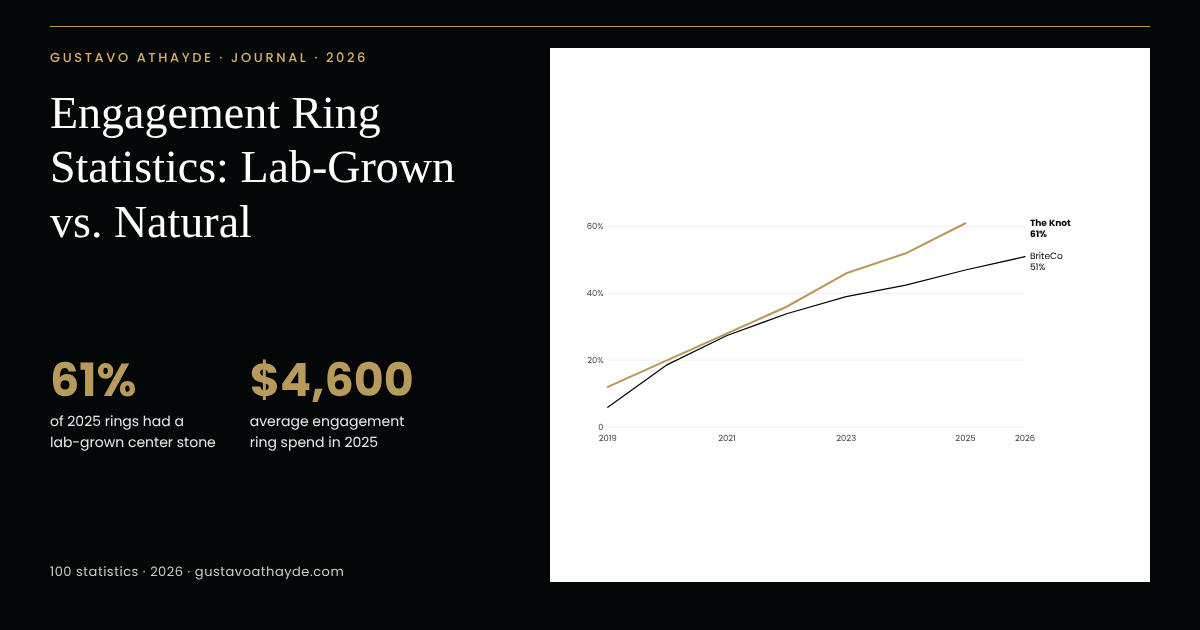
The engagement ring has changed more in the past six years than in the previous fifty. In 2025, lab-grown center stones appeared in 61% of American engagement rings, up from 12% in 2019, while average spending fell to $4,600. Adjusted for inflation, that is 38% less than couples spent in 2019, even as the average stone grew to 1.9 carats.
The story is not one of decline for natural diamonds. The median natural ring has more than doubled in price since 2019, and couples who choose one spend about 1.6 times as much as those who choose lab-grown. Below are 100 engagement ring statistics on lab-grown vs. natural stones, prices, proposal traditions and the American jewelers who make them.
At a glance
Key takeaways
- Lab-grown center stones were in 61% of engagement rings in 2025, up from 12% in 2019.
- Sales tracking (58%) and insurance appraisals (51% in early 2026) confirm lab-grown now leads in units.
- The average ring cost $4,600 in 2025, down from $6,000 in 2021 and 38% below 2019 in real terms.
- A natural ring averaged $7,000 and a lab-grown ring $4,300 in 2025.
- The median natural ring has risen 112% since 2019; the median lab-grown ring has fallen 18%.
- Average carat weight reached 1.9; lab-grown stones averaged 2.0 carats and natural stones 1.6.
- Nearly 9 in 10 proposers presented a ring, and about 70% asked for the family’s blessing.
- 88% of couples customized their ring or had it designed from scratch.
- World mined diamond output fell to 98.8 million carats in 2025, 34.5% below 2017, the decade’s high.
- Wholesale lab-grown prices have fallen about 90% since 2019.
Engagement ring statistics: the lab-grown share
Six years ago, a lab-grown center stone was the exception. Every major measure now shows it in roughly half or more of new American engagement rings, although the exact figure depends on whether it is counted by survey, by sales or by appraisal.
SHARE THIS CHART
Copy the code below to embed this chart on your site:
What couples report
- 1.
Lab-grown center stones were in 61% of engagement rings bought by U.S. couples who married in 2025, according to a survey of 10,474 couples.
- 2.
That share is up 239% since 2020 (2025 data).
- 3.
In 2024, for the first time, more than half of couples (52%) said their engagement ring featured a lab-grown stone.
- 4.
Lab-grown stones made up 46% of center stones in 2023, nearly four times the 12% recorded in 2019.
- 5.
More than one-third of center stones (36%) were lab-grown in 2022.
- 6.
The lab-grown share of engagement rings has risen by 49 percentage points in six years, from 12% in 2019 to 61% in 2025, an increase of about fivefold.
— Gustavo Athayde analysis of The Knot 2024 Real Weddings Study, The Knot 2026 Real Weddings Study data
- 7.
40% of couples who married in 2025 said it was specifically important to them that their stone be lab-grown.
- 8.
39% of couples surveyed in 2025 still chose a natural stone.
What sales and appraisals show
- 9.
Sales tracking by Tenoris tells a similar story: the lab-grown share of engagement ring sales grew from about 10% in 2020 to 58% in 2025.
- 10.
Lab-grown diamonds appeared in 51% of newly appraised engagement rings from January through June 2026, up from 6% in 2019, according to insurance appraisal data.
— BriteCo Jewelry, Diamond & Watch Price Index 2026, via Stacker
- 11.
On the same appraisal measure, the lab-grown share stood at 47.0% for the full year 2025, compared with 42.5% in 2024 and 5.9% in 2019.
— BriteCo
Retailers and independent jewelers
- 12.
At Signet Jewelers, parent of Kay, Zales and Jared, lab-grown stones accounted for under 50% of bridal sales during the 2025 holiday season, while lab-grown fashion jewelry grew to just over 20%.
- 13.
Lab-grown stones accounted for 15% of diamond sales value at U.S. independent jewelers in 2025, compared with 85% for natural diamonds, according to point-of-sale data from 950 stores.
- 14.
One in two independent jewelers said in 2025 that lab-grown diamonds account for at least half of their center-stone sales.
- 15.
Sales of finished natural diamond engagement rings fell 4% in 2025, while sales of lab-grown diamond engagement rings rose 31%, according to The Edge retail data.
What this means for couples. Both stones are now mainstream choices. The decision rests on what a couple values most: size and price, or rarity and origin. Either way, the ring becomes the first object of a shared life, and many couples pair it with a couple’s monogram that marks the same beginning.
How much an engagement ring costs
The average engagement ring has become less expensive every year since 2021, largely because lab-grown stones cost far less. Natural diamond rings, meanwhile, have held their value or grown more expensive.
Average spending, year by year
- 16.
The average engagement ring cost $4,600 in 2025.
- 17.
That is down from $5,200 in 2024, when proposers spent that amount on average for their ring.
- 18.
Average spending has declined every year since 2021: $6,000 in 2021, $5,800 in 2022, $5,500 in 2023 and $5,200 in 2024.
- 19.
In nominal dollars, the average engagement ring cost 23.3% less in 2025 than in 2021.
— Gustavo Athayde analysis of National Jeweler, reporting The Knot, The Knot 2026 Real Weddings Study data
- 20.
Adjusted for inflation, the $5,900 average of 2019 equals about $7,430 in 2025 dollars, so the 2025 average of $4,600 is 38% lower in real terms.
— Gustavo Athayde analysis of The Knot 2021 Jewelry & Engagement Study, The Knot 2026 Real Weddings Study, U.S. Bureau of Labor Statistics, CPI-U series CUUR0000SEAG02 and CUUR0000SA0 data
- 21.
For historical context, the average engagement ring cost $6,351 in 2017.
Engagement ring spending and lab-grown share, 2019–2025
Year Average spend In 2025 dollars Lab-grown center stones Average carats 2019 $5,900 $7,430 12% — 2020 $5,500 $6,842 — 1.5 2021 $6,000 $7,129 nearly 1 in 4 1.5 2022 $5,800 $6,380 36% — 2023 $5,500 $5,811 46% 1.6 2024 $5,200 $5,337 52% 1.7 2025 $4,600 $4,600 61% 1.9
Sources: The Knot Real Weddings Studies and Jewelry & Engagement Studies; inflation adjustment with BLS CPI-U annual averages (Gustavo Athayde analysis). The Knot did not publish an exact lab-grown share for 2020 or 2021.
Natural vs. lab-grown prices
- 22.
A lab-grown engagement ring averaged $4,300 in 2025, compared with $7,000 for a ring with a natural stone.
— The Knot, INSTORE, reporting The Knot 2026 Real Weddings Study, Rapaport, reporting The Knot 2026 Real Weddings Study
- 23.
In 2024, a proposer could expect to spend $4,900 on a lab-grown ring versus $7,600, on average, for a mined diamond ring.
- 24.
A natural diamond engagement ring cost 1.63 times as much as a lab-grown ring in 2025, up from 1.55 times in 2024; average prices fell 7.9% for natural rings and 12.2% for lab-grown rings over the year.
— Gustavo Athayde analysis of The Knot 2025 Real Weddings Study, The Knot, INSTORE, reporting The Knot 2026 Real Weddings Study data
- 25.
Appraisal data put the median natural diamond engagement ring at $12,961 in 2025, versus $4,557 for lab-grown.
— BriteCo Jewelry, Diamond & Watch Price Index 2026, via Stacker
Prices at specialty jewelers
- 26.
Between 2019 and 2025, the median appraised natural engagement ring rose 112% (from $6,101), while the median lab-grown ring fell 18% (from $5,533).
— Gustavo Athayde analysis of BriteCo data
- 27.
The average natural diamond engagement ring sold by U.S. specialty jewelers rose 9% in 2025, to $7,364.
— Rapaport, reporting Natural Diamond Council and Tenoris data
- 28.
The average purchase price of a loose natural diamond climbed 6.3% to $11,000 in 2025.
- 29.
American women surveyed by De Beers paid an average of $4,063 per piece of natural diamond jewelry in 2025, compared with $3,242 in 2023.
Natural vs. lab-grown at a glance
Measure, 2025 Natural Lab-grown Average engagement ring (The Knot) $7,000 $4,300 Average center stone (The Knot) 1.6 ct 2.0 ct Median engagement ring (BriteCo) $12,961 $4,557 Median price per carat (BriteCo) $8,428 $2,057 Median ring, change since 2019 (BriteCo) +112% −18% 1-carat stone (IMF, citing Zimnisky) $4,220 $800 3-carat stone (IMF, citing Zimnisky) $55,255 $3,735 Share of 2025 couples choosing it (The Knot) 39% 61%
Sources: The Knot 2026 Real Weddings Study and The Knot lab-grown diamonds page; BriteCo appraisal data; IMF Country Report 25/325 citing Paul Zimnisky. Change since 2019 is a Gustavo Athayde calculation.
Carat size, shape, metal and design
Lower prices per carat have let couples buy larger stones, and personalization has become the norm rather than the exception.
Carat weight
- 30.
The average engagement ring carried 1.9 carats in 2025.
- 31.
Lab-grown stones averaged 2.0 carats and natural stones 1.6 carats in 2025.
— The Knot
- 32.
The average engagement ring weighed 1.7 carats in 2024, compared with 1.5 carats in 2021.
- 33.
Between 2021 and 2025, average carat weight grew 27% while average spending fell 23%, so couples paid about 40% less per carat of ring (roughly $2,420 per carat in 2025, versus $4,000 in 2021).
— Gustavo Athayde analysis of The Knot 2025 Real Weddings Study, The Knot 2026 Real Weddings Study, National Jeweler, reporting The Knot data
- 34.
One in three engagement rings totaled more than two carats in 2023, including side stones and accents.
Shape, metal and setting
- 35.
Round diamonds were chosen by 26% of couples in 2025, followed closely by oval at 25%.
- 36.
Emerald, princess, pear and marquise shapes each accounted for 8% of 2025 center stones.
- 37.
Round brilliants made up 62% of natural diamond engagement ring units sold by U.S. specialty jewelers in 2025.
- 38.
Yellow gold was the metal of 39% of engagement rings in 2025, up 140% over five years.
- 39.
48% of couples said their engagement ring was a white metal in 2025.
- 40.
Solitaire settings were chosen by 38% of couples in 2025, and 83% picked a clear diamond.
- 41.
Sapphire (23%) and moissanite (20%) were the most popular non-diamond center stones in 2025.
Custom design and heirlooms
- 42.
88% of 2025 ring buyers made custom edits to their ring or had it fully custom-designed.
- 43.
In 2019, 31% of couples custom-designed a ring from scratch and 7% reset heirloom diamonds (historical data).
- 44.
A prong setting appeared on 35% of engagement rings in 2024, and hidden halos on 18%.
What this means for personalization. Nearly nine in ten couples now customize their ring. The same instinct extends to engraving, a signet design or a wedding monogram that carries the couple’s initials into every detail of the day.
Proposal traditions that endure
Whatever the stone, the customs around the proposal have changed little. Most proposers still ask the family’s blessing, kneel and present a ring, and December remains the season of engagements.
The proposal itself
- 45.
Nearly 9 in 10 proposers in 2025 popped the question with a ring in hand.
- 46.
89% of people proposed with a ring in hand, 85% got down on one knee and 87% said the words “Will you marry me?” (2024).
- 47.
Nearly 70% of proposers asked for the parents’ permission or blessing in 2024.
- 48.
71% of couples sought parental permission before the proposal in 2022.
- 49.
In 2017, 78% of grooms asked their partner’s family for permission (historical data).
Engagement season and the road to marriage
- 50.
December remained the most popular month to get engaged in 2024, and Christmas Day the most popular day of the year.
- 51.
15% of couples got engaged in December in 2022, with Christmas Eve and Christmas Day the top dates.
- 52.
About 40% of proposals in 2025 took place between Thanksgiving and Valentine’s Day.
- 53.
More than half of couples (57%) discussed engagement and marriage more than a year before the proposal (2024).
- 54.
The average engagement lasted 15 months in 2024; Zola’s 2026 report puts the average engagement at 18 months.
— The Knot 2025 Real Weddings Study, Zola First Look Report 2026
- 55.
94% of couples exchanged at least one ring after getting engaged, and 5% of opposite-sex couples exchanged two rings (2024).
- 56.
The United States recorded 2,128,446 marriages in 2024, a rate of 6.3 per 1,000 people and about 4% more than in 2023 (provisional).
What this means for families. Asking for a blessing remains the custom for about seven in ten proposers. For the wedding that follows, our guides to the most popular wedding dates and wedding costs by state continue the story.
The shopping journey and America’s jewelers
Most rings are still bought in person, from a jeweler, after months of looking. The trade that serves those couples is made up in large part of independent and self-employed craftspeople.
How couples shop
- 57.
57% of proposers began searching for a ring more than six months before the proposal (2025).
- 58.
About three in four proposers (77%) spent four months or less on research and purchase (2025).
- 59.
79% of ring recipients were involved in choosing the ring (2025).
- 60.
One in four couples shopped at a retailer together before the proposal (2025).
- 61.
55% of Zola couples shopped for rings together, and 68% decided together when to get engaged (2026 report).
- 62.
64% of engagement rings were purchased in a store in 2025, and only about one-third online.
- 63.
Proposers visited an average of two retailers in person and looked at 10 rings before buying (2025).
Jewelers, prices and spending
- 64.
America employs 32,800 jewelers and precious stone and metal workers, with a median annual wage of $52,540 (May 2025).
— U.S. Bureau of Labor Statistics, Occupational Outlook Handbook
- 65.
32% of the nation’s jewelers are self-employed, the largest employer category after jewelry retailers (2025).
— U.S. Bureau of Labor Statistics, Occupational Outlook Handbook
- 66.
Employment of jewelers is projected to change by −3% from 2025 to 2035, with about 3,700 openings a year (projection).
— U.S. Bureau of Labor Statistics, Occupational Outlook Handbook
- 67.
Signet Jewelers reported fiscal 2026 sales of $6.8 billion and operated 2,582 stores on January 31, 2026.
- 68.
Consumer prices for jewelry rose 11.8% in the 12 months to September 2026, more than three times the 3.7% rise in overall consumer prices.
- 69.
Over the decade 2015–2025, jewelry prices rose 22.1% while overall consumer prices rose 35.8%, so jewelry became about 10% less expensive in real terms.
— Gustavo Athayde analysis of U.S. Bureau of Labor Statistics, CPI-U series CUUR0000SEAG02 and CUUR0000SA0 data
- 70.
Americans spent $106.2 billion on jewelry and watches in 2025, up from $104.5 billion in 2024.
Natural diamonds: supply and prices
Mined diamond output has fallen by about a third since 2017. Prices for smaller natural stones have weakened most, while larger stones have held steady.
World supply
- 71.
The world’s mines produced 98.8 million carats of rough diamonds worth $9.23 billion in 2025.
- 72.
Mined rough diamonds averaged $93.43 per carat in 2025.
- 73.
World mined diamond output in 2025 was 34.5% below the 2017 level of 150.9 million carats, the highest of the past decade.
— Gustavo Athayde analysis of Kimberley Process, Kimberley Process data
- 74.
The value of mined rough in 2025 was 42.2% below the 2022 total of $15.96 billion, and the average value per carat fell 29.4% from $132.30 in 2022.
— Gustavo Athayde analysis of Kimberley Process, Kimberley Process data
- 75.
Russia was the largest producer by volume in 2025 with 31.5 million carats; Botswana produced 15.5 million carats worth $1.98 billion.
- 76.
The United States mines no gem-quality diamonds; world output of gem diamonds was an estimated 69.0 million carats in 2025.
- 77.
By value, America’s diamond imports came chiefly from India (46%), Israel (27%) and Belgium (11%) in 2021–2024.
- 78.
The U.S. Geological Survey attributes the natural diamond downturn that began in early 2023, which has especially affected stones of one carat or less, in part to the increased popularity of less expensive synthetic diamonds (2025).
Natural diamond prices
- 79.
On the RapNet Diamond Index, polished natural diamond prices fell 9.9% for 1-carat stones in 2025, 20.3% for 0.30-carat stones and 26% for 0.50-carat stones.
— Rapaport
- 80.
De Beers’ average realised rough price declined 7% to $142 per carat in 2025, and its average rough price index fell 12%.
- 81.
De Beers expects to produce 25–28 million carats of rough diamonds in 2026 (projection).
- 82.
A 1-carat natural diamond sold for about $4,220, compared with $800 for a lab-grown one, according to analyst Paul Zimnisky as cited by the IMF in 2025; at 3 carats the figures were $55,255 and $3,735.
- 83.
At those prices, a lab-grown diamond cost 81% less than a natural one at 1 carat and 93% less at 3 carats (2025).
— Gustavo Athayde analysis of International Monetary Fund, citing analyst Paul Zimnisky data
Lab-grown diamonds: production and prices
Lab-grown output has grown more than twentyfold in a decade, and America is its main market. Abundant supply has driven wholesale prices down by roughly 90% since 2019.
Production and demand
- 84.
Lab-grown diamond producers were expected to make 25 million rough carats for jewelry in 2025, up from under 1 million around 2015.
- 85.
The United States accounts for more than three-fourths of the world’s demand for lab-grown diamonds (2025).
- 86.
Wholesale lab-grown diamond prices have fallen by about 90% since 2019, according to the IMF (2025).
- 87.
An index of wholesale lab-grown prices was down 96% from its 2018 start by the second quarter of 2026, and fell 13% year over year in that quarter.
- 88.
On Edahn Golan’s wholesale price list, a round, 1-carat IGI-certified lab-grown diamond cost an average of $178 per carat in the third quarter of 2025.
Brands and American producers
- 89.
De Beers launched its Lightbox lab-grown brand in 2018 at $800 per carat, and announced its intention to close the brand in May 2025.
- 90.
In May 2024, Lightbox cut its price to $500 per carat for IJ-color stones, from $800.
- 91.
Appraisal data show the median lab-grown diamond falling from $4,622 per carat in 2019 to $2,057 in 2025, while natural diamonds rose from $6,237 to $8,428 per carat.
— BriteCo Jewelry, Diamond & Watch Price Index 2026, via Stacker
- 92.
U.S. production of lab-created gemstones fell 35% to an estimated $37 million in 2025, after a leading American lab-grown diamond company in Oregon ceased operations in July 2025.
- 93.
Lab-created gemstones were manufactured by five U.S. companies in North Carolina, California, Oregon, South Carolina and Arizona in 2025.
- 94.
Pandora announced in May 2021 that it would no longer use natural diamonds in its jewelry, switching to lab-grown stones.
What this means for heirlooms. A ring chosen for a lifetime is chosen for more than its resale value. What gives any stone lasting meaning is the story attached to it, the same principle behind a family signet passed from one generation to the next.
Rules, grading and trade
Federal guides allow a lab-grown stone to be called a diamond, provided the seller says clearly that it was made in a laboratory. Grading and trade rules have shifted as well.
- 95.
In 2018, the Federal Trade Commission eliminated the word “natural” from its definition of a diamond, in revisions approved by a 5–0 vote.
- 96.
Under the FTC’s Jewelry Guides, the word diamond may describe a lab-grown stone only when it is immediately preceded, with equal conspicuousness, by a term such as “laboratory-grown” or “laboratory-created” (in force in 2026).
- 97.
In 2019, the FTC sent warning letters to eight sellers of lab-grown and simulated diamonds, asking them to describe their products accurately.
- 98.
GIA announced in 2025 that it would no longer use its natural-diamond color and clarity nomenclature for lab-grown stones, noting that more than 95% of lab-grown diamonds entering the market fall into a very narrow range of color and clarity.
— GIA
- 99.
U.S. imports of gemstones fell an estimated 44% to about $11 billion in 2025, and diamonds made up 79% of their value.
- 100.
An August 2025 executive order placed an additional 25% duty on Indian goods; the February 2026 U.S.–India framework set an 18% reciprocal rate and said the reciprocal tariff on gems and diamonds would be removed once an interim agreement is concluded.
— Executive Order 14329, Joint Statement of the United States and India
Methodology
Engagement ring spending, carat weight, shape and lab-grown share come mainly from The Knot’s annual surveys of U.S. couples (10,474 couples married in 2025; 16,956 in 2024), labeled by the year the couple married. Where The Knot’s figures were available only through trade press, the press report is cited.
Lab-grown share differs by method: The Knot surveys couples, Tenoris tracks sales at U.S. specialty jewelers, BriteCo counts rings it appraises for insurance, and Signet and De Beers report their own channels. These figures are presented separately and are not combined.
Inflation adjustments use BLS CPI-U annual averages (all items, series CUUR0000SA0); the 2025 average excludes October 2025, which was not published. Mine supply data come from the Kimberley Process and the U.S. Geological Survey. Price comparisons are descriptive; ring prices include settings, so per-carat figures derived from them are approximate. Projections are labeled as such.
About the author

Gustavo Athayde — Founder & Creative Director, GUSTAVO ATHAYDE
Gustavo Athayde is the founder and creative director of GUSTAVO ATHAYDE, a bespoke monogram atelier based in Sioux Falls, South Dakota. A graphic designer by training, he creates monograms, personal and family crests, heraldic emblems, signet designs and wax seals for individuals, families, couples and brands across the United States. Every commission is refined line by line into a symbol meant to be kept, used and passed down.
Follow the atelier on Instagram · Request a private consultation
Frequently asked questions
- What percentage of engagement rings are lab-grown?
- About 61% of engagement rings bought by couples who married in 2025 had a lab-grown center stone, according to The Knot. Sales and appraisal data put the share between roughly 50% and 58%.
- How much does the average engagement ring cost in 2026?
- The latest full-year figure is $4,600 for 2025, down from $5,200 in 2024. Natural diamond rings averaged $7,000 and lab-grown rings $4,300.
- Are lab-grown diamonds real diamonds?
- Yes. Since 2018 the FTC has defined a diamond without the word “natural,” but sellers must clearly disclose that a lab-grown stone is laboratory-grown or laboratory-created.
- How much cheaper is a lab-grown diamond than a natural one?
- In 2025, a 1-carat lab-grown diamond cost about $800 against roughly $4,220 for a natural stone, or 81% less, according to analyst Paul Zimnisky as cited by the IMF; the gap widens at larger sizes.
- What is the average engagement ring carat size?
- The average ring carried 1.9 carats in 2025: lab-grown stones averaged 2.0 carats and natural stones 1.6 carats.
- When do most couples get engaged?
- December is the most popular month, with Christmas Day the most popular day. About 40% of proposals fall between Thanksgiving and Valentine’s Day.
Cite this page
Source: Gustavo Athayde, "Engagement Ring Statistics 2026: Lab-Grown vs. Natural", https://gustavoathayde.com/engagement-ring-statistics/Feel free to use these statistics and charts — we just ask for a link back to this page.
Sources
- 16 CFR § 23.25, Misuse of the word “gem” and laboratory-created stones (Cornell LII) (Code of Federal Regulations)
- Annual Global Summary 2017 (Kimberley Process)
- Annual Global Summary 2022 (Kimberley Process)
- Botswana: Country Report No. 25/325 (Box 1, lab-grown diamonds) (International Monetary Fund)
- Consumer Price Index, Table 2 (September 2026) (U.S. Bureau of Labor Statistics)
- CPI-U database, Jewelry (CUUR0000SEAG02) and All items (CUUR0000SA0) (U.S. Bureau of Labor Statistics)
- Diamonds and pearls and revisions to the FTC’s Jewelry Guides (July 24, 2018) (Federal Trade Commission)
- Executive Order 14329 (August 6, 2025), Daily Compilation of Presidential Documents, govinfo (The White House)
- FTC approves final revisions to Jewelry Guides (July 2018) (Federal Trade Commission)
- Joint Statement of the United States and India (February 6, 2026), Daily Compilation of Presidential Documents, govinfo (The White House)
- Mineral Commodity Summaries 2026: Gemstones (U.S. Geological Survey)
- Occupational Outlook Handbook: Jewelers and Precious Stone and Metal Workers (U.S. Bureau of Labor Statistics)
- Personal consumption expenditures: Jewelry and watches (FRED DJRYRC1A027NBEA) (U.S. Bureau of Economic Analysis)
- Provisional number of marriages and divorces and rates: United States, 2000–2024 (CDC/NCHS)
- Rough Diamond Statistics, Annual Global Summary 2025 (Kimberley Process)
- Warning letters: lab-grown and simulated diamond sellers should describe products accurately (April 2, 2019) (Federal Trade Commission)
Wedding and couple studies
- 2017 Jewelry & Engagement Study press release (The Knot Worldwide)
- 2021 Jewelry & Engagement Study press release (The Knot Worldwide)
- 2026 Real Weddings Study press release (Business Wire, February 18, 2026) (The Knot)
- Data insights from weddings in 2022 (The Knot)
- Lab-grown diamonds: what to know (2026) (The Knot)
- Real Weddings Study data: weddings in 2023 (The Knot)
- The First Look Report 2026 (Zola)
- The Knot Worldwide unveils 2026 Real Weddings Study (The Knot Worldwide)
- Wedding proposal myths, debunked (2024 Jewelry & Engagement Study) (The Knot)
- Weddings in 2024: Real Weddings Study data insights (The Knot)
Industry and company data
- Fourth Quarter and Full Year Fiscal 2026 results (March 19, 2026) (Signet Jewelers)
- Intention to close the Lightbox business (May 9, 2025) (De Beers Group)
- Latest research on U.S. consumer trends, Diamond Report 2026 (June 29, 2026) (De Beers Group)
- Lightbox pricing announcement (May 14, 2024) (De Beers Group)
- New descriptive terminology for laboratory-grown diamonds (June 2, 2025) (GIA)
- Production Report for the third quarter of 2026 (October 20, 2026) (Anglo American)
- RapNet Diamond Index 2025 full-year press release (January 6, 2026) (Rapaport)
- Report: lab-grown diamonds reach 51% of new engagement rings in 2026 (BriteCo Price Index) (Stacker)
- Signet Jewelers Q4 FY2026 earnings call transcript (The Motley Fool)
- The Lab-Grown vs. Natural Diamond Report (appraisal data, 2019–2026) (BriteCo)
- U.S. natural diamond jewelry sales data release (February 12, 2026) (Natural Diamond Council)
Trade press
- Big Survey 2025: lab-grown diamonds (INSTORE)
- De Beers loss widens amid ongoing diamond market challenges (February 20, 2026) (Mining Weekly)
- Engagement ring trends 2026: what’s in and why (National Jeweler)
- Lab-grown diamond prices show signs of stabilizing (2026) (JCK)
- Lab-grown taking over engagement ring spending: The Knot (2026) (Rapaport)
- Natural diamonds in bridal: Edahn Golan (2026) (JCK)
- NDC: average engagement ring price tops $7,000 (February 15, 2026) (Rapaport)
- Pandora’s moving from natural to lab-grown diamonds (2021) (National Jeweler)
- State of Diamonds: the way forward for natural diamonds (2026) (National Jeweler)
- The engagement market and lab-grown diamonds (2026) (JCK)
- The Knot 2019 Jewelry & Engagement Study stats (JCK)
- What 10,000 couples who just got married can tell you about your business (2026) (INSTORE)
- Wholesale lab-grown diamond prices drop 9% in Q3 (October 2025) (INSTORE)