
Coat of Arms: A Language Built to Outlast Its Bearer

The Coat of Arms: A Language Written to Outlast Its Bearer
On the oldest grammar of personal identity, and how its discipline survives in the crest monogram and the classic monogram of today.
Legacy & Family Heritage
Why the Coat of Arms Still Governs How We Mark a Name
A coat of arms is often mistaken for decoration, and the mistake is understandable.
Its lions, shields, and interlaced ornament photograph beautifully, and photographs flatten meaning into style.
But a coat of arms was never conceived as ornament, and it has never truly behaved like one.
It was conceived as a sentence, written in color and form, declaring exactly who stood behind it.
That sentence could be read across a battlefield, across a banquet hall, and across a century.
No other visual tradition in Western culture has carried identity with such stubborn precision for so long.
I have spent more than a decade designing personal emblems, and the coat of arms remains my constant reference.
Not because my clients require battlefield recognition, but because the discipline behind the form has never expired.
A coat of arms solved a problem that every family, founder, and couple still faces today.
How does a name become visible without being written out, and recognizable without being explained?
The medieval answer was so effective that we are still living inside its logic.
Every crest monogram I compose at the atelier descends, directly or obliquely, from that answer.
Every classic monogram engraved onto silver borrows its confidence from the same centuries of testing.
This essay is an attempt to read the coat of arms the way its makers intended.
Not as antiquarian curiosity, but as a working grammar of belonging that remains fully alive.
We will trace its origins in necessity, long before it acquired its reputation for grandeur.
We will examine the strict visual language that governed its composition, a language with rules older than most nations.
We will follow it through royal courts, where it reached its most disciplined and most public expression.
And we will watch it change shape in the modern era, becoming the crest monogram and the personal emblem.
Along the way, a quieter argument will emerge about what families actually inherit from one another.
They inherit stories, certainly, and property, occasionally, and temperament, whether they wish to or not.
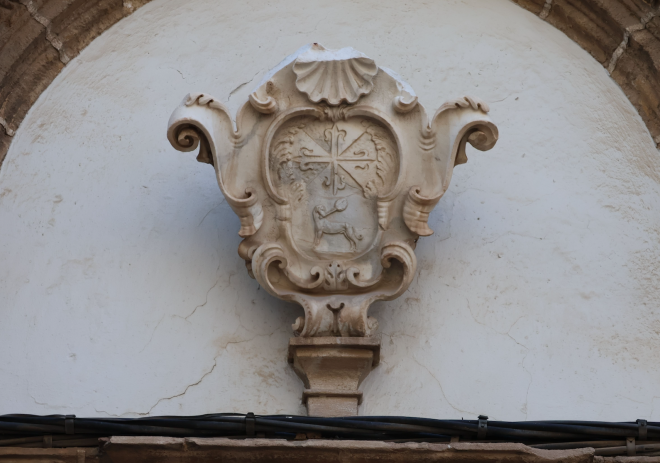
But the families who think in generations also inherit symbols, and symbols behave differently than stories.
A story changes slightly with every telling, softened or sharpened by whoever carries it forward.
A symbol, properly made, does not change at all.
It is the same mark on a great-grandmother’s linen and on a granddaughter’s wedding invitation.
That constancy is the entire point, and it is what a coat of arms was engineered to provide.
Readers hoping for a tutorial on drawing heraldry will not find one in these pages.
The Journal does not publish instructions; it publishes appreciation, and the distinction matters here more than usual.
A coat of arms cannot be assembled from a tutorial any more than a lineage can.
It can only be understood, and then, if the occasion truly calls for it, commissioned with care.
What follows is the understanding, offered in the same spirit a curator might walk you through a collection.
The commissioning, should it ever interest you, begins with a far simpler act.
It begins with a conversation about a name, which is where every coat of arms has always begun.
Let us start where the tradition itself started, with mud, iron, and the urgent need to be known.
Royal Traditions
Mud, Iron, and the Birth of the Coat of Arms
The coat of arms was born on the twelfth-century battlefield, where recognition was a matter of survival.
A knight sealed inside a helmet was anonymous, and anonymity in combat was lethal in both directions.
Allies could not rally to a man they could not identify, and chroniclers could not credit his deeds.
So knights began painting bold, simple devices onto their shields, devices visible through dust and distance.
A red chevron on gold, a silver lion on blue: forms chosen for legibility before beauty.
The surcoat worn over armor carried the same device, and the garment gave the tradition its name.
The coat of arms was, quite literally, a coat, and its arms were the weapons it accompanied.
What began as battlefield signage became hereditary within roughly two generations, and that shift changed everything.
A son bearing his father’s device was no longer describing himself; he was continuing someone.
The mark stopped being a label and started being an inheritance, which is a profound difference.
Labels identify; inheritances obligate.
A knight who bore his grandfather’s arms carried his grandfather’s reputation onto the field with him.
Disgrace the arms, and you disgraced every man who had worn them before you.
This is the moment the coat of arms acquired its moral weight, and it has never set that weight down.
By the thirteenth century, the system had grown crowded enough to require adjudication.
Two families claiming the same device was no longer an inconvenience; it was a legal dispute.
Heralds, once mere announcers at tournaments, became the registrars and referees of this visual language.
They recorded who bore what, ruled on conflicts, and slowly codified the grammar of the entire tradition.
Twelfth Century
Knights paint bold devices onto shields and surcoats, seeking recognition through closed helmets and battlefield dust.
Legibility at distance, not beauty, governs every early compositional choice.
Thirteenth Century
Arms become hereditary, passing from father to son as a visual surname carried into every engagement.
Heralds begin recording bearings, transforming battlefield custom into an administered system.
Fourteenth & Fifteenth Centuries
Disputes over identical arms reach the courts, and formal heraldic authorities emerge to adjudicate them.
The grammar of blazon is codified, allowing any coat of arms to be described in precise words.
Sixteenth & Seventeenth Centuries
The coat of arms migrates from armor onto seals, silver, architecture, and the printed bookplate.
Merchant and professional families petition for grants, extending the tradition beyond the nobility.
Nineteenth Century
Heraldic revival spreads armorial taste through prosperous households across Europe and America.
Engraved crests appear on stationery, linen, and carriage doors as marks of considered identity.
Present Day
The coat of arms persists through granting bodies, family archives, and the bespoke crest monogram.
Its discipline of hereditary, legible identity now informs personal emblems commissioned worldwide.
On Origins
The coat of arms was not invented as a luxury; it was invented as a necessity, and everything luxurious about it was earned afterward, across eight centuries of faithful use.
That codification survives, remarkably, into the present day.
In England, the body that has granted and recorded armorial bearings since 1484 still exercises the same authority its medieval predecessors established.
A coat of arms there is not designed; it is granted, following procedures older than the printing press.
Few institutions on earth have administered a single visual system with such unbroken continuity.
I find this continuity genuinely moving, and not for sentimental reasons.
It proves that a well-made system of identity can outlive every circumstance that created it.
The battlefield vanished, the tournament vanished, the knight himself vanished, and the coat of arms remained.
It migrated onto seals, then silver, then bookplates, then gateposts, adapting its surface without altering its logic.
That is the pattern every enduring personal symbol follows, and it is worth stating plainly.
Surfaces change constantly; structure, done correctly, changes almost never.
The coat of arms understood this before any theory of design existed to articulate it.
Its makers separated what a mark is from how a mark is rendered, and guarded only the former.
A lion could be drawn crudely on a barn door or exquisitely on vellum; it remained the same lion.
This tolerance for imperfect rendering is what allowed the system to travel across every class and craft.
A blacksmith, a weaver, and a court painter could all reproduce the same arms faithfully.
Very few identity systems since have matched that democratic durability, and none have exceeded it.
The timeline above compresses eight centuries of that migration into its essential movements.
Read it less as history than as a demonstration of how patiently a good idea travels.
The Art of Monograms
Blazon: The Grammar Inside Every Coat of Arms
Every coat of arms can be written down in words, and this fact astonishes most people who learn it.
The words belong to a technical language called blazon, half Norman French and half pure geometry.
Azure, a lion rampant argent: three words, and a trained reader sees the shield exactly.
A blue field, a silver lion rearing upright, no ambiguity and no room for interpretation.
Blazon is the reason a coat of arms could survive centuries before photography existed.
The image did not need to travel; the sentence traveled, and the image could be rebuilt anywhere.
I know of no other design tradition that achieved lossless transmission seven hundred years before the digital file.
The grammar rests on a small set of elements, combined according to strict rules.
The field is the background of the shield, and it comes first in every description.
The charges are the figures placed upon it: lions, eagles, chevrons, stars, crosses, and hundreds more.
The tinctures are the permitted colors, and their governance is where the discipline truly shows.
Heraldry recognizes two metals, gold and silver, alongside a handful of rich colors.
The famous rule of tincture forbids placing color upon color or metal upon metal.
A blue charge may not sit on a black field, nor a gold star upon silver.
The rule exists for one reason only, and that reason is contrast.
A shield had to be read in an instant, in poor light, at a hostile distance.
Low-contrast heraldry was not ugly; it was useless, and medieval designers refused to produce it.
Eight hundred years later, I hold every emblem leaving my atelier to exactly that standard.
If a mark cannot be read at a glance, it has failed, whatever its other virtues.
The rule of tincture is, in this sense, the oldest accessibility guideline in Western design.
Element |
What It Is |
Why It Matters |
|---|---|---|
The Field |
The background surface of the shield itself. |
Named first in every blazon; the ground on which all meaning is placed.<h4 |