
Unisex Names in America: Which Names Changed Sides? 100 Statistics for 2026
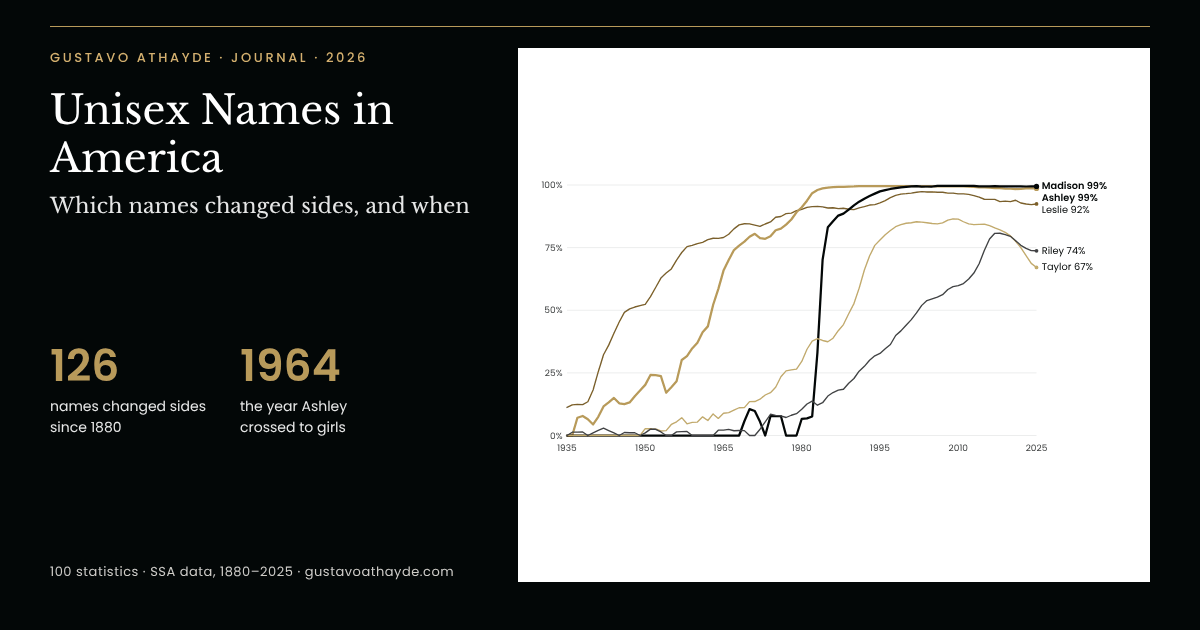
Unisex names have a longer history in America than most parents realize. Ashley, Leslie, Kelly and Madison were all once given mainly to boys. Our analysis of Social Security Administration records from 1880 to 2025 finds 126 names whose majority changed sides, and Leslie crossed to girls in 1946 by a single baby.
Below are 100 statistics: our own Crossover Index of 43 major names and the year each crossed the 50% mark, the novels and films behind them, the rarer names that moved toward boys, the names split almost evenly today, and what research and surveys say. The surprise is that the traffic, long one-way, now runs in both directions.
At a glance
Key takeaways
- 126 names changed sides between 1880 and 2025: 82 from boys to girls and 44 from girls to boys.
- Ashley is the largest name in our index: 875,722 babies since 1880. It crossed to girls in 1964 and was the No. 1 girls’ name in 1991 and 1992.
- Leslie crossed in 1946 by one baby, 2,139 girls to 2,138 boys; Kelly crossed in 1957 by 28.
- 66 of the 126 crossovers happened in 1990 or later, and the 2000s had the most of any decade, 23.
- Boys kept coming: 37 of 82 boys-to-girls names reached their highest number of boys after girls had taken the majority.
- 21 years is the median time from crossover to 90% girls; Madison took four, from 1985 to 1989.
- Both directions: since 2015, 17 common names moved 10 or more points toward boys and 12 toward girls.
- Dakota was the most evenly shared name of 2025, with 1,035 girls and 1,074 boys.
- 84.4% of living Americans named Jean are women, although newborn Jeans have been mostly boys since 1990.
The Crossover Index: unisex names that changed sides
Our Crossover Index follows every name given to at least 1,000 boys and 1,000 girls since 1880 and identifies those whose majority sex reversed. Of the 126 that changed sides, 43 have been given to at least 50,000 babies; they appear in the tables below with the year each crossed the 50% mark.
Five famous crossovers
SHARE THIS CHART
Copy the code below to embed this chart on your site:
The Crossover Index, 1 to 11
# Name Crossover year Earlier majority Girls’ share, 2025 Babies since 1880 1 Ashley 1964 88% boys (1940s) 98% 875,722 2 Kelly 1957 92% boys (1910s) 79% 556,365 3 Jean (to boys) 1990 87% girls (1880s) 33% 483,475 4 Lauren 1945 99% boys (1920s) 100% 481,395 5 Taylor 1990 100% boys (1910s) 66% 443,686 6 Madison 1985 100% boys (1910s) 100% 427,675 7 Leslie 1946 91% boys (1880s) 92% 383,418 8 Allison 1943 75% boys (1910s) 100% 322,944 9 Tracy 1954 77% boys (1910s) 75% 312,894 10 Courtney 1962 76% boys (1920s) 67% 281,432 11 Morgan 1980 100% boys (1910s) 65% 269,269
The Crossover Index, 12 to 22
# Name Crossover year Earlier majority Girls’ share, 2025 Babies since 1880 12 Riley 2003 100% boys (1910s) 73% 246,985 13 Dana 1956 65% boys (1910s) 91% 246,842 14 Avery 1998 90% boys (1910s) 82% 236,886 15 Lynn 1942 77% boys (1900s) 82%* 234,778 16 Kim 1955 68% boys (1940s) 85%* 214,768 17 Sydney 1933 84% boys (1910s) 98% 187,700 18 Stacy 1952 76% boys (1920s) 89% 186,268 19 Lindsey 1969 99% boys (1920s) 100% 165,286 20 Shelby 1936 94% boys (1910s) 92% 165,279 21 Aubrey 1974 90% boys (1900s) 97% 164,605 22 Addison 1996 100% boys (1910s) 98% 162,320
The Crossover Index, 23 to 33
# Name Crossover year Earlier majority Girls’ share, 2025 Babies since 1880 23 Peyton 2008 69% boys (1980s) 80% 140,602 24 Lindsay 1966 60% boys (1940s) 100%* 135,501 25 Ashton (to boys) 1998 63% girls (1980s) 4% 107,927 26 Skylar 1994 75% boys (1980s) 94% 105,716 27 Whitney 1962 81% boys (1940s) 95% 103,657 28 Kendall 1993 99% boys (1920s) 85% 101,883 29 Kennedy 1993 99% boys (1960s) 97% 101,120 30 Ariel 1982 76% boys (1960s) 62% 100,665 31 Quinn 2010 86% boys (1960s) 80% 89,495 32 Jody (to boys) 1990 68% girls (1940s) 29%* 87,407 33 Payton 1992 84% boys (1980s) 86% 84,784
The Crossover Index, 34 to 43
# Name Crossover year Earlier majority Girls’ share, 2025 Babies since 1880 34 Sandy 1937 94% boys (1910s) 82%* 79,530 35 Jan (to boys) 1984 62% girls (1940s) 10%* 76,934 36 Dominique (to boys) 2009 83% girls (1960s) 30% 74,343 37 Harley 1994 100% boys (1880s) 79% 71,872 38 Donnie (to boys) 1928 71% girls (1910s) 0%* 68,060 39 Reese 2003 99% boys (1920s) 77% 64,381 40 Emery 1996 100% boys (1910s) 91% 64,249 41 Loren 1988 99% boys (1910s) 58%* 59,320 42 Ollie (to boys) 1962 80% girls (1880s) 28% 59,267 43 Amari (to boys) 2005 67% girls (1990s) 29% 53,282
Names with at least 50,000 babies since 1880 whose majority sex changed; all moved from boys to girls unless marked. Crossover year: the first year the new majority led and then held the lead in all but at most two later years (years with 20+ babies). Earlier majority: the first decade with 500+ babies and a 60%+ majority. *Fewer than 100 babies in 2025. Source: Gustavo Athayde analysis of SSA baby name data, 1880–2025.
What the index shows
- 1.
126 names changed sides in American birth records between 1880 and 2025: each began with a clear majority of one sex and is now given mostly to the other.
— Gustavo Athayde analysis of SSA data
- 2.
82 of the 126 moved from boys to girls between 1880 and 2025. By contrast, only 44 moved from girls to boys.
— Gustavo Athayde analysis of SSA data
- 3.
10,140,219 babies have received one of these 126 names since 1880, and 7,129,735 of them were girls given a name that began on the boys’ side.
— Gustavo Athayde analysis of SSA data
- 4.
43 names with at least 50,000 babies since 1880 have changed sides, and 35 of them crossed from boys to girls (1880–2025).
— Gustavo Athayde analysis of SSA data
- 5.
Ashley is the largest name in our index to change sides: 875,722 babies since 1880, 98.2% of them girls.
— Gustavo Athayde analysis of SSA data
When names crossed
- 6.
66 of the 126 crossings happened in 1990 or later, more than in the previous 110 years combined (through 2025).
— Gustavo Athayde analysis of SSA data
- 7.
The 2000s saw the most crossings of any decade, 23, followed by the 1990s with 22 and the 2010s with 20 (1880–2025).
— Gustavo Athayde analysis of SSA data
- 8.
11 names crossed in the 1940s, including Leslie, Lauren, Allison and Lynn, the busiest decade before 1960.
— Gustavo Athayde analysis of SSA data
- 9.
37 of the 82 boys-to-girls names reached their highest number of boys only after girls had already taken the majority (1880–2025).
— Gustavo Athayde analysis of SSA data
- 10.
21 years: the median time from crossover to a share of at least 90% girls, among the 28 boys-to-girls names that reached 90% and never fell below 85% afterward (1880–2025).
— Gustavo Athayde analysis of SSA data
Crossovers by decade
What this means for families. A name can change character over a generation, yet initials and a family surname keep their meaning. Our guide to the luxury personal monogram shows how a cipher built on initials stays personal whichever way a name drifts.
Unisex names statistics: the big picture
Shared names have always existed in American records, although they have never been common. However, the share of babies given one has roughly tripled since the mid-1980s.
Shared names since 1880
- 11.
11,854 first names appear for both boys and girls in at least one year of SSA records from 1880 to 2025.
— Gustavo Athayde analysis of SSA data
- 12.
1,053 names have been given to at least 1,000 boys and at least 1,000 girls since 1880 (through 2025).
— Gustavo Athayde analysis of SSA data
- 13.
4.5% of babies born in 2025 received a unisex name, defined as one shared at least 20/80 between the sexes that year. In 1985, by contrast, the share was 1.5%.
— Gustavo Athayde analysis of SSA data
The unisex share today
- 14.
5.1% in 2022 was the highest share of babies given a unisex name by our measure, 1880–2025. Since then, however, the share has eased slightly.
— Gustavo Athayde analysis of SSA data
- 15.
7.6% of 2025 babies received a name shared at least 10/90 between the sexes, compared with 4.2% in 1975.
— Gustavo Athayde analysis of SSA data
- 16.
74,161 girls and 76,643 boys born in 2025 received a unisex name (20/80 rule), so girls and boys now share them almost equally.
— Gustavo Athayde analysis of SSA data
- 17.
43 names given to at least 1,000 babies in 2025 were shared at least 20/80, compared with 22 in 2000 and 14 in 1975.
— Gustavo Athayde analysis of SSA data
About the records
- 18.
5 or more: a name must be given to at least five babies of one sex in a year to appear in the SSA’s public baby name files (SSA documentation, 2026).
- 19.
100% of Social Security card application records, as of March 2026, feed the agency’s baby name files, and names are ranked separately for each sex.
- 20.
1 to 2 percent of children in a study of almost 11 million white Illinois births (1916–1989) had clearly androgynous names, Harvard Magazine reported in 2000 (historical).
A century of shared names
The great crossovers: Ashley, Leslie, Kelly and Madison
Several of the most familiar girls’ names of the late 20th century began on the boys’ side. In each case, moreover, the records show the precise year the balance tipped.
Ashley
- 21.
1964 was the year Ashley crossed to girls, with 181 girls and 110 boys. Back in 1955, however, only 8 of the 89 babies named Ashley were girls.
— Gustavo Athayde analysis of SSA data
- 22.
No. 1: Ashley’s rank among girls’ names in 1991 and 1992, and it stayed in the top 10 from 1983 to 2005.
— Gustavo Athayde analysis of SSA data
- 23.
54,856 girls were named Ashley in 1987, the name’s peak. By contrast, only 27 boys received it in 2025.
— Gustavo Athayde analysis of SSA data
- 24.
Until the 1960s, Ashley was more commonly given to boys in the United States. The name began as a surname taken from English place names meaning “ash tree clearing.”
Leslie and Kelly
- 25.
1 baby decided Leslie’s crossover: in 1946, 2,139 girls and 2,138 boys received the name.
— Gustavo Athayde analysis of SSA data
- 26.
2,358 boys were named Leslie in 1952, the most in any year, six years after girls took the majority. By 2025, however, the number was 32.
— Gustavo Athayde analysis of SSA data
- 27.
1957: Kelly crossed to girls by just 28 babies, 1,903 to 1,875. A year later, in fact, girls led by more than 2,000.
— Gustavo Athayde analysis of SSA data
- 28.
82,400 boys have been named Kelly since 1880, along with 473,965 girls, so one Kelly in seven has been a boy.
— Gustavo Athayde analysis of SSA data
Madison, Taylor and Lauren
- 29.
1985: Madison crossed to girls, 301 to 81. By 2001, 22,166 girls received the name, and it ranked No. 2.
— Gustavo Athayde analysis of SSA data
- 30.
1990 was Taylor’s crossover year, with 7,262 girls and 6,579 boys. It peaked at No. 6 among girls from 1994 to 1996.
— Gustavo Athayde analysis of SSA data
- 31.
8,239 boys were named Taylor in 1992, its peak for boys, two years after girls took the lead.
— Gustavo Athayde analysis of SSA data
- 32.
1945: Lauren crossed to girls (381 girls, 62 boys). In 2025, 777 girls received it, and fewer than five boys.
— Gustavo Athayde analysis of SSA data
Allison and Tracy
- 33.
1943: Allison crossed to girls. By 2025 it was 99.8% female, with 2,564 girls.
— Gustavo Athayde analysis of SSA data
- 34.
1954: Tracy crossed to girls, 611 to 445. Later, it reached No. 10 among girls in 1970, with 18,464 babies.
— Gustavo Athayde analysis of SSA data
How fast a name changes sides
Some names crossed within a few years; others took half a century to settle. In contrast with the popular image of a sudden switch, many names kept gaining boys for years after girls took the majority.
Fast and slow crossovers
- 35.
4 years: Madison went from its 1985 crossover to at least 90% girls by 1989, the fastest move among names with at least 100,000 babies that changed sides.
— Gustavo Athayde analysis of SSA data
- 36.
16 years after girls took the majority, Ashley still gained boys: its boys’ peak, 746, came in 1980.
— Gustavo Athayde analysis of SSA data
- 37.
3,093 boys were named Kelly in 1967, a decade after its crossover year and its highest count for boys.
— Gustavo Athayde analysis of SSA data
- 38.
3,380 boys received Tracy in 1966, twelve years after it became a majority-girl name.
— Gustavo Athayde analysis of SSA data
Names of the 1930s to 1950s
- 39.
1936: Shelby crossed to girls in the same year that it jumped from 67 to 1,071 girls.
— Gustavo Athayde analysis of SSA data
- 40.
1933: Sydney crossed to girls (107 to 87), about half a century before it settled above 90% girls in 1985.
— Gustavo Athayde analysis of SSA data
- 41.
1955: Kim crossed to girls; two years later, 11,426 girls and 1,974 boys received the name.
— Gustavo Athayde analysis of SSA data
- 42.
153 boys and 90 girls were named Kim among white Illinois births in 1953. By 1957 there were 453 girls and only 76 boys, according to the Lieberson study as reported by Harvard Magazine (historical).
- 43.
19 of the 44 girls-to-boys names reached 90% boys and never fell below 85% afterward, compared with 28 of the 82 boys-to-girls names (1880–2025).
— Gustavo Athayde analysis of SSA data
Where the crossover names came from
Many names that changed sides began as English, Scottish or Irish surnames and place names. Later, novels, films and television often marked the moment they became feminine.
Novels and literature
- 44.
1936: Margaret Mitchell gave the name Ashley to a male character, Ashley Wilkes, in Gone with the Wind.
- 45.
1849: Charlotte Brontë named a main character Shirley in her novel of that title; child actress Shirley Temple later gave the name a further boost.
- 46.
8 girls and 10 boys were named Shirley in 1880. Since 1887, however, girls have outnumbered boys every year.
— Gustavo Athayde analysis of SSA data
- 47.
1904: Beverly became common as an American feminine name after George Barr McCutcheon’s novel Beverly of Graustark; it had been a masculine name in the 19th century.
- 48.
1940: the character Tracy Lord in The Philadelphia Story helped make Tracy feminine; Charles Dickens had used it for a male character in 1837.
Film and television
- 49.
1984: Madison was not commonly used for girls until after the film Splash, released that year.
- 50.
42 girls and 42 boys were named Madison in 1984, the year of Splash. Two years later, however, the count was 646 girls.
— Gustavo Athayde analysis of SSA data
Earlier shifts and famous bearers
- 51.
Mid-1920s: Meredith, a Welsh masculine name, has been used more often for girls than for boys in English-speaking countries since then.
- 52.
Before 1940, Kelly was mostly masculine; it rose for girls in the 1940s and 1950s, a rise often linked to actress Grace Kelly.
- 53.
1960s: actress Whitney Blake initiated the popular use of Whitney as a feminine name.
- 54.
2010: Quinn was more common for boys in the United States until that year, the year after the character Quinn Fabray began appearing on Glee.
- 55.
2010 was indeed Quinn’s crossover year in SSA data: 1,279 girls and 1,237 boys, compared with 630 girls in 2009.
— Gustavo Athayde analysis of SSA data
What this means for couples. Many of these names began as family surnames, carried from one generation to the next. A couple monogram or a family crest honors that same lineage in a form meant to be passed down.
The rare reverse: names that moved toward boys
Movement from girls to boys has been far less common, but it is not unknown. Notably, the past decade has seen more common names move toward boys than toward girls.
Girls to boys since 1880
- 56.
44 names moved from girls to boys between 1880 and 2025, among them Jean, Ashton, Dominique, Jody and Kyrie.
— Gustavo Athayde analysis of SSA data
- 57.
1,421,479 babies received a girls-to-boys name, compared with 8,718,740 for the boys-to-girls names (1880–2025).
— Gustavo Athayde analysis of SSA data
- 58.
Jean is the largest name to cross from girls to boys: 12,512 girls received it in 1927, but boys took the majority in 1990, and in 2025 there were 176 boys and 88 girls.
— Gustavo Athayde analysis of SSA data
- 59.
1998: Ashton crossed to boys, 1,028 to 945. Subsequently, 5,436 boys received the name in 2004.
— Gustavo Athayde analysis of SSA data
- 60.
2012: Kyrie crossed to boys, 243 to 143, and by 2025 it was given to 1,416 boys and 73 girls.
— Gustavo Athayde analysis of SSA data
The last decade
- 61.
17 names with at least 1,000 babies in 2025 (and at least 200 in 2015) moved 10 or more points toward boys since 2015. By contrast, 12 moved that far toward girls.
— Gustavo Athayde analysis of SSA data
- 62.
29 points: the fall in Alexis’s share of girls from 2015 to 2025, the largest drop among names given to at least 1,000 babies in 2025. As a result, it was 48.4% girls that year.
— Gustavo Athayde analysis of SSA data
- 63.
87.6% to 64.7%: Morgan’s share of girls from 2015 to 2025, as the number of boys rose from 381 to 532.
— Gustavo Athayde analysis of SSA data
- 64.
2025: Finley tipped back to boys, 1,017 to 753, after girls had led in 2015 with 60.2% of the name.
— Gustavo Athayde analysis of SSA data
- 65.
5,212 boys were named Rowan in 2025, a record, compared with 1,240 girls; its share of girls fell from 35.3% in 2015 to 19.2%.
— Gustavo Athayde analysis of SSA data
The decade’s biggest moves
Unisex names on the line in 2025
Meanwhile, a handful of names are now split almost evenly between boys and girls. The table shows the twelve names closest to an even split among those given to at least 1,000 babies in 2025.
The most evenly shared names of 2025
# Name Girls, 2025 Boys, 2025 Girls’ share, 2025 Girls’ share, 2015 1 Dakota 1,035 1,074 49.1% 58.6% 2 Blake 1,035 1,080 48.9% 15.1% 3 Tatum 1,661 1,736 48.9% 62.3% 4 Alexis 547 584 48.4% 77.5% 5 Shiloh 1,098 1,220 47.4% 66.3% 6 Charlie 2,160 2,460 46.8% 48.3% 7 Armani 534 609 46.7% 43.4% 8 Rory 1,332 1,768 43.0% 32.9% 9 Finley 753 1,017 42.5% 60.2% 10 Parker 2,536 3,477 42.2% 21.1% 11 Azariah 463 645 41.8% 47.5% 12 Ariel 851 533 61.5% 83.8%
Names given to at least 1,000 babies in 2025, ranked by closeness to an even split. Source: Gustavo Athayde analysis of SSA baby name data.
Dakota, Blake and Tatum
- 66.
Dakota was the most evenly shared name of 2025 among names with at least 1,000 babies: 1,035 girls and 1,074 boys.
— Gustavo Athayde analysis of SSA data
- 67.
Blake was nearly level in 2025, with 1,035 girls and 1,080 boys; in 2015 it had 752 girls and 4,234 boys.
— Gustavo Athayde analysis of SSA data
- 68.
34 points: Blake’s gain in its share of girls from 2015 to 2025, the largest move toward girls among names with at least 1,000 babies in 2025.
— Gustavo Athayde analysis of SSA data
- 69.
48.9% of babies named Tatum in 2025 were girls, down from 62.3% in 2015, as the name approached an even split.
— Gustavo Athayde analysis of SSA data
Charlie, Parker, Emerson and others
- 70.
Charlie‘s majority has flipped twice: girls overtook boys in 2016 (1,767 to 1,711), and boys led again in 2025 (2,460 to 2,160).
— Gustavo Athayde analysis of SSA data
- 71.
5.5% of babies named Charlie in 1910 were girls, compared with 46.8% in 2025.
— Gustavo Athayde analysis of SSA data
- 72.
2,536 girls were named Parker in 2025, its record, compared with 1,447 in 2015; boys fell from 5,418 to 3,477.
— Gustavo Athayde analysis of SSA data
- 73.
62.0% of babies named Emerson in 2025 were girls, and the name reached record counts for both sexes that year: 2,241 girls and 1,371 boys.
— Gustavo Athayde analysis of SSA data
- 74.
1,332 girls and 1,768 boys were named Rory in 2025, both records; the girls’ share rose from 32.9% to 43.0% in a decade.
— Gustavo Athayde analysis of SSA data
- 75.
4,441 girls and 1,666 boys were named Riley in 2025. In fact, no name given mainly to girls that year had more boys.
— Gustavo Athayde analysis of SSA data
Living Americans and newborns: what the 2020 Census shows
Birth records show who receives a name today, while the census shows who carries it. As a result, a name’s history remains visible in the living population long after newborn records have moved on.
The 2020 Census
- 76.
5.2 million different first names were recorded in the 2020 Census after editing, according to a Census Bureau brief published in 2026.
- 77.
More than 99 percent: the male or female share of many first names in the 2020 Census, which found that few names are equally common among men and women.
- 78.
36 of the 1,000 most common first names in the 2020 Census were shared at least 20/80 between men and women.
— Gustavo Athayde analysis of Census Bureau data
- 79.
4,823,366 Americans counted in the 2020 Census carried one of those 36 shared names, led by Jordan with 452,330 people.
— Gustavo Athayde analysis of Census Bureau data
- 80.
38 of the 126 names that changed sides rank among the 1,000 most common first names of Americans counted in 2020.
— Gustavo Athayde analysis of Census Bureau data
Living Americans compared with newborns
- 81.
84.4% of Americans named Jean in the 2020 Census were women, even though boys have outnumbered girls among newborn Jeans since 1990 (SSA and Census data).
— Gustavo Athayde analysis of Census Bureau data
- 82.
56.4% of living Americans named Riley were women in 2020, compared with 72.7% of babies given the name in 2025.
— Gustavo Athayde analysis of Census Bureau data
- 83.
18.2% of Americans named Leslie in 2020 were men (52,838 people), a living trace of the name’s boys’ era.
— Gustavo Athayde analysis of Census Bureau data
- 84.
50.8% female: Harley was the most evenly split name among the 1,000 most common in the 2020 Census, with 43,968 people.
Living Americans compared with newborns
What research says about unisex names
Sociologists have studied shared names for decades. Still, their findings differ on whether such names are a passing stage or a stable tradition of their own.
The Lieberson study
- 85.
8 percent of daughters but only 3 percent of sons of college-educated white Illinois parents received one of 45 common androgynous names in 1995, Harvard Magazine reported of the Lieberson study.
- 86.
Less than 3 percent of children sharing the average child’s name were of the opposite sex in the white Illinois births data (1916–1989), the same report found.
- 87.
2000: Lieberson, Dumais and Baumann found that the disposition to use androgynous names had increased among parents of daughters.
Later research
- 88.
1880–2016: in SSA data for those years, use of most androgynous names rose and fell in tandem for boys and girls, Seguin, Julien and Zhang found in 2021.
- 89.
Longer lives: the same 2021 study found that androgynous names remain in use for longer than names given to one sex.
- 90.
47 unisex names appeared among Pennsylvania babies of white mothers in five sample years from 1990 to 2010, and change usually ran from a small majority of boys to a large majority of girls, Barry and Harper found in 2014.
Names and outcomes
- 91.
Middle school: boys with female-sounding names tended to misbehave more once they entered middle school, Figlio found in Florida records from 1996 to 2000.
- 92.
About 5%: the estimated rise in a female lawyer’s probability of becoming a judge from changing her name from Sue to Kelly, in Coffey and McLaughlin’s 2009 study of South Carolina.
- 93.
2,246,400 registered voters were in the South Carolina dataset behind that 2009 study, which counted 156 male and 52 female judges in the state in November 2007.
What parents say about choosing a name
Surveys suggest that most Americans still prefer a name that is clearly a boy’s or a girl’s, and that family remains the most common source of a name.
Family names
- 94.
27% of American adults say their first name comes from a family member, and 43% say their middle name does (YouGov, 2022).
— YouGov
- 95.
32% of men say they were named after a family member, compared with 21% of women (YouGov, 2022).
— YouGov
Attitudes toward shared names
- 96.
15% of Americans favor giving girls names traditionally given to boys, while 39% are not fans of the trend (YouGov, 2022).
— YouGov
- 97.
13% of Americans are all for giving boys names traditionally given to girls; 52% are not fans (YouGov, 2022).
— YouGov
- 98.
75% of expecting parents and parents in a 2021 survey by The Bump (2,717 respondents) said they would give their baby a family name.
- 99.
59% of respondents in the same 2021 survey preferred a more traditional boy or girl name, although 71% would consider a gender-neutral one.
- 100.
23% of 453 mothers in a 2025 BabyCenter poll named their baby after a family member, the most common source of inspiration.
What this means for monograms. When a first name could belong to anyone, the surname and the initials carry the family story. Our bespoke monograms guide explains how a well-drawn cipher turns those letters into a lasting symbol.
Methodology
Our counts come from the Social Security Administration’s national baby name file (names.zip), which lists every first name given to at least five babies of one sex in each year from 1880 to 2025, based on Social Security card applications. Different spellings, such as Lindsay and Lindsey, are counted as separate names.
How we defined a crossover
The Crossover Index covers the 1,053 names given to at least 1,000 boys and 1,000 girls since 1880. A name changed sides if one sex held at least 60% of its babies in the first decade with 500 or more births in which either sex held 60% or more, and the other sex held at least 60% from 2016 to 2025 (or in its last decade with 500 or more births); names without a lasting crossover year were excluded.
The crossover year is the first year in which the new majority led and then kept the lead in all but at most two later years with 20 or more babies.
A unisex name in a given year is one whose less common sex received at least 20% (or 10%) of the babies with that name that year; because this measure counts only those 1,053 names, it slightly understates the true share.
Census figures come from the Census Bureau’s table of the 1,000 most frequent first names in the 2020 Census, by sex. All comparisons are descriptive. A novel, film or public figure that preceded a change shows a coincidence in time, not proof of cause, and survey results come from the polls cited.
About the author

Gustavo Athayde — Founder & Creative Director, GUSTAVO ATHAYDE
Gustavo Athayde is the founder and creative director of GUSTAVO ATHAYDE, a bespoke monogram atelier based in Sioux Falls, South Dakota. A graphic designer by training, he creates monograms, personal and family crests, heraldic emblems, signet designs and wax seals for individuals, families, couples and brands across the United States. Every commission is refined line by line into a symbol meant to be kept, used and passed down.
Follow the atelier on Instagram · Request a private consultation
Frequently asked questions
- What are unisex names?
- They are names given to both boys and girls. In this analysis, a name counts as unisex in a given year when the less common sex receives at least 20% of the babies with that name.
- Was Ashley a boy’s name?
- Yes. In the 1940s, about 88% of babies named Ashley were boys. Girls took the majority in 1964, and by 2025 the name was 98.5% female.
- Which names changed from boys to girls?
- Among the largest are Ashley, Kelly, Lauren, Taylor, Madison, Leslie, Allison, Tracy, Courtney, Morgan, Riley, Dana and Avery, all once mainly given to boys.
More about unisex names
- Do names ever move from girls to boys?
- Rarely, but it happens. We found 44 such names since 1880, including Jean, Ashton, Dominique and Kyrie, and since 2015 several common names, such as Alexis and Morgan, have gained boys.
- What is the most gender-neutral name today?
- Among names given to at least 1,000 babies in 2025, Dakota came closest to an even split, at 49.1% girls. Blake and Tatum followed closely.
- How common are unisex names in America?
- About 4.5% of babies born in 2025 received a name shared at least 20/80 between the sexes. The record was 5.1% in 2022.
Cite this page
Source: Gustavo Athayde, "Unisex Names in America: Which Names Changed Sides", https://gustavoathayde.com/unisex-names/Feel free to use these statistics and charts — we just ask for a link back to this page.
Sources
- Androgynous names: Lieberson, Dumais and Baumann in the American Journal of Sociology (Harvard Magazine, 2000)
- Ashley: name meaning and history (Behind the Name)
- Background information on the baby names data (Social Security Administration)
- Beverly: name meaning and history (Behind the Name)
- Beyond the Top 1000 Names: national data, names.zip, 1880–2025 (Social Security Administration)
- Boys Named Sue: Disruptive Children and Their Peers (Figlio, NBER Working Paper 11277, 2005)
- Do Masculine Names Help Female Lawyers Become Judges? (Coffey and McLaughlin, American Law and Economics Review, 2009)
- First and Last Names in the 2020 Census, brief C2020BR-13 (U.S. Census Bureau, 2026)
- Frequently Occurring First Names in the 2020 Census by Sex: Top 1,000 First Names (U.S. Census Bureau)
- Gender-neutral and unisex baby names to increase in popularity in 2021 (The Bump, Business Wire)
- Kelly: name meaning and history (Behind the Name)
More sources
- Madison: name meaning and history (Behind the Name)
- Meredith: name meaning and history (Behind the Name)
- Parents reveal how they chose their baby's name, BabyCenter poll (FOX Television Stations)
- Quinn: name meaning and history (Behind the Name)
- Shirley: name meaning and history (Behind the Name)
- The Instability of Androgynous Names: The Symbolic Maintenance of Gender Boundaries (Lieberson, Dumais and Baumann, American Journal of Sociology, 2000)
- The stability of androgynous names: dynamics of gendered naming practices in the United States, 1880–2016 (Seguin, Julien and Zhang, Poetics, 2021)
- Tracy: name meaning and history (Behind the Name)
- Unisex names for babies born in Pennsylvania 1990–2010 (Barry and Harper, Names, 2014)
- Where American first and middle names come from (YouGov, 2022)
- Whitney: name meaning and history (Behind the Name)