
100 Genealogy and DNA Testing Statistics 2026: Who Is Tracing Their Roots
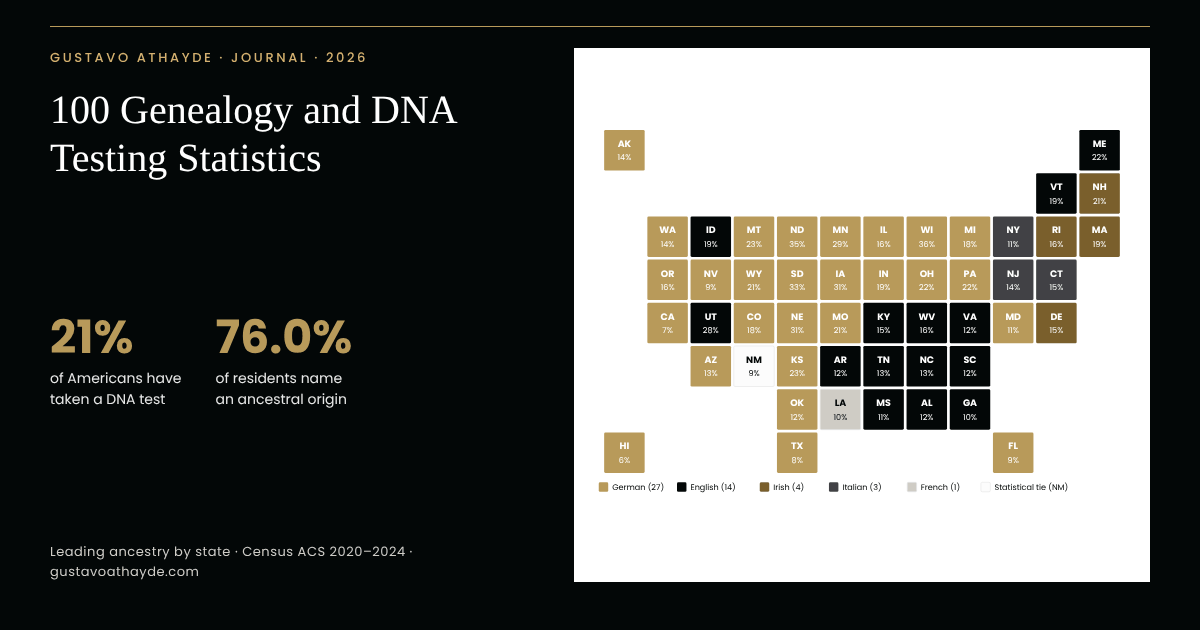
One in five Americans (21%) has now taken a DNA test, and among those who have tested or are interested, learning about ancestry and heritage is the most common reason (59%), according to YouGov. Yet only 9% say they know a great deal about their family’s history. These genealogy statistics trace that gap between curiosity and knowledge.
Below you will find our Family Roots Index for all 50 states, built from Census ancestry data, together with 100 statistics on DNA testing, genealogy companies, free records, family memory and privacy.
At a glance
Key takeaways
- 21% of Americans have taken a DNA test, and 43% say they or a relative have done so (YouGov, 2025).
- Ancestry is the top reason to test (59%), yet only 9% say they know a great deal about their family’s history.
- New Mexico and Hawaii lead our Family Roots Index, with about 81% of residents naming an ancestral origin.
- German ancestry leads in 27 states; English and Irish are statistically tied for second nationally.
- AncestryDNA’s network grew 93% from 2019 to 2026, to more than 29 million people.
- FamilySearch added about 6 million free names and images a day in 2025.
- 63% of grandparents have not recorded their life stories, though 73% would use technology to do so.
- 23andMe sold for $305 million in 2025, about $20 per customer, after 1.9 million asked to delete their data.
The Family Roots Index: where Americans name their origins
Genealogy begins with a simple question: where did your family come from? The Census Bureau asks a version of it every year. Our Family Roots Index measures, for each state, the share of residents who answer the American Community Survey’s ancestry question with at least one origin, from German, Irish or Mexican to Lebanese, Nigerian or simply “American.”
SHARE THIS CHART
Copy the code below to embed this chart on your site:
Highlights of the ranking
- 1.
76.0% of U.S. residents named at least one ancestry or ethnic origin in the American Community Survey (2020–2024 average); the remaining 24.0% gave no answer or one that could not be classified.
— U.S. Census Bureau; Gustavo Athayde analysis
- 2.
New Mexico (80.9%) and Hawaii (80.6%) lead our Family Roots Index, statistically tied for the highest share of residents who name an ancestral origin (ACS 2020–2024).
— U.S. Census Bureau; Gustavo Athayde analysis
- 3.
Rhode Island (80.1%), California and New Jersey (79.8% each) follow in the Family Roots Index, with Connecticut (79.6%) and Wisconsin (79.4%) close behind (ACS 2020–2024).
— U.S. Census Bureau; Gustavo Athayde analysis
- 4.
82.0% of Washington, D.C., residents name an ancestral origin, higher than any state; the District is shown in our table but not ranked (ACS 2020–2024).
— U.S. Census Bureau; Gustavo Athayde analysis
- 5.
West Virginia (62.9%) ranks 50th in the Family Roots Index, after Arkansas (65.8%) and Kentucky (66.1%), which are statistically tied; in these long-settled states, many families have lived in America for so many generations that fewer residents name an origin abroad (ACS 2020–2024).
— U.S. Census Bureau; Gustavo Athayde analysis
The “American” answer
- 6.
5.3% of U.S. residents, about 17.8 million people, simply report their ancestry as “American,” the fourth most common answer in the country (ACS 2020–2024).
— U.S. Census Bureau; Gustavo Athayde analysis
- 7.
12.9% of Alabamians report “American” ancestry, the highest share of any state, followed by Kentucky (11.5%) and Tennessee (11.3%) (ACS 2020–2024).
— U.S. Census Bureau; Gustavo Athayde analysis
- 8.
Four states (Alabama, Kentucky, Tennessee and Mississippi) have at least 10% of residents answering “American” to the ancestry question, against 5.3% nationally (ACS 2020–2024).
— U.S. Census Bureau; Gustavo Athayde analysis
Family Roots Index, states 1–17
Rank State Name an origin MOE “American” Leading ancestry Share 1 New Mexico 80.9% ±0.5 3.9% German / English 8.7% 2 Hawaii 80.6% ±0.4 1.2% German 5.8% 3 Rhode Island 80.1% ±0.6 3.7% Irish 16.1% 4 California 79.8% ±0.2 2.8% German 6.8% 4 New Jersey 79.8% ±0.2 3.3% Italian 13.7% 6 Connecticut 79.6% ±0.3 3.3% Italian 15.3% 7 Wisconsin 79.4% ±0.2 3.4% German 35.8% 8 New Hampshire 79.0% ±0.4 4.2% Irish 20.6% 9 Delaware 78.3% ±0.5 4.6% Irish 14.8% 9 Minnesota 78.3% ±0.2 3.3% German 29.2% 11 Florida 78.1% ±0.2 7.7% German 8.9% 11 Massachusetts 78.1% ±0.2 3.5% Irish 18.6% 11 Nevada 78.1% ±0.3 3.4% German 9.4% 11 Washington 78.1% ±0.2 3.8% German 14.5% 15 Vermont 78.0% ±0.5 7.0% English 19.1% 16 New York 77.3% ±0.1 4.2% Italian 10.9% 16 Utah 77.3% ±0.3 4.0% English 28.3%
Family Roots Index, states 18–34
Rank State Name an origin MOE “American” Leading ancestry Share 18 Texas 77.1% ±0.2 4.6% German 8.3% 19 South Dakota 77.0% ±0.6 4.4% German 33.1% 20 Maryland 76.9% ±0.3 4.1% German 11.4% 21 Arizona 76.6% ±0.3 4.0% German 12.6% 21 Illinois 76.6% ±0.1 3.4% German 16.1% 23 Oregon 76.5% ±0.3 4.3% German 16.3% 24 Colorado 75.9% ±0.3 3.5% German 17.9% 24 North Dakota 75.9% ±0.6 3.0% German 34.5% 26 Pennsylvania 75.6% ±0.2 4.4% German 21.6% 27 Michigan 75.5% ±0.2 4.3% German 17.7% 27 Montana 75.5% ±0.5 5.5% German 22.9% 29 Louisiana 75.4% ±0.4 7.4% French 9.6% 30 Maine 75.3% ±0.5 5.9% English 21.8% 31 Nebraska 75.2% ±0.4 3.5% German 31.0% 32 Virginia 75.0% ±0.2 8.4% English 12.0% 33 Alaska 74.9% ±0.7 3.6% German 14.2% 34 Idaho 74.5% ±0.4 5.3% English 19.3%
Family Roots Index, states 35–50
Rank State Name an origin MOE “American” Leading ancestry Share 35 North Carolina 74.3% ±0.2 8.3% English 12.7% 36 Iowa 73.6% ±0.3 4.6% German 30.5% 36 Wyoming 73.6% ±0.7 5.0% German 21.5% 38 South Carolina 73.5% ±0.3 8.3% English 12.1% 39 Ohio 73.4% ±0.2 5.6% German 22.3% 40 Georgia 73.1% ±0.2 7.6% English 10.4% 41 Kansas 72.8% ±0.3 5.6% German 23.3% 42 Mississippi 72.2% ±0.4 10.0% English 10.6% 43 Tennessee 71.1% ±0.3 11.3% English 13.3% 44 Missouri 70.5% ±0.3 6.8% German 21.3% 45 Alabama 70.3% ±0.2 12.9% English 12.1% 46 Oklahoma 69.9% ±0.3 6.1% German 12.0% 47 Indiana 68.9% ±0.3 6.9% German 19.5% 48 Kentucky 66.1% ±0.3 11.5% English 14.5% 49 Arkansas 65.8% ±0.4 7.5% English 12.3% 50 West Virginia 62.9% ±0.4 9.5% English 15.7% — District of Columbia 82.0% ±0.6 3.0% Irish 8.1%
Share of residents reporting at least one ancestry (any response other than “unclassified or not reported”), ACS 2020–2024 5-year estimates; MOE = 90% margin of error. States whose shares differ by less than the combined margin are statistically tied; ranks are shared when the rounded values match. “Leading ancestry” excludes “American,” “European” and “other groups.” Source: U.S. Census Bureau; Gustavo Athayde analysis.
Reading the index
What this means
A lower score is not a lack of heritage. In Appalachia and much of the South, families have lived on the same land for many generations, and many residents answer “American” or leave the question blank. For them, family history usually starts with a surname, a county courthouse and a family Bible rather than a port of arrival. A family crest can carry that story as well as any immigrant record, as our guide to the luxury family crest explains.
DNA testing statistics: how many Americans have tested
Consumer DNA tests moved from novelty to household item in less than a decade. The most recent national polls put the share of Americans who have tested at about one in five.
- 9.
21% of Americans have taken a DNA test, according to a January 2025 YouGov poll of 1,164 U.S. adult citizens.
— YouGov
- 10.
43% of Americans said in 2025 that they, a family member or both had taken a DNA test.
— YouGov
- 11.
28% of Americans 65 and older have taken a DNA test, the highest share of any age group (YouGov, 2025).
— YouGov
- 12.
22.6% of U.S. adults had taken an ancestry test in 2022 (4,403 respondents), making ancestry the most common type of genetic test in the country (National Cancer Institute HINTS 6 survey).
- 13.
40% of U.S. adults had undergone at least one genetic test of any kind in 2022, up from 19% in 2020 (HINTS 6, medical tests included).
Who plans to test next
- 14.
12% of U.S. adults said in December 2024 that they were considering a DNA test in the next six months (YouGov, 1,001 adults).
— YouGov
- 15.
23% of adults ages 18 to 29 said in December 2024 that they were considering a DNA test, the highest interest of any age group (YouGov).
— YouGov
- 16.
47% of Americans considering a DNA test in December 2024 were looking at ancestry and genealogy tests (YouGov).
— YouGov
- 17.
15% of U.S. adults, about one in seven, said in 2019 that they had used a mail-in DNA testing service (Pew Research Center; historical comparison).
Why Americans take a DNA test, and what they find
Heritage, not health, is the main reason Americans spit in a tube. The results often bring more than a pie chart of origins.
- 18.
59% of Americans who have taken a DNA test or are interested in one name learning about their ancestry and heritage as a reason, the most common reason in a January 2025 YouGov poll.
— YouGov
- 19.
87% of Americans who had used a mail-in DNA test in 2019 said they wanted to learn where their family came from (Pew Research Center; historical).
- 20.
25% of Americans who have taken a DNA test, or whose immediate family member has, said in 2025 that the results uncovered close relatives they had not known about (YouGov).
— YouGov
- 21.
33% of Americans who have taken a DNA test, or whose immediate family member has, said in 2025 that a result had surprised them (YouGov).
— YouGov
- 22.
71% of Americans said in 2025 that they would take a DNA test if it meant learning of a biological sibling they had never met, up from 62% in February 2022 (YouGov).
— YouGov
What Americans know about their ancestry
- 23.
31% of Americans said in 2025 that they would like to know a great deal about their family’s ancestry or heritage (YouGov).
— YouGov
- 24.
9% of Americans say they already know a great deal about their family’s ancestry, rising to 15% among those over 65 (YouGov, 2025).
— YouGov
- 25.
22% of Americans believe they definitely (7%) or probably (14%) have an ancestor who was an important historical figure or royalty (YouGov, 2025; figures rounded).
— YouGov
- 26.
40% of new Ancestry sign-ups are under 35, according to the company’s chief executive in April 2026.
— Semafor
What this means
Most Americans want to know far more about their ancestry than they do. A DNA test can open the door, but names, places and dates found in records are what turn a match list into a family story worth recording and passing down.
America’s ancestry and surnames, state by state
The ancestry question in the American Community Survey offers the most detailed portrait of the country’s family origins. German, English and Irish roots run through every region, with strong local signatures.
- 27.
41.8 million Americans, 12.5% of the population, report German ancestry, the most common ancestry in the country (ACS 2020–2024).
— U.S. Census Bureau; Gustavo Athayde analysis
- 28.
English (31.7 million) and Irish (31.6 million) ancestries are statistically tied for second place in the U.S. (ACS 2020–2024).
— U.S. Census Bureau; Gustavo Athayde analysis
- 29.
16.2 million Americans report Italian ancestry (4.8%), and 8.3 million report Polish ancestry (ACS 2020–2024).
— U.S. Census Bureau; Gustavo Athayde analysis
- 30.
German is the leading specific ancestry in 27 states, English in 14, Irish in 4, Italian in 3 and French in 1; in New Mexico, German and English are statistically tied (ACS 2020–2024).
— U.S. Census Bureau; Gustavo Athayde analysis
The leading ancestry in each state
- 31.
35.8% of Wisconsin residents report German ancestry, the highest share of any state, ahead of North Dakota (34.5%) and South Dakota (33.1%) (ACS 2020–2024).
— U.S. Census Bureau; Gustavo Athayde analysis
- 32.
28.3% of Utah residents report English ancestry, the highest share in the nation (ACS 2020–2024).
— U.S. Census Bureau; Gustavo Athayde analysis
- 33.
20.6% of New Hampshire residents report Irish ancestry, the highest share of any state; Irish also leads in Massachusetts, Rhode Island and Delaware (ACS 2020–2024).
— U.S. Census Bureau; Gustavo Athayde analysis
- 34.
15.3% of Connecticut residents report Italian ancestry, the highest share in the country; Italian also leads in New Jersey and New York (ACS 2020–2024).
— U.S. Census Bureau; Gustavo Athayde analysis
- 35.
Louisiana is the only state where French is the leading specific ancestry, reported by 9.6% of residents (ACS 2020–2024).
— U.S. Census Bureau; Gustavo Athayde analysis
- 36.
20.3% of North Dakota residents report Norwegian ancestry, the highest share of any state (ACS 2020–2024).
— U.S. Census Bureau; Gustavo Athayde analysis
Surnames and the 2020 Census
- 37.
46.6 million Americans reported English origin in the 2020 Census, followed by German (45.0 million) and Irish (38.6 million), counting each group alone or in any combination.
- 38.
About 6.3 million different surnames were reported in the 2010 Census, the latest Census surname data.
- 39.
Only 11 surnames were reported more than 1 million times each in the 2010 Census, led by Smith with 2,442,977 people.
- 40.
62% of the surnames reported in the 2010 Census belonged to just one respondent, a reminder of how distinctive a family name can be.
What this means
A surname is often the first clue in any family history. Families who want to honor two lines, such as a maternal and a paternal surname, often combine them in a custom coat of arms or a shared monogram.
Genealogy statistics: the companies and their databases
A handful of companies hold most of the world’s genealogical DNA and digitized records. Their figures show an industry still growing, record by record.
- 41.
More than 29 million people belong to Ancestry’s growing DNA network (company figure, April 2026).
— Ancestry
- 42.
- 43.
More than 70 billion historical records and over 3.8 million subscribers make up Ancestry’s collection and membership (2025 Impact Report, April 2026).
— Ancestry
- 44.
About 11 million records a day: that is the average pace implied by the more than 4 billion records Ancestry added in 2025.
— Ancestry; Gustavo Athayde analysis
- 45.
68 new and updated DNA regions were introduced by AncestryDNA in 2025, connecting customers to more than 3,600 places worldwide.
— Ancestry
MyHeritage and the DNA databases
- 46.
38.6 billion historical records, a DNA database of 9.6 million people and 58 million family trees are held by MyHeritage (company figures, 2026).
- 47.
6.6 billion historical records were added by MyHeritage in 2025.
- 48.
95 million structured marriage, engagement and divorce records were published by MyHeritage in 2025, a rich source for tracing family weddings.
- 49.
79 ethnicities now appear in MyHeritage’s DNA estimates after its 2025 update, nearly double the previous 42.
- 50.
More than 54 million DNA kits were available for genealogical matching across the major databases in March 2026, according to genetic genealogist Leah Larkin.
- 51.
A little under 14 million kits remained in 23andMe’s database in March 2026, down from about 15 million in October 2024 (The DNA Geek).
Genealogy platforms by the numbers
Platform Records DNA Trees or members As of Ancestry 70 billion+ 29 million+ (DNA network) 3.8 million+ subscribers 2026 MyHeritage 38.6 billion 9.6 million (DNA database) 58 million family trees 2026 FamilySearch 22.7 billion+ names and images — 1.8 billion people in one tree 2025 23andMe — a little under 14 million kits — 2026
Company figures, except 23andMe (The DNA Geek, March 2026). FamilySearch is a free nonprofit service. Sources: Ancestry, MyHeritage, FamilySearch, The DNA Geek.
FamilySearch, RootsTech and free family history
Much of America’s family history research happens for free. FamilySearch, a nonprofit operated by The Church of Jesus Christ of Latter-day Saints, keeps adding records at a pace that would have seemed impossible a generation ago.
- 52.
More than 2.2 billion searchable names and images were added by FamilySearch in 2025, bringing its free collection to more than 22.7 billion.
- 53.
About 6 million searchable names and images a day, on average, were added to FamilySearch’s free collection in 2025.
— FamilySearch; Gustavo Athayde analysis
- 54.
34% growth in three years: FamilySearch’s free collection rose from 16.9 billion names and images in 2022 to more than 22.7 billion in 2025.
— FamilySearch; FamilySearch; Gustavo Athayde analysis
- 55.
37% more visits: FamilySearch.org drew more than 297 million visits in 2025, against 217 million in 2022.
— FamilySearch; FamilySearch; Gustavo Athayde analysis
- 56.
1.8 billion people now appear in FamilySearch’s shared Family Tree, after it grew by more than 163 million people in 2025.
Centers, RootsTech and the library
- 57.
467 million sources were attached to ancestors in the FamilySearch Family Tree in 2025.
- 58.
More than 6,400 FamilySearch centers operate in 129 countries, after 310 new locations opened in 2025.
- 59.
235 countries and all 50 states were represented at RootsTech 2025, and more than 660,000 people using its Relatives at RootsTech feature viewed 6.6 million ancestral relationships.
- 60.
More than 4 million people attended RootsTech 2024 in person and online, from 232 countries and territories.
- 61.
8 billion names are held by the FamilySearch Library in Salt Lake City, the world’s largest genealogical library (2026).
Census records, archives and the 72-year rule
Federal records remain the backbone of American genealogy. Census schedules, military files and pension records connect each generation to the one before it.
- 62.
151 million people were counted in the 1950 Census, whose records the National Archives released on April 1, 2022, after the 72-year confidentiality period.
- 63.
April 2032 is when the 1960 Census records are expected to open to the public under the 72-year rule, following the 1950 Census release on April 1, 2022.
— National Archives; Gustavo Athayde analysis
- 64.
More than 1 million users and 37 million page views reached the 1950 Census website in its first week online in April 2022.
- 65.
532,047,895 digitized pages are available in the National Archives Catalog (2026).
The National Archives and the Library of Congress
- 66.
129 million page views were logged by the National Archives Catalog in fiscal year 2025.
- 67.
1,603,870 requests for veterans’ records were fulfilled by the National Archives in 2024, a key source for families tracing military service.
- 68.
More than 2.3 million pages of Revolutionary War pension files gained AI-extracted, searchable text in fiscal 2025, through a National Archives partnership with FamilySearch.
- 69.
More than 65.5 million National Archives records were to become available in the first phase of Ancestry’s 2024 digitization agreement, its largest archive collaboration to date.
— Ancestry
- 70.
More than 50,000 compiled family histories and over 100,000 U.S. local histories are held by the Library of Congress, whose genealogy collection dates to the 1815 purchase of Thomas Jefferson’s library.
Family memory, heirlooms and traditions
Genealogy is also kept at home: in the names of grandparents, a recipe card, a ring or a trip to an ancestral village. These surveys measure how Americans hold on to that memory.
- 71.
70% of Americans say knowing their family’s history is important, according to a 2021 Ipsos KnowledgePanel poll of 1,026 adults.
— Ipsos
- 72.
53% of Americans cannot name all four of their grandparents, and 66% want to learn more about their family history (Ancestry survey of 2,113 adults, 2022).
— Ancestry
- 73.
37% of Americans are familiar with their mother’s life before she had children, while 79% of mothers are willing to share their stories (Ancestry survey, 2023).
— Ancestry
- 74.
63% of grandparents have not recorded their life stories, and just 9% do so regularly (AARP survey of 1,347 adults 50 and older, 2025).
— AARP
- 75.
73% of grandparents say they would use technology to capture their stories if it were available (AARP, 2025).
— AARP
- 76.
46% of grandparents motivated to record their legacy want to create something meaningful to pass down, and 35% want to preserve cultural or family traditions (AARP, 2025).
— AARP
Grandparents, recipes and heirlooms
- 77.
79% of U.S. grandparents describe grandparenting as extremely or very fulfilling (AARP survey of more than 3,300 grandparents, late 2025).
— AARP
- 78.
Two-thirds of U.S. adults ages 65 and older were grandparents in 2024, according to Census Bureau data compiled by Pew Research Center.
- 79.
55% of Americans have a treasured family recipe, and 52% of those polled say that recipe is more than 25 years old (Talker Research poll of 5,000 adults for Jennie-O, October 2025).
- 80.
51% of Americans would rather inherit a select few meaningful items than everything a loved one owned; only 20% want everything (Talker Research for 1-800-GOT-JUNK?, 2026).
- 81.
27% of frequent U.S. travelers have tried ancestry or heritage travel (Talker Research poll of 2,000 travelers, 2026).
- 82.
38% of U.S. visitors to Scotland named Scottish ancestry as a motivation for their trip (VisitScotland Visitor Survey 2023, base of 152 U.S. visitors).
What this means
Families who want their history to outlast them tend to choose a few meaningful objects over many. An engraved signet, a family seal or a monogram on a christening gown carries names forward in a form the next generation can hold; our guide to signet design shows how.
Privacy, 23andMe and the stewardship of family data
A DNA sample is a family document: it says something about parents, siblings and cousins as well as the person who sent it. That is why privacy is the most common hesitation, and why the 23andMe bankruptcy drew wide attention.
- 83.
42% of Americans who are not very interested in DNA tests cite privacy as their reason, the most common reason for avoiding them (YouGov, 2025).
— YouGov
- 84.
30% of Americans said in 2025 that privacy is very much a concern when deciding whether to take a DNA test, up from 25% in February 2022 (YouGov).
— YouGov
- 85.
37% of respondents named the privacy and security of their genetic information as their top concern about DNA testing in December 2024 (YouGov).
— YouGov
The 23andMe case
- 86.
March 23, 2025 is the date 23andMe filed for Chapter 11, with a commitment of up to $35 million in debtor-in-possession financing.
— 23andMe
- 87.
19% more than Regeneron’s earlier $256 million offer: TTAM Research Institute, led by co-founder Anne Wojcicki, agreed in June 2025 to buy 23andMe for $305 million.
— 23andMe; Gustavo Athayde analysis
- 88.
About $20 per customer: that is what the $305 million paid for 23andMe in 2025 works out to across its roughly 15 million customers.
— 23andMe; Oregon Department of Justice; Gustavo Athayde analysis
- 89.
About 13% of 23andMe’s 15 million customers, 1.9 million people, asked the company to delete their data after its 2025 bankruptcy filing.
— STAT; Gustavo Athayde analysis
Lawsuits, the 2023 breach and the balance sheet
- 90.
28 states and the District of Columbia joined a bipartisan lawsuit on June 9, 2025, to block the sale of genetic data from roughly 15 million 23andMe customers without their consent (Oregon Department of Justice).
- 91.
6.9 million customers had genetic and other personal information exposed in 23andMe’s 2023 data breach; the company agreed to pay $46.75 million to victims (Reuters, 2026).
— WHBL
- 92.
£2.31 million was the fine imposed on 23andMe by the UK Information Commissioner’s Office in June 2025 over the 2023 breach, which affected 155,592 UK residents.
- 93.
27% was the drop in 23andMe’s revenue in fiscal 2024, to $219.6 million from $299.5 million a year earlier.
— 23andMe; Gustavo Athayde analysis
What this means
Before testing, read how a company stores samples, whether it shares data with researchers or law enforcement, and how to delete an account. Deciding together as a family is wise, because a single test reveals information about relatives as well.
The science and the solved cases
Genetic genealogy rests on a small fraction of the genome and on very large family trees. The same tools that reunite families now help identify the unnamed.
- 94.
99.6% is how identical any two people’s genomes are on average, according to the National Human Genome Research Institute (2026); the familiar 99.9% figure is a simplification.
- 95.
About 60% of searches for individuals of European descent would find a third cousin or closer in consumer genealogy databases, a 2018 study in Science estimated (historical).
- 96.
13 murders: the Golden State Killer pleaded guilty to them in 2020, after investigators identified him in 2018 by building his family tree from public genealogy websites.
— Court TV
- 97.
November 1, 2019 is when the U.S. Justice Department’s interim policy on forensic genetic genealogy took effect (historical).
- 98.
19 unidentified people were named by the nonprofit DNA Doe Project in 2025; their cases had gone unsolved for 27 years on average.
- 99.
Five children were identified in the first year of Othram’s Project 525 (May 2024 to May 2025), while more than 1,200 unidentified-decedent cases involving children remained active in the national NamUs system.
— Othram
- 100.
$2.24 billion is the projected size of the U.S. consumer genomics market by 2030, up from an estimated $473.9 million in 2023 (Grand View Research; projection).
Methodology
Our Family Roots Index measures the share of each state’s residents who report at least one ancestry in the American Community Survey 2020–2024 5-year estimates (Table B04006), computed as one minus the share “unclassified or not reported.” Any answer counts, including “American.” Margins of error come from the same table; states whose difference is smaller than the square root of the sum of their squared margins are described as statistically tied.
The leading ancestry in each state is the largest specific group, excluding “American,” “European” and “other groups.” Ancestry is self-reported and respondents may list up to two, so counts overlap. The 2020 Census figures measure detailed origins alone or in any combination and are not directly comparable with ACS ancestry.
Company figures (Ancestry, MyHeritage, FamilySearch, 23andMe) are as reported by each company or by named secondary sources, on the dates given. Growth rates and per-day averages are our own calculations from those figures. Survey results come from the polls named in each item; sponsored polls are identified as such. All comparisons are descriptive.
About the author

Gustavo Athayde — Founder & Creative Director, GUSTAVO ATHAYDE
Gustavo Athayde is the founder and creative director of GUSTAVO ATHAYDE, a bespoke monogram atelier based in Sioux Falls, South Dakota. A graphic designer by training, he creates monograms, personal and family crests, heraldic emblems, signet designs and wax seals for individuals, families, couples and brands across the United States. Every commission is refined line by line into a symbol meant to be kept, used and passed down.
Follow the atelier on Instagram · Request a private consultation
Frequently asked questions
- What percentage of Americans have taken a DNA test?
- About 21% of Americans had taken a DNA test as of January 2025, according to YouGov, and 43% said they, a family member or both had done so. In 2019, Pew Research Center put the figure at 15%.
- What is the largest DNA database for genealogy?
- AncestryDNA, with more than 29 million people in its network as of April 2026. 23andMe held a little under 14 million kits in March 2026, and MyHeritage reports a DNA database of 9.6 million.
- What is the most common ancestry in the United States?
- German, reported by 41.8 million people, or 12.5% of the population, in the 2020–2024 American Community Survey. English (31.7 million) and Irish (31.6 million) follow, statistically tied.
- Which state has the highest share of residents who know their roots?
- In our Family Roots Index, New Mexico (80.9%) and Hawaii (80.6%) are statistically tied for the highest share of residents who name an ancestral origin. West Virginia ranks 50th at 62.9%.
- When will the 1960 Census records be released?
- Under the 72-year rule, individual 1960 Census records are expected to open in April 2032, as the 1950 records did on April 1, 2022.
- Is genealogy research free?
- Much of it is. FamilySearch offers more than 22.7 billion names and images at no cost, and the National Archives Catalog holds more than 532 million digitized pages.
Cite this page
Source: Gustavo Athayde, "100 Genealogy and DNA Testing Statistics 2026", https://gustavoathayde.com/genealogy-dna-testing-statistics/Feel free to use these statistics and charts — we just ask for a link back to this page.
Sources
- 1950 Census fact sheet (National Archives)
- 2020 Census: detailed White population (U.S. Census Bureau)
- Frequently occurring surnames from the 2010 Census (U.S. Census Bureau)
- FY2025 Agency Performance Report (National Archives)
- Genetic testing in the U.S., HINTS 6 (Frontiers in Genetics) (Makhnoon et al.)
- Human genomic variation (National Human Genome Research Institute)
- Interim policy on forensic genetic genealogy (U.S. Department of Justice)
- Local History and Genealogy collections (Library of Congress)
- Multi-state fight to protect genetic information (Oregon Department of Justice)
- National Archives by the numbers (National Archives)
- People reporting ancestry, Table B04006, ACS 2020–2024 5-year (U.S. Census Bureau)
- This week in the 1950 Census (National Archives)
- What's in a name? 2010 Census surnames (U.S. Census Bureau)
Surveys
- 6 facts about grandparents in the U.S. (Pew Research Center)
- Americans know little about Mom's past (Ancestry)
- Family recipes bind generations together (Talker Research)
- Grandparents study 2026 (AARP)
- Grandparents, their role and their legacy (AARP)
- Interest and concerns in DNA testing (YouGov)
- Knowing their ancestry is important (Ipsos)
- Mail-in DNA test results bring surprises (Pew Research Center)
- More than half of Americans can't name all four grandparents (Ancestry)
- Spotlight on the U.S. visitor to Scotland (VisitScotland)
- The Great Junk Transfer 2026 (1-800-GOT-JUNK?)
- What Americans think about home DNA tests (YouGov)
- What is really inspiring trips in 2026 (Talker Research)
Companies, nonprofits and news
- 2022 Genealogy Highlights (FamilySearch)
- 2024 Annual Impact Report (Ancestry)
- 2024 Genealogy Highlights (FamilySearch)
- 2025 Genealogy Highlights (FamilySearch)
- 23andMe leaders questioned on genetic data risks (STAT)
- About MyHeritage (MyHeritage)
- Agreement on sale to TTAM Research Institute (23andMe)
- Ancestry surpasses 15 million members in its DNA network (Ancestry)
- Annual Report 2025 (DNA Doe Project)
- Blackstone completes acquisition of Ancestry (Business Wire)
- California settles 23andMe data breach claims (Reuters) (WHBL)
- Database sizes, March 2026 (The DNA Geek)
- Fine for failing to protect UK users' data (Information Commissioner's Office (UK))
- Fourth quarter and full fiscal year 2024 results (23andMe)
- Golden State Killer case (Associated Press) (Court TV)
- How old records and new AI brought growth to Ancestry (Semafor)
- Identity inference of genomic data using long-range familial searches (Science, 2018) (Erlich, Shor, Pe'er and Carmi)
- Impact Report 2025 (Ancestry)
- Largest archive collaboration with the National Archives (Ancestry)
- Library in Salt Lake City (Temple Square)
- Project 525 (Othram)
- RootsTech 2025 Recap (FamilySearch)
- U.S. consumer genomics market report (Grand View Research)
- Voluntary Chapter 11 process (23andMe)
- Year in Review 2025 (MyHeritage)