
Name Change After Marriage Statistics 2026: Who Takes the Family Name
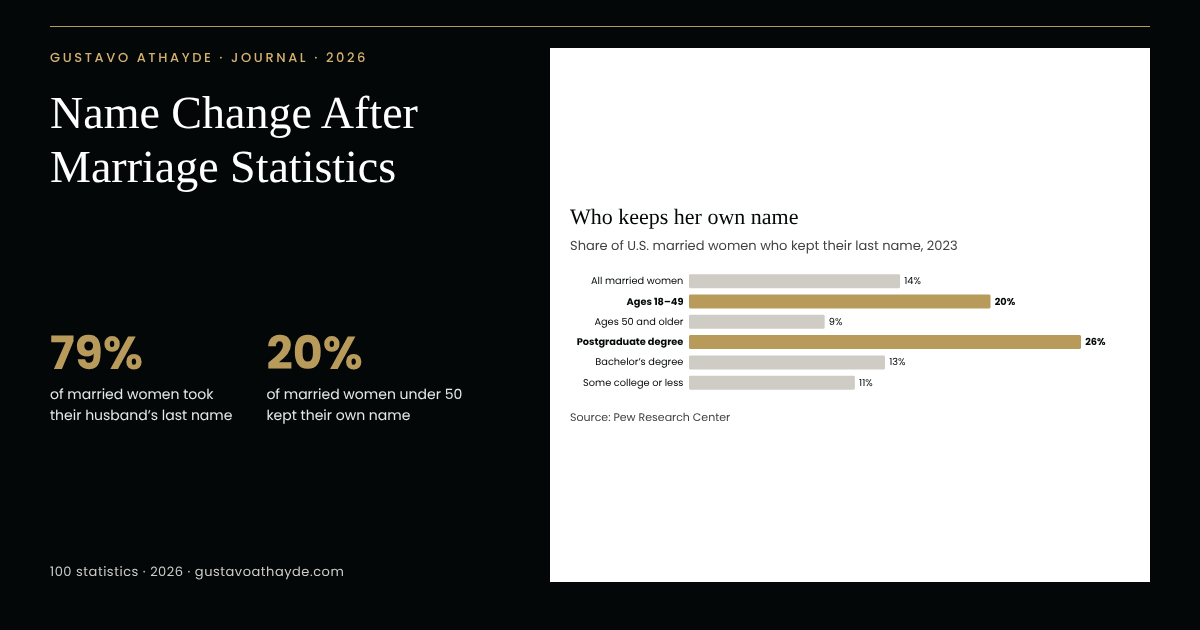
Name change after marriage statistics show that most American wives still take their husband’s last name. In Pew Research Center’s 2023 survey, 79% of women in opposite-sex marriages said they had done so, while 14% kept their own name and 5% hyphenated. Among husbands, however, just 5% took their wife’s name.
The same data also show where the custom is changing. Married women under 50 are more than twice as likely as older women to have kept their name, and women with a postgraduate degree are the most likely of all. Below, therefore, are 100 statistics on age, education, family, cost and tradition.
At a glance
Key takeaways
- 79% of married women took their husband’s name in 2023; 14% kept their own and 5% hyphenated.
- Only 5% of married men took their wife’s name, and 92% kept their own.
- Married women ages 18 to 49 are 2.2 times as likely as women 50 and older to have kept their name (20% vs. 9%).
- With a postgraduate degree, 26% kept their name, against 11% of women with some college or less.
- In Hawaii’s 2010 records, brides 45 and older kept their name 18.0% of the time, against about 10% of brides under 25.
- A third of never-married women would take a spouse’s name, and 24% are not sure.
- 58% of Americans view a wife taking her spouse’s name positively; 20% say the same of a husband.
- 52% say children of parents with different names should take the father’s name.
- A Social Security card with the new name is free; basic fees in New York City total about $47.50.
- About 95% of Japanese wives take the husband’s name; in Quebec, both spouses keep their own.
Name change after marriage statistics today
Most American wives still take their husband’s name. The share varies with how the question is asked, from 69% in one 2025 poll to 79% in Pew Research Center’s 2023 survey, which we use as the main reference.
The main numbers
- 1.
79% of women in opposite-sex marriages say they took their husband’s last name when they married, according to a 2023 survey that included 2,437 married adults.
- 2.
Another 14% kept their own last name, while 5% hyphenated both names (2023).
- 3.
In other words, about one in five married women (19%) did not take her husband’s name on its own in 2023: 14% kept their name and 5% hyphenated.
— Gustavo Athayde analysis of Pew Research Center data
- 4.
A 2025 poll measured it differently and found that 69% of married women carry a last name they took when they married, while 29% still have the name on their birth certificate.
— YouGov
- 5.
Across the whole population, therefore, 41% of American women carry a last name taken at marriage, against essentially no men; that is 21% of all Americans (2025).
— YouGov
- 6.
Meanwhile, 75% of Americans say their current last name is the one on their birth certificate: 95% of men, compared with 56% of women (2025).
— YouGov
Other surveys and the scale of the choice
- 7.
In addition, a separate study of 6,105 married and unmarried U.S. adults, fielded from 2023 to 2024, found that 77% of married women took their partner’s last name.
- 8.
In Zola’s survey of engaged couples marrying in 2025, 66% planned to take a partner’s last name, and 6% planned to create a new last name together.
— Zola
- 9.
The choice also comes up often: the United States recorded 2,128,446 marriages in 2024, a rate of 6.3 per 1,000 people (provisional).
- 10.
By one estimate based on the American Community Survey, more than 2.3 million women (2,361,030) married in 2023.
- 11.
Earlier, in 2014, 1,562,606 people changed their surnames with Social Security because of marriage, and more than 99% of them were women (historical data).
— Voice of America, reporting Social Security Administration data
- 12.
In other words, there were roughly 73 marriage-related name changes for every 100 marriages recorded in 2014 (2,140,272 marriages, excluding Georgia; historical data).
— Gustavo Athayde analysis of Voice of America, reporting Social Security Administration data, CDC/NCHS, National Vital Statistics System data
Name change after marriage statistics by age
Age is one of the clearest dividing lines. In particular, women who married more recently, and women who married later in life, are more likely to keep their own name.
SHARE THIS CHART
Copy the code below to embed this chart on your site:
Age today
- 13.
20% of married women ages 18 to 49 say they kept their last name, compared with 9% of those ages 50 and older (2023).
- 14.
As a result, younger married women are about 2.2 times as likely as women 50 and older to have kept their own name (2023).
— Gustavo Athayde analysis of Pew Research Center data
Age at marriage
- 15.
In Hawaii’s marriage records for 2010, 80.5% of 23,927 brides changed their last name, 12.6% kept it and 6.6% hyphenated (historical data).
- 16.
Moreover, the share keeping their name rose with age at marriage, from about 10% of brides under 25 to 18.0% of brides 45 and older (Hawaii, 2010).
- 17.
Pooling the age groups, 9.7% of Hawaii brides under 30 kept their name in 2010, compared with 14.9% of brides 30 and older.
— Gustavo Athayde analysis of MacEacheron, Names (Hawaii Department of Health data) data
- 18.
By contrast, the share taking the husband’s name fell from 85.5% of brides ages 20 to 24 to 74.3% of brides 45 and older (Hawaii, 2010).
- 19.
In New York Times wedding announcements, brides older than the median kept their name 33% of the time in the 1990s, against 13% of younger brides; in the 2000s, the shares were 25% and 11% (historical data).
Hawaii brides by age, 2010
Age at marriage Took husband’s name Kept own name (count) Kept own name Brides Under 20 85.0% 62 10.0% 618 20–24 85.5% 356 10.0% 3,554 25–29 84.4% 605 9.5% 6,390 30–34 78.8% 670 13.5% 4,947 35–39 77.6% 427 14.4% 2,958 40–44 77.6% 248 13.3% 1,858 45 and older 74.3% 648 18.0% 3,602
Source: MacEacheron, Names (Hawaii Department of Health data). Hyphenated or combined names and other choices make up the remainder.
Later marriage and new customs
- 20.
Meanwhile, brides are older than ever: the median age at first marriage reached 28.4 for women and 30.8 for men in 2025.
- 21.
Both medians are therefore 7.3 years higher than in 1975, when they stood at 21.1 for women and 23.5 for men.
— Gustavo Athayde analysis of U.S. Census Bureau data
- 22.
The share of first marriages at ages 30 to 34 rose from 17% in 2008 to 24% in 2024, while the share at ages 18 to 24 fell from 32% to 21%.
- 23.
Younger adults are also more open to new naming customs: 24% of adults under 45 view a blended new surname positively, compared with 13% of older Americans (2025).
— YouGov
What this means for couples. Couples who marry later often bring established names, careers and households to the marriage. A couple’s monogram can honor both names without asking either to disappear, while a personal monogram keeps each partner’s own initials in use.
Name change after marriage statistics by education
Education is the other strong divide, and the pattern has held for decades: the more advanced the degree, the more likely a woman is to keep her name. Still, most women at every level of schooling take their husband’s name.
Who keeps her name, by group
Group of married women, 2023 Kept own last name All married women 14% Ages 18 to 49 20% Ages 50 and older 9% Postgraduate degree 26% Bachelor’s degree 13% Some college or less 11% Hispanic 30% White 10% Black 9%
Source: Pew Research Center. Survey of 5,073 U.S. adults, April 10–16, 2023; women in opposite-sex marriages.
Education today
- 24.
26% of married women with a postgraduate degree kept their last name, compared with 13% of those with a bachelor’s degree and 11% of those with some college or less (2023).
- 25.
Married women with a postgraduate degree are thus about 2.4 times as likely to have kept their name as women with some college or less (2023).
— Gustavo Athayde analysis of Pew Research Center data
What earlier research found
- 26.
Earlier, in the 2004 American Community Survey, women with a doctorate had odds of using a nonconventional surname 9.8 times those of women without a bachelor’s degree (historical data).
- 27.
In addition, in the same 2004 ACS sample, the odds were 2.8 times higher for women with a master’s degree and 5.0 times higher for those with a professional degree; only 6% of native-born married women had a nonconventional surname.
- 28.
Similarly, an estimated 18.5% of college-graduate women in the United States kept their names after marriage in 2001 (historical data).
Harvard, Massachusetts and the Times
- 29.
In Massachusetts birth records from the 1990s, college graduates were two to five times as likely as other women, depending on age, to keep their surnames (historical data).
- 30.
Among college-educated women in Massachusetts birth records, however, the share keeping their name fell from 23% in 1990 to 20% in 1995 and 17% in 2000 (historical data, adjusted to the year of marriage).
- 31.
At Harvard, 44% of women in the class of 1980 who were married by 1990 had kept their surname, compared with 32% of the class of 1990 married by 2000 (historical data).
- 32.
Likewise, in New York Times announcements, brides with a graduate degree kept their name 32% of the time in the 1990s, against 15% of other brides; in the 2000s, the gap narrowed to 22% versus 14% (historical data).
The next generation of brides
Women who have never married are less settled on the question than married women were. A third would take their spouse’s name, but nearly a quarter are not sure, which leaves the custom’s future largely in their hands.
Plans and preferences
- 33.
Among never-married women, 33% say they would take their spouse’s last name if they married, 23% would keep their own, 17% would hyphenate and 24% are not sure (2023).
- 34.
In fact, among never-married women who chose one of those three options, 45% would take their spouse’s name, 32% would keep their own and 23% would hyphenate (2023).
— Gustavo Athayde analysis of Pew Research Center data
- 35.
Among never-married men, 73% say they would keep their last name, 20% are not sure, 4% would hyphenate and 2% would take their spouse’s name (2023).
- 36.
Likewise, 64% of women who are not yet married expect to take their partner’s last name, compared with 77% of married women who did (2023–2024).
- 37.
Among all women who are married, have been married or plan to marry, 70% will take a partner’s last name; 5% of men say the same (2023–2024).
What Americans would prefer
- 38.
Also, when asked what they would prefer, 55% of women would take their spouse’s last name, and 64% of men would prefer their spouse take theirs (2025).
— YouGov
- 39.
Overall, 32% of Americans would prefer that their spouse take their last name and 30% would prefer to take their spouse’s (2025).
— YouGov
- 40.
By contrast, only 13% of Americans would prefer that both partners keep their original names, including 17% of women and 9% of men (2025).
— YouGov
- 41.
Moreover, 72% of married women do not plan to keep a professional name separate from their personal one (2023–2024).
- 42.
However, 27% of women planning to change their maiden name only plan to change it in their personal life (2023–2024).
Men and the married name
Few American husbands change their name, and the custom of the bride taking the groom’s name has no real counterpart among men. Younger men, however, are slightly more open to the idea.
Husbands
- 43.
By comparison, 92% of men in opposite-sex marriages say they kept their last name; just 5% took their wife’s, and fewer than 1% hyphenated (2023).
- 44.
Therefore, for every married man who took his wife’s surname, about 16 married women took their husband’s (2023).
— Gustavo Athayde analysis of Pew Research Center data
- 45.
Asked a different way, fewer than 1% of married men say they carry a last name they took at marriage, and 94% have their name from birth (2025).
— YouGov
- 46.
15% of unmarried Gen Z men say they would take a partner’s name, compared with 5% of millennial and 6% of Gen X men (2023–2024).
- 47.
In a nationally representative sample of 877 married men, only 27, or 3%, had changed their surname at marriage (study published 2018).
— ScienceDaily, reporting Shafer and Christensen (Journal of Family Issues)
- 48.
Only 20% of Americans view a man taking his wife’s last name positively, although women are more favorable than men (23% vs. 16%) (2025).
— YouGov
- 49.
Britons, however, are slightly more open to the custom: 27% view a man taking his wife’s name positively, against 20% of Americans (2025).
— YouGov
How Americans view each choice
The traditional choice is also the most admired one. More Americans view a wife taking her husband’s name favorably than any alternative, and most say the decision belongs to the couple.
Views of each choice
- 50.
58% of Americans view a woman taking her spouse’s last name positively, compared with 20% for a man taking his spouse’s name (2025).
— YouGov
- 51.
The traditional custom is therefore viewed favorably by nearly three times as many Americans as the reverse (2025).
— Gustavo Athayde analysis of YouGov data
- 52.
32% view both partners keeping their original names positively, while 18% view it negatively (2025).
— YouGov
- 53.
Meanwhile, Americans are split on hyphenation: 28% view a hyphenated married name positively and an equal 28% negatively (2025).
— YouGov
- 54.
Blended new surnames, by contrast, draw more skepticism: 18% view them positively and 39% negatively; swapping names as middle names draws 18% positive and 31% negative (2025).
— YouGov
- 55.
32% of Americans say sharing the same last name is a necessary way for a married couple to show commitment, while 56% say it is not (2025).
— YouGov
- 56.
Women are more likely than men to say a shared name is not necessary to show commitment (63% vs. 48%) (2025).
— YouGov
- 57.
Women are also more favorable than men toward both partners keeping their names (38% vs. 26%) and toward hyphenation (33% vs. 24%) (2025).
— YouGov
Values and background
- 58.
81% of Republican women say they would prefer to take their spouse’s last name, compared with 42% of Democratic women (2025).
— YouGov
- 59.
Likewise, 82% of Republican men would prefer their spouse take their last name, against 49% of Democratic men (2025).
— YouGov
- 60.
Among married women, 10% of Republicans and Republican leaners kept their own name, compared with 20% of Democrats and Democratic leaners; the shares range from 7% of conservative Republican women to 25% of liberal Democratic women (2023).
- 61.
In an analysis of Pew’s 2023 survey, 92% of married conservative women took their husband’s name, compared with 70% of married liberal women.
- 62.
30% of Hispanic married women kept their last name, compared with 10% of White and 9% of Black married women (2023).
What this means for families. A shared surname still remains, for most Americans, the simplest expression of a new household. Families who want that name to endure therefore often give it a visual form: a family crest, a coat of arms or a signet that can be passed down.
Children, family and the shared name
The name question also reaches beyond the couple. Most Americans expect children to carry their father’s surname, and couples who share a name tend to stay married longer, though researchers caution that this reflects who chooses a shared name more than the name itself.
Children’s surnames
- 63.
52% of Americans say that when a married man and woman have different last names, their children should take the father’s name; 58% of men and 47% of women agree (2025).
— YouGov
- 64.
By contrast, 17% say the children should carry both parents’ names hyphenated, and 4% say the mother’s name (2025).
— YouGov
- 65.
In the United Kingdom, however, only 34% say such children should take the father’s name, and 22% favor a hyphenated name (2025).
— YouGov
- 66.
Only 8% of respondents give their children the mother’s last name, and another 8% hyphenate to include both parents’ names (2023–2024).
- 67.
For example, among women who hyphenated, 63% said the main reason was to preserve their family name (2023–2024).
- 68.
In addition, among women who took their husband’s name, 18% kept their former surname as a middle name, in a study of users of an online name-change service (2008–2012 data).
Marriage and divorce
- 69.
Spouses who do not share a surname divorce at about a 50% higher rate than those who do, according to an analysis of Texas divorce records from 2016 and 2017; the author attributes most of the gap to differences between couples, not to the name itself.
- 70.
Couples who share a name stay together about 12 years on average before a divorce, against 8 to 10 years for other naming choices (Texas, 2016–2017).
- 71.
Perhaps 75% to 80% of Texas couples share a surname, but only 64% of Texas divorces involve a shared surname (2016–2017).
- 72.
Finally, after a divorce, 36% of Americans think a person who changed names at marriage should return to the original name, 6% think they should keep the married name and 51% say it depends (2025).
— YouGov
- 73.
Overall, married couples remain a large share of American homes: 47% of U.S. households were married couples in 2025.
What this means for families. Choosing a family name is also choosing what the children will inherit. Many couples also mark that decision on the wedding day itself, with a wedding monogram built around the shared initial.
The paperwork: how to change your name after marriage
Changing a name after marriage costs little in government fees, but it takes a sequence of steps. Social Security comes first; the driver license, the passport and the bank and payroll records then follow.
What a married name costs
Step Government fee, 2026 Source Marriage license (New York City) $35 NYC 311 Marriage license (Smith County, Texas) $82, or $22 with premarital course Smith County Clerk Social Security card with new name $0 Social Security Administration Passport name change within 1 year of issue (DS-5504) $0 U.S. Department of State Adult passport renewal (DS-82) $130 U.S. Department of State Driver license name update (New York, by mail) $12.50 New York State DMV Court name change, adult (California, not via marriage) $435–$450 Judicial Branch of California
Sources: NYC 311, Smith County Clerk, Texas, Social Security Administration, U.S. Department of State, U.S. Department of State, New York State DMV, Judicial Branch of California. Fees vary by state and county.
Social Security and the passport
- 74.
There is no charge for a Social Security number and card, including a corrected card after a marriage name change (2026).
- 75.
Replacement Social Security cards are limited to three a year and 10 in a lifetime, although cards issued for a legal name change do not count toward those limits (2026).
- 76.
After that, the new card arrives by mail in 5 to 10 business days once Social Security has processed the request (2026).
- 77.
In addition, couples married in one of 21 participating states could request the name change online, provided they waited at least 30 days after the wedding and had their marriage certificate and proof of identity (2024).
- 78.
Changing the name on a U.S. passport issued less than a year earlier costs nothing with Form DS-5504 when the name changed within that year, unless expedited service is requested (2026).
- 79.
Otherwise, an adult passport book renewal by mail or online costs $130; a first passport costs $130 plus a $35 acceptance fee (2026).
Marriage and driver licenses
- 80.
At the state level, for example, updating the name on a New York driver license by mail costs $12.50 (2026).
- 81.
Similarly, a marriage license in New York City costs $35 (2026).
— NYC 311
- 82.
In Smith County, Texas, by contrast, a marriage license costs $82, or $22 for couples who complete the state’s premarital course (2026).
Total cost and REAL ID
- 83.
Altogether, in New York City, the basic filing fees for a married name come to about $47.50: the $35 license and the $12.50 license update, with the Social Security card free and a recent passport corrected at no cost (2026).
— Gustavo Athayde analysis of NYC 311, New York State DMV, Social Security Administration, U.S. Department of State data
- 84.
By comparison, an adult name change through the courts in California costs $435 to $450 in court filing fees alone, about nine times the marriage route in New York (2026).
— Gustavo Athayde analysis of Judicial Branch of California, NYC 311, New York State DMV data
- 85.
Meanwhile, federal REAL ID enforcement began on May 7, 2025, and applicants whose current name differs from their identity document must bring legal name-change documents.
- 86.
Finally, one name-change service, MissNowMrs, reported that 40% of newlyweds legally change their name within the first three months of marriage (company claim, 2014).
What this means for newlyweds. Updating Social Security first makes the rest easier. It is also the moment to retire the maiden initials on stationery and linens; etiquette has long held that a wax seal or monogram with married initials waits until after the wedding.
A short history of the married name in America
For most of American history, the wife’s adoption of her husband’s name was so customary that some states wrote it into law. The share of women keeping their name rose after 1975, peaked in the 1990s and then leveled off.
The long-run trend
- 87.
Among college-graduate women, keeping one’s name rose from about 2% to 4% around 1975 to just below 20% in 2001 (historical data).
- 88.
In New York Times wedding announcements, name keeping rose from 1% in the 1970s to 9% in the 1980s and 23% in the 1990s, then leveled off at 18% in the 2000s (historical data).
Law and the family name
- 89.
Until 1975, Hawaii law required every married woman to adopt her husband’s name as the family name (historical).
- 90.
Hawaii’s Act 114 of 1975 then replaced that rule: each party to a marriage now declares the surname each will use (historical).
- 91.
Earlier, in 1971, a federal court in Forbush v. Wallace upheld Alabama’s rule that a woman assume her husband’s surname upon marriage, finding it had a rational basis (historical).
America’s surnames
- 92.
Every married name joins a vast family tree: 162,253 surnames that occur at least 100 times cover 90% of Americans with a recorded surname (latest Census surname data, 2010).
- 93.
Meanwhile, Smith remains the most common surname, borne by 2,442,977 people, while 62% of the roughly 6.3 million surnames reported were recorded only once (latest Census surname data, 2010).
Married names around the world
Naming customs differ widely across countries. The United States sits between nations where the shared family name is required by law and nations where both spouses keep their birth names by default.
Married-name customs at a glance
Country Rule and practice United States Free choice; 79% of wives took the husband’s name (2023) Japan One shared surname required; about 95% take the husband’s (2024) Germany Shared name optional; about 74% chose the husband’s (2016) United Kingdom Free choice; 59% of women would take the spouse’s (2016) France Birth name kept legally; 91% used the husband’s (1995) Quebec (Canada) Both spouses keep their surname Italy Children receive both parents’ surnames by default (2022 ruling)
Sources: Pew Research Center, ABC News (Australia), Statista, citing the Society for the German Language (GfdS), YouGov UK, Service-Public.fr, INED, Population et Sociétés no. 367, Gouvernement du Québec, Constitutional Court of Italy, Judgment 131/2022.
Country by country
- 94.
In Japan, for instance, where married couples must share one surname, wives take the husband’s name in about 95% of cases (2024).
- 95.
In a 2017 survey of 606,866 Japanese marriages, only 4.1% of couples chose the wife’s surname, close to the 5% of American husbands who take their wife’s name.
- 96.
In Quebec, by contrast, both spouses keep their own surname after they marry (2026).
- 97.
In France, a married woman legally keeps her birth name; nevertheless, 91% of married women used their husband’s name in 1995 (historical data).
- 98.
Similarly, in Germany, just under 74% of couples chose the husband’s name as the married name in 2016.
— Statista, citing the Society for the German Language (GfdS)
- 99.
- 100.
In Italy, finally, a 2022 Constitutional Court ruling struck down the automatic use of the father’s surname alone for children, favoring both parents’ surnames.
Methodology
The core figures come from Pew Research Center’s survey of 5,073 U.S. adults (April 10–16, 2023), which asked people in opposite-sex marriages what they did with their last name, and from a YouGov survey of 1,162 U.S. adult citizens (April 15–20, 2025). The two measure slightly different things: Pew asked what women did at marriage, while YouGov asked whether a woman’s current name came from marriage, which explains part of the gap between 79% and 69%.
Comparisons by age at marriage use Hawaii Department of Health records for 23,927 brides in 2010, published in the journal Names; comparisons by education also draw on Census Bureau and academic research labeled as historical. Company surveys from The Female Quotient and Zola are identified as such. Fees come from official government pages and vary by state and county.
Gustavo Athayde analyses are simple ratios, sums and pooled shares of the published figures; calculations are shown in our verification log. Comparisons are descriptive, not causal, and survey figures from different studies are not combined except where clearly labeled.
About the author

Gustavo Athayde — Founder & Creative Director, GUSTAVO ATHAYDE
Gustavo Athayde is the founder and creative director of GUSTAVO ATHAYDE, a bespoke monogram atelier based in Sioux Falls, South Dakota. A graphic designer by training, he creates monograms, personal and family crests, heraldic emblems, signet designs and wax seals for individuals, families, couples and brands across the United States. Every commission is refined line by line into a symbol meant to be kept, used and passed down.
Follow the atelier on Instagram · Request a private consultation
Frequently asked questions
- What percentage of women change their last name after marriage?
- About 79% of women in opposite-sex marriages took their husband’s last name, according to Pew Research Center’s 2023 survey. Another 14% kept their own name and 5% hyphenated.
- Are younger women less likely to take their husband’s name?
- Yes. 20% of married women ages 18 to 49 kept their own name, compared with 9% of women 50 and older.
- Does education affect whether a woman keeps her name?
- It does. 26% of married women with a postgraduate degree kept their name, against 13% with a bachelor’s degree and 11% with some college or less.
- How many men take their wife’s last name?
- Very few. Only 5% of men in opposite-sex marriages took their wife’s name, and fewer than 1% hyphenated.
- How much does it cost to change your name after marriage?
- The Social Security card is free, and a passport issued within the past year can be corrected at no cost. In New York City, the license and driver license update come to about $47.50.
- What last name do children usually get?
- Most Americans, 52%, say children of parents with different last names should take the father’s name; 17% favor a hyphenated name.
Cite this page
Source: Gustavo Athayde, "Name Change After Marriage Statistics 2026", https://gustavoathayde.com/name-change-after-marriage-statistics/Feel free to use these statistics and charts — we just ask for a link back to this page.
Sources
- Act 114 (Session Laws of Hawaii 1975)
- Adult name change: file your forms (Judicial Branch of California)
- Advocates news: online name change after marriage (August 8, 2024) (Social Security Administration)
- Change your name on your Social Security card (Social Security Administration)
- Change your name or non-address information (New York State DMV)
- Families and living arrangements, press release CB25-TPS.78 (2025) (U.S. Census Bureau)
- Federal enforcement of REAL ID begins today (May 7, 2025) (California DMV)
- Forbush v. Wallace, 341 F. Supp. 217 (M.D. Ala. 1971)
- Form DS-5504, passport data correction and name change (U.S. Department of State)
- Frequently occurring surnames from the 2010 Census (U.S. Census Bureau)
- Jech v. Burch, 466 F. Supp. 714 (D. Haw. 1979)
- Judgment no. 131 of 2022 (Constitutional Court of Italy)
- Marriage license (NYC 311)
- Marriage licenses (Smith County Clerk, Texas)
- Married name (Gouvernement du Québec)
- Passport fees (U.S. Department of State)
- Provisional number of marriages and divorces and rates: United States, 2000–2024 (CDC/NCHS)
- Use of a spouse’s name (French government) (Service-Public.fr)
- What’s in a name? (August 2017) (U.S. Census Bureau)
- Your Social Security number and card, Publication 05-10002 (Social Security Administration)
Research centers and polls
- About eight-in-ten women in opposite-sex marriages say they took their husband’s last name (September 7, 2023) (Pew Research Center)
- Can sharing a last name save your marriage? It depends (Lyman Stone, April 16, 2026) (Institute for Family Studies)
- How do Britons think couples should choose their married name? (2025) (YouGov UK)
- Le nom des femmes mariées dans l’Union européenne, Population et Sociétés no. 367 (INED)
- Marriage rate in the U.S.: geographic variation, 2023, Family Profile FP-24-25 (ACS data) (NCFMR, Bowling Green State University)
- Most married women change their last name after the wedding (survey of 1,162 U.S. adult citizens, April 2025) (YouGov)
- Six in ten women would like to take their spouse’s surname (2016) (YouGov UK)
- Timing of first marriage, Family Profile FP-26-13 (ACS data) (NCFMR, Bowling Green State University)
Academic studies
- Brides’ surname choices in Hawai’i, 2010, Names: A Journal of Onomastics 68(4), 2020 (Hawaii Department of Health records) (MacEacheron)
- Making a name: women’s surnames at marriage and beyond, Journal of Economic Perspectives 18(2), 2004 (Goldin and Shim)
- Men who take their wife’s last name (Shafer and Christensen, Journal of Family Issues, May 2018) (ScienceDaily)
- The bride is keeping her name: a 35-year retrospective analysis of trends and correlates (2009) (Kopelman, Shea-Van Fossen, Paraskevas, Lawter and Prottas)
- Women’s former surnames as middle names, Names: A Journal of Onomastics 64(4), 2016 (Scheuble and Johnson)
- Women’s marital naming choices in a nationally representative sample, Journal of Family Issues 31(5), 2010 (abstract) (Gooding and Kreider)
Industry, company and press
- How engaged couples are reinventing the wedding playbook (couples marrying in 2025) (Zola)
- Japan’s enforcing of same surnames for couples has only a short history (Nippon.com)
- Marriage proposal can bring up identity question (December 24, 2016; Social Security Administration data) (Voice of America)
- Name change at German marriages (citing GfdS, 2016) (Statista)
- Newlyweds change names in October: tips for getting it done (October 7, 2014; MissNowMrs data) (Philadelphia Magazine)
- The Maiden Name Debate research report (6,105 U.S. adults, 2023–2024) (The Female Quotient with The Knot and SmithGeiger)
- Why Japanese couples have little choice over their surname (April 20, 2024) (ABC News (Australia))