
Are American Names Getting Longer? 140 Years of Name Length
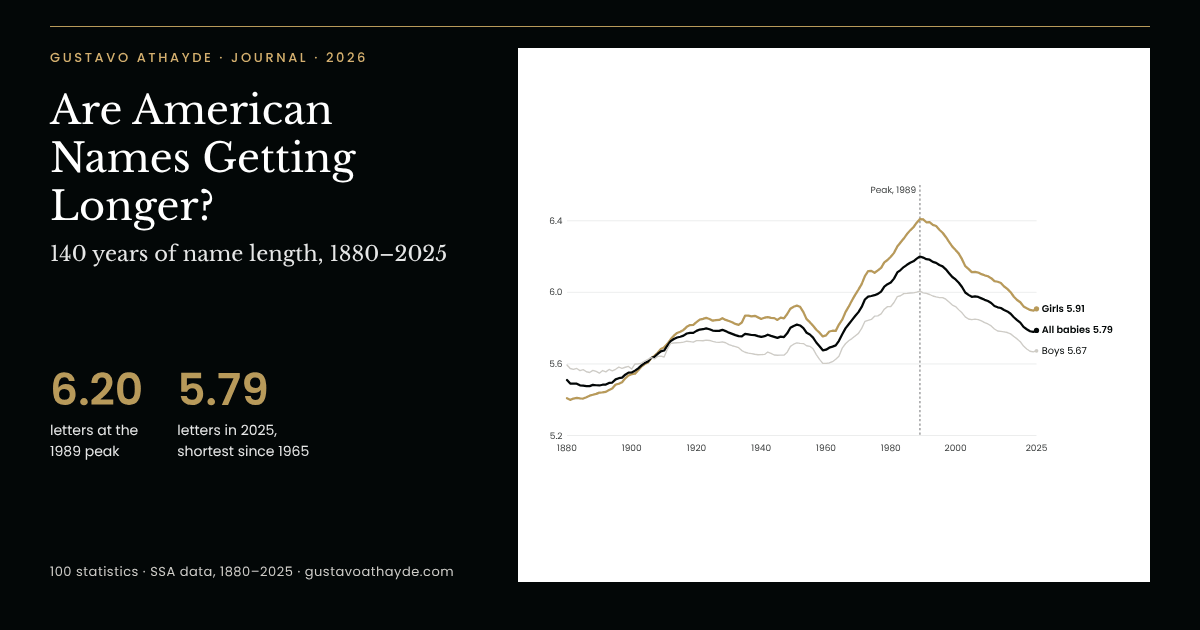
Are American names getting longer? For a century they were. Our analysis of Social Security Administration records finds that the average newborn’s first name grew from 5.51 letters in 1880 to a peak of 6.20 in 1989, the era of Christopher and Jennifer. Since then, however, the trend has reversed: in 2025 the average was 5.79 letters, and 2023 to 2025 were the shortest years since 1965.
Below are 100 name length statistics: our own state ranking, 140 years of averages for girls and boys, the rise of Liam and Mia, the long names still at record highs, surname length from the Census, and what research and surveys say about names.
At a glance
Key takeaways
- 5.79 letters was the average first name of a 2025 newborn, down from a peak of 6.20 in 1989.
- 2023 to 2025 were the shortest years for American names since 1965, although 2025 brought the first small rise since 2006.
- 18.6% of 2025 babies received a name of four letters or fewer, up from 11.8% in 1996.
- Liam, four letters, has been the top boys’ name since 2017; in 1990 the top two boys’ names were Michael and Christopher.
- Alabama and Texas give the longest names (5.83 letters); Hawaii gives the shortest (5.39).
- Every state and the District of Columbia gives shorter names today than in 1985.
- Girls’ names have been longer than boys’ every year since 1907, by 0.23 letters in 2025.
- Charlotte, Theodore and Evangeline all reached record highs in 2025: long names are rarer, not gone.
- 6.31 letters is the average American surname, longer than the average newborn first name.
Name length by state: the 2025 ranking
Our ranking measures the average number of letters in the first names of babies born in each state in 2025, weighted by how many babies received each name. Alabama and Texas lead at 5.83 letters; Hawaii, at 5.39, gives the shortest names in the nation.
The map of name length
Ranking, 1 to 13
Rank State Letters, 2025 Girls Boys 4 letters or fewer Letters, 1985 Change 1 Alabama 5.83 5.97 5.71 16.9% 6.27 −0.44 1 Texas 5.83 5.98 5.69 18.2% 6.13 −0.30 3 South Carolina 5.82 5.95 5.72 17.2% 6.29 −0.46 3 Arkansas 5.82 5.97 5.69 17.1% 6.15 −0.33 3 West Virginia 5.82 5.95 5.70 15.9% 6.15 −0.34 6 Indiana 5.81 5.94 5.70 17.9% 6.09 −0.27 6 New Mexico 5.81 5.93 5.72 19.7% 6.19 −0.38 6 Kentucky 5.81 5.93 5.70 17.6% 6.16 −0.35 9 Tennessee 5.80 5.95 5.68 17.7% 6.23 −0.43 9 Arizona 5.80 5.93 5.69 19.5% 6.18 −0.38 9 Kansas 5.80 5.92 5.70 18.6% 6.01 −0.21 9 Missouri 5.80 5.92 5.69 18.1% 6.11 −0.31 9 Mississippi 5.80 5.89 5.72 15.9% 6.28 −0.48
Ranking, 14 to 26
Rank State Letters, 2025 Girls Boys 4 letters or fewer Letters, 1985 Change 14 Oklahoma 5.79 5.94 5.67 18.1% 6.07 −0.28 15 North Carolina 5.78 5.91 5.67 18.2% 6.25 −0.47 15 Alaska 5.78 5.83 5.74 19.6% 6.15 −0.37 15 Ohio 5.78 5.90 5.67 18.6% 6.12 −0.34 15 New Hampshire 5.78 5.87 5.70 19.3% 6.21 −0.43 19 Georgia 5.77 5.90 5.66 18.1% 6.28 −0.51 19 Maine 5.77 5.85 5.70 19.7% 6.14 −0.37 19 Nevada 5.77 5.88 5.67 20.3% 6.22 −0.46 22 Vermont 5.76 5.78 5.75 19.8% 6.09 −0.33 22 Illinois 5.76 5.86 5.68 20.0% 6.16 −0.39 22 Wisconsin 5.76 5.87 5.67 19.1% 6.01 −0.25 22 Virginia 5.76 5.88 5.65 19.4% 6.24 −0.48 26 California 5.75 5.85 5.67 20.9% 6.16 −0.41
Ranking, 27 to 39
Rank State Letters, 2025 Girls Boys 4 letters or fewer Letters, 1985 Change 26 Oregon 5.75 5.86 5.66 19.6% 6.06 −0.31 26 Nebraska 5.75 5.88 5.64 19.4% 6.01 −0.26 26 Idaho 5.75 5.86 5.66 19.7% 6.00 −0.25 30 Michigan 5.74 5.84 5.66 19.7% 6.11 −0.37 30 Florida 5.74 5.88 5.62 20.0% 6.24 −0.50 30 Colorado 5.74 5.86 5.64 20.3% 6.11 −0.37 33 Connecticut 5.73 5.82 5.66 21.5% 6.24 −0.50 34 Pennsylvania 5.72 5.84 5.62 19.9% 6.11 −0.39 34 Iowa 5.72 5.85 5.62 20.1% 5.96 −0.23 34 Louisiana 5.72 5.87 5.59 19.0% 6.13 −0.41 37 Washington 5.71 5.80 5.63 20.5% 6.09 −0.38 37 Maryland 5.71 5.80 5.63 20.1% 6.19 −0.48 39 Wyoming 5.70 5.77 5.66 20.6% 6.04 −0.34
Ranking, 40 to 51
Rank State Letters, 2025 Girls Boys 4 letters or fewer Letters, 1985 Change 40 Delaware 5.69 5.80 5.61 21.9% 6.19 −0.49 40 Rhode Island 5.69 5.79 5.61 23.0% 6.24 −0.55 40 Montana 5.69 5.76 5.64 20.4% 6.01 −0.32 40 Massachusetts 5.69 5.77 5.61 22.3% 6.20 −0.52 44 New Jersey 5.68 5.75 5.62 21.9% 6.22 −0.54 45 Minnesota 5.67 5.75 5.61 20.7% 6.00 −0.33 45 New York 5.67 5.73 5.61 21.6% 6.23 −0.56 47 South Dakota 5.65 5.70 5.62 21.1% 5.97 −0.32 48 District of Columbia 5.64 5.69 5.60 24.4% 6.29 −0.65 49 North Dakota 5.63 5.69 5.59 22.0% 5.96 −0.33 50 Utah 5.61 5.69 5.53 23.3% 6.00 −0.40 51 Hawaii 5.39 5.38 5.41 29.1% 6.07 −0.68
Average number of letters per first name, weighted by births. Equal values to two decimals share a rank.
Longest and shortest
- 1.
Alabama and Texas gave babies the longest first names in 2025, an average of 5.83 letters, followed by South Carolina at 5.82 and Arkansas at 5.82.
— Gustavo Athayde analysis of SSA state data
- 2.
Hawaii had the shortest average first name of any state in 2025, 5.39 letters, and it is the only state where girls’ names averaged fewer letters than boys’ (5.38 vs. 5.41).
— Gustavo Athayde analysis of SSA state data
- 3.
Utah (5.61) and North Dakota (5.63) follow Hawaii with the shortest average names of 2025, and South Dakota ranks 47th at 5.65 letters.
— Gustavo Athayde analysis of SSA state data
How every state changed since 1985
- 4.
All 50 states and the District of Columbia gave shorter names on average in 2025 than in 1985; the national state-file average fell from 6.16 to 5.76 letters.
— Gustavo Athayde analysis of SSA state data
- 5.
Hawaii saw the largest decline from 1985 to 2025, 0.68 letters, followed by the District of Columbia (0.65) and New York (0.56).
— Gustavo Athayde analysis of SSA state data
- 6.
Kansas changed the least: its average fell only 0.21 letters between 1985 and 2025, followed by Iowa (0.23) and Wisconsin (0.25).
— Gustavo Athayde analysis of SSA state data
Short and long names by state
- 7.
29.1% of babies born in Hawaii in 2025 received a name of four letters or fewer, the highest share of any state; West Virginia and Mississippi had the lowest, 15.9% and 15.9%.
— Gustavo Athayde analysis of SSA state data
- 8.
Texas ranks first among the large states: its 335,593 listed births in 2025 averaged 5.83 letters, compared with 5.75 in California, 5.74 in Florida and 5.67 in New York.
— Gustavo Athayde analysis of SSA state data
- 9.
12.4% of Texas babies born in 2025 had a first name of eight or more letters, the highest share in the nation, ahead of Arizona (12.2%) and California (12.2%).
— Gustavo Athayde analysis of SSA state data
- 10.
The map has turned around: in 1930 Maine, Vermont and New Hampshire gave the longest names; by 2025 the longest belonged to Alabama, Texas and South Carolina, while New England ranked in the middle and lower half.
— Gustavo Athayde analysis of SSA state data
Are American names getting longer? The 140-year answer
For most of the 20th century, the answer was yes. Since 1989, however, the trend has reversed, and newborn names are now about as short as they were in the mid-1960s.
Average name length, 1880–2025
SHARE THIS CHART
Copy the code below to embed this chart on your site:
Name length statistics at a glance
- 11.
5.79 letters was the average length of a newborn’s first name in 2025, weighted by the number of babies given each name.
— Gustavo Athayde analysis of SSA data
- 12.
6.20 letters was the all-time high, reached in 1989. American first names have since lost 0.41 letters on average, a decline of 6.7%.
— Gustavo Athayde analysis of SSA data
- 13.
5.51 letters was the average in 1880, the first year of Social Security records; by 1989 names had grown 12.5% longer.
— Gustavo Athayde analysis of SSA data
- 14.
2023, 2024 and 2025 produced the shortest average names since 1965; 2024, at 5.779 letters, was the shortest year since 1965.
— Gustavo Athayde analysis of SSA data
The recent trend
- 15.
2025 brought the first increase in average name length since 2006, a small rise from 5.779 to 5.787 letters.
— Gustavo Athayde analysis of SSA data
- 16.
34 of the 36 years from 1990 to 2025 saw the average first name grow shorter than the year before; the exceptions were 2006 and 2025.
— Gustavo Athayde analysis of SSA data
- 17.
Six letters is the most common name length in America: 29.5% of babies born in 2025 received a six-letter name, such as Olivia, Oliver or Amelia.
— Gustavo Athayde analysis of SSA data
Letters and decades
- 18.
3,315,343 births are listed in the SSA file for 2025, and together their first names add up to 19,186,803 letters.
— Gustavo Athayde analysis of SSA data
- 19.
1,368,073 fewer letters were written on 2025 birth certificates than if that year’s babies had received names of 1989’s average length.
— Gustavo Athayde analysis of SSA data
- 20.
The 1990s were the longest-named decade on record, averaging 6.15 letters per baby, just ahead of the 1980s at 6.14.
— Gustavo Athayde analysis of SSA data
Average name length by decade
Decade Average letters No. 1 girls’ name* No. 1 boys’ name* 1880s 5.48 Mary John 1890s 5.51 Mary John 1900s 5.61 Mary John 1910s 5.75 Mary John 1920s 5.79 Mary John 1930s 5.76 Mary Robert 1940s 5.76 Mary James 1950s 5.76 Linda James 1960s 5.75 Mary David 1970s 5.98 Jennifer Michael 1980s 6.14 Jennifer Michael 1990s 6.15 Jessica Michael 2000s 6.00 Emily Jacob 2010s 5.90 Isabella Jacob 2020s 5.80 Olivia Liam
Average letters per first name for all babies born in the decade (2020s: 2020–2025). *No. 1 name in the first year of each decade.
The long-name era: 1960s to 1990s
The longest names in American history belong to the generation born between the late 1970s and the late 1990s. Christopher, Jennifer, Jessica and Elizabeth defined that era.
The 1989 peak
- 21.
Girls’ names peaked at 6.41 letters in 1989, compared with 5.41 in 1880 and 5.91 in 2025.
— Gustavo Athayde analysis of SSA data
- 22.
Boys’ names also peaked in 1989, at 6.01 letters, and have reached six letters or more on average only twice: in 1988 and 1989.
— Gustavo Athayde analysis of SSA data
- 23.
16.6% of babies born in 1989 received a name of eight letters or more, the highest share on record; in 2025 the share was 11.1%.
— Gustavo Athayde analysis of SSA data
- 24.
2.2% of babies born in 1984 had a first name of ten letters or more, the high point for very long names; by 2025 that share was 0.6%.
— Gustavo Athayde analysis of SSA data
Christopher, Jennifer and the No. 1 names
- 25.
Christopher, at 11 letters, was given to 60,021 boys in 1984, its peak year, and ranked in the boys’ top 10 every year from 1967 to 2009.
— Gustavo Athayde analysis of SSA data
- 26.
Christopher was the longest name in the combined top 10 for 43 consecutive years, from 1967 to 2009; Charlotte (9 letters) has held that place since 2014.
— Gustavo Athayde analysis of SSA data
- 27.
Jennifer (8 letters) was the No. 1 girls’ name for 15 years, from 1970 to 1984, peaking at 63,600 babies in 1972; just 501 girls received it in 2025.
— Gustavo Athayde analysis of SSA data
- 28.
Jennifer and Isabella, with 8 letters each, are the longest names ever to rank No. 1 for girls; Isabella held the top spot in 2009 and 2010.
— Gustavo Athayde analysis of SSA data
- 29.
Michael, at 7 letters, is the longest name ever to rank No. 1 for boys; it held the top spot for 44 years between 1954 and 1998.
— Gustavo Athayde analysis of SSA data
- 30.
The top 100 girls’ names averaged 6.57 letters in 1995, 1997 and 1999, the highest on record, compared with 5.67 in 2025.
— Gustavo Athayde analysis of SSA data
What this means for families. A long first name has always invited a nickname, yet its initial stays the same. Our guide to the luxury personal monogram explains how a single letter can carry a full name with restraint.
The great shortening: Liam, Mia, Leo and Ivy
Since the 1990s, parents have turned to short, classic and often vowel-rich names. As a result, the share of babies given a name of four letters or fewer is now the highest since 1966.
Short and long names, 1880–2025
Short names today
- 31.
18.6% of babies born in 2025 received a name of four letters or fewer, up from a low of 11.8% in 1996 and the highest share since 1966.
— Gustavo Athayde analysis of SSA data
- 32.
Liam, with four letters, was the most popular boys’ name for the ninth straight year in 2025, given to 20,818 boys.
— Gustavo Athayde analysis of SSA data
- 33.
Liam and Noah, the top two boys’ names of 2025, have a combined eight letters; in 1990 the top two were Michael and Christopher, with 18.
— Gustavo Athayde analysis of SSA data
- 34.
3.4% of girls born in 2025 received a three-letter name such as Mia, Ava or Ivy, nearly three times the 1990 share of 1.2%.
— Gustavo Athayde analysis of SSA data
- 35.
Mia was the most popular three-letter name of 2025, given to 11,078 girls; Leo led three-letter boys’ names with 8,173.
— Gustavo Athayde analysis of SSA data
The long names fade
- 36.
20.2% of boys born in 2025 received a name of four letters or fewer, compared with 16.3% in 1990.
— Gustavo Athayde analysis of SSA data
- 37.
Two-letter names remain rare: Bo, the most popular, was given to 698 boys in 2025, its highest count on record.
— Gustavo Athayde analysis of SSA data
- 38.
Leo (3 letters) reached its record of 8,293 boys in 2022, and Ivy (3 letters) its record of 5,343 girls in 2024.
— Gustavo Athayde analysis of SSA data
- 39.
Kristopher, a longer spelling of Christopher, peaked at 2,525 boys in 1978 and was given to only 172 in 2025.
— Gustavo Athayde analysis of SSA data
- 40.
Jessica, No. 1 for girls from 1985 to 1995 except 1991–92, peaked at 55,992 babies in 1987 and was given to 424 girls in 2025.
— Gustavo Athayde analysis of SSA data
- 41.
The number of distinct names has fallen alongside length: 17,297 different girls’ names were recorded in 2025, down from 19,841 in 2010.
— Gustavo Athayde analysis of SSA data
How the mix of lengths changed
Girls’ names and boys’ names
Girls’ names have been longer than boys’ for more than a century. The gap, though, has narrowed since 1990, and among the most popular names it has briefly reversed.
The gap between girls and boys
- 42.
Girls’ names averaged 0.23 letters more than boys’ in 2025 (5.91 vs. 5.67).
— Gustavo Athayde analysis of SSA data
- 43.
Boys’ names were longer than girls’ in 1880, by 0.18 letters; girls have had the longer names every year since 1907.
— Gustavo Athayde analysis of SSA data
- 44.
The gap between girls’ and boys’ names was widest in 1990, at 0.41 letters, and has since narrowed by nearly half.
— Gustavo Athayde analysis of SSA data
- 45.
Girls’ names averaged six letters or more every year from 1970 to 2017; they have been below six since 2018.
— Gustavo Athayde analysis of SSA data
Where girls’ names stand today
- 46.
Girls’ names in 2025 were as short on average as in 1939; for boys, the 2023–2025 averages were the shortest since 1964.
— Gustavo Athayde analysis of SSA data
- 47.
13.2% of girls born in 2025 received a name of eight or more letters, compared with 9.2% of boys.
— Gustavo Athayde analysis of SSA data
- 48.
The top 100 boys’ names were longer on average than the top 100 girls’ names in 2018 and again in 2025 (5.74 vs. 5.67 letters), a reversal not seen since the 1880s.
— Gustavo Athayde analysis of SSA data
The longest and shortest names of 2025
Long names have not disappeared. On the contrary, several of them, such as Charlotte, Theodore and Evangeline, reached record numbers in 2025.
The favorite name of each length
Long names at record highs
- 49.
Charlotte (9 letters) was the most popular long name of 2025, given to 13,400 girls, its highest count ever.
— Gustavo Athayde analysis of SSA data
- 50.
Theodore (8 letters) reached a record 13,355 boys in 2025 and ranked fourth, the longest name in the boys’ top 10.
— Gustavo Athayde analysis of SSA data
- 51.
Evangeline (10 letters) was the most popular ten-letter name of 2025, with a record 1,998 girls.
— Gustavo Athayde analysis of SSA data
- 52.
Christopher was still the most popular 11-letter name in 2025, with 4,748 boys, about one-thirteenth of its 1984 peak.
— Gustavo Athayde analysis of SSA data
Limits of the data
- 53.
5 names of the maximum 15 letters were recorded in 2025, among them Muhammadmustafa, given to 8 boys.
— Gustavo Athayde analysis of SSA data
- 54.
0.6% of babies born in 2025 received a name of ten letters or more, about 1 in 169.
— Gustavo Athayde analysis of SSA data
- 55.
2 characters is the shortest name the Social Security Administration includes in its public baby name files, a rule applied across all years from 1880 to 2025.
- 56.
Names given to fewer than 5 babies in a state or in the nation are left out of the SSA files to protect privacy, so the rarest and many of the longest spellings never appear in the 2025 data.
What this means for couples. When a first name runs to nine or ten letters, initials often carry it more gracefully than the full spelling. A couple monogram or a wedding monogram pairs two names in a single, balanced emblem.
Surnames: the other half of a name
First names change with fashion, but surnames pass from one generation to the next. Census data show that the typical American surname is longer than the typical newborn’s first name.
Surname length
- 57.
6.31 letters was the average length of an American surname in the 2010 Census, weighted by the number of people who carry each name (latest Census surname data, 2010).
— Gustavo Athayde analysis of Census Bureau data
- 58.
Six letters is the most common surname length, shared by 25.1% of Americans in the 2010 surname file, the same as the most common first-name length among 2025 newborns.
— Gustavo Athayde analysis of Census Bureau data
- 59.
3.5% of Americans in the 2010 surname file carry a last name of ten letters or more; Richardson, with 259,798 people, is the most common of them.
— Gustavo Athayde analysis of Census Bureau data
- 60.
Lee, with 693,023 people, is the most common three-letter surname in America, followed by Kim (262,352) and Cox (261,231), according to 2010 Census data.
— Gustavo Athayde analysis of Census Bureau data
Census surname facts
- 61.
6.3 million different surnames were reported in the 2010 Census, and 3.9 million of them, or 61.9%, were reported only once (latest Census surname data, 2010).
- 62.
Smith remained the most common surname in the 2010 Census, carried by 2,442,977 people (latest Census surname data, 2010).
- 63.
239 surnames were enough to cover a quarter of the U.S. population in 2010, and the ten most frequent accounted for just 4.9%.
- 64.
Hyphens and spaces were removed from surnames in the 2010 Census tabulation, so a compound name such as Smith-Jones was recorded as SMITHJONES.
Marriage and the family name
Most American couples still share one family name. For those who keep or combine names, however, the full name on an invitation or an engraving can grow considerably longer.
Taking a spouse’s name
- 65.
79% of women in opposite-sex marriages say they took their husband’s last name, according to a 2023 Pew Research Center survey.
- 66.
14% of married women kept their own last name and 5% hyphenated both names, the longest option on a monogram or a mailbox (2023).
- 67.
92% of married men say they kept their last name; 5% took their wife’s, and fewer than 1% hyphenated (2023).
- 68.
20% of married women ages 18 to 49 kept their surname in 2023, compared with 9% of those 50 and older.
Views on hyphenated names
- 69.
17% of never-married women say they would hyphenate both names if they married, while 33% would take their spouse’s name and 23% would keep their own (2023).
- 70.
52% of Americans say children should take the father’s last name when parents’ surnames differ, and 17% favor a hyphenated name (2025).
— YouGov
- 71.
Americans split evenly on hyphenated surnames: 28% view them positively and 28% negatively, according to a 2025 YouGov poll.
— YouGov
- 72.
About 35% of college-graduate brides in New York Times wedding announcements kept their surname in 2001, compared with fewer than 10% in 1980 (historical).
What this means for families. A shared surname gives a household a single initial to pass down. A family crest or a custom wax seal turns that initial into an heirloom.
How long can a name be?
Government forms set practical limits on length. Most Americans never meet them; still, the limits explain why very long names are so rarely recorded in full.
Federal limits
- 73.
26 spaces are available on the first line of a Social Security card for the first and middle names, and 26 on the second for the last name and suffix (SSA policy in force in 2024).
- 74.
16 characters each are allowed for first and middle names in SSA’s name-entry system, and 21 for the last name (2024).
- 75.
39 characters is the minimum name field federal REAL ID rules require on a driver’s license, as of 2025; longer names are truncated under the international ICAO 9303 standard.
- 76.
39 characters is also the limit for names in the machine-readable zone of a passport, as noted in Department of Homeland Security name standards in 2025.
State rules and records
- 77.
120 characters of name space have been available on Hawaii driver’s licenses and state ID cards since November 2013, when the state expanded its name fields to conform with new national standards.
- 78.
July 1, 2026 is the date California’s Department of Public Health began amending vital records to include accents and other diacritical marks, under a 2025 state law.
- 79.
Texas law requires its vital records to record any diacritical mark used in a person’s name, such as an accent or a tilde (statute in force in 2025).
- 80.
2,253 words make up the longest personal name on record, held by Laurence Watkins since 1990, according to Guinness World Records.
What research says about name length
Linguists, sociologists and economists have studied how names change and what their sound and length signal. Meanwhile, other countries report the same move toward short names.
Studies of naming fashion
- 81.
32% of American boys born in 1955 received one of the ten most popular names; by 2007, fewer than 1 in 10 did, according to a study of more than 325 million SSA records (historical).
- 82.
22% of girls born in 1955 received a top-10 name, compared with about 1 in 12 in 2007, in the same study (historical).
- 83.
135 spellings of Michaela have appeared in U.S. name statistics, along with 103 versions of Kaylee and 83 of Kayden, according to a 2023 count by name analyst Laura Wattenberg.
- 84.
“Raindrop names” is the label name expert Laura Wattenberg uses for short names of four or fewer letters with two vowels, such as Emma and Liam; Quartz noted in 2018 that names were still well above their early-1960s length.
— Quartz
- 85.
36% of newborn American boys had names ending in “n”, compared with 14% in 1950, Discover reported in 2013, citing Laura Wattenberg’s data (historical).
Sound, length and perception
- 86.
39.77% of the 200 most popular U.S. boys’ names of 2010–2015 ended in an unstressed “n” syllable, the “Age of Aidans” pattern, up from 34.88% in 2000–2009, in a peer-reviewed 2019 study.
- 87.
348 million American baby names from 1880 to 2017 were analyzed in a linguistics study that found girls’ names have, on average, more vowels and more syllables than boys’.
- 88.
Longer men’s names conveyed more success and morality but less popularity and cheerfulness, in a 1993 study of 858 given names by Mehrabian and Piercy, summarized in the journal Names in 1997 (historical).
- 89.
$3,600 less in annual salary was associated with each extra letter in a first name, in a 2013 analysis of 6 million members by the job site TheLadders (company analysis, historical).
Other countries
- 90.
The Netherlands has seen the average top-10 boys’ name drop from 6.5 letters to 4.0 over the past 50 years, according to a 2026 analysis by YourSurprise reported by NL Times.
— NL Times
- 91.
In Brussels, most baby names had six letters about 30 years ago, but since 2014 parents have more often chosen five, according to a 2025 analysis of Statbel data.
- 92.
Canada’s most popular names in 2021 were Noah, Liam, William, Leo and Benjamin for boys and Olivia, Emma, Charlotte, Amelia and Ava for girls, several of them also among America’s favorites.
What Americans say about their names
Surveys show that most Americans keep the name they were given, and that family remains a common source of first and middle names.
Names and nicknames
- 93.
63% of Americans go by the first name given to them at birth, according to a 2022 YouGov survey.
— YouGov
- 94.
23% of Americans are usually called by a nickname based on their first name, and 4% by a name based on their initials (2022).
— YouGov
- 95.
27% of Americans say their first name comes from a family member, and 43% say their middle name does (2022).
— YouGov
- 96.
Men are more likely than women to carry a family name: 32% of men and 21% of women say they were named after a family member (2022).
— YouGov
Choosing a name
- 97.
39% of American adults prefer first names that are less common, compared with 24% who prefer more common ones, in a 2025 YouGov poll of 2,567 adults.
— YouGov
- 98.
9% of parents regret the name they chose for their baby, and 20% of those surveyed say they prefer their child’s nickname, according to a 2024 BabyCenter survey.
- 99.
59% of parents lean toward traditional boy or girl names, according to a 2021 survey of more than 2,700 parents by The Bump.
- 100.
The “S” in Harry S. Truman, president from 1945 to 1953, stood for no name at all: it was a compromise between the names of his two grandfathers, Anderson Shipp Truman and Solomon Young.
What this means for monograms. Whether a name has three letters or eleven, a monogram reduces it to its essentials. Our bespoke monograms guide shows how a well-drawn cipher turns any name into a lasting signature.
Methodology
Our averages come from the Social Security Administration’s national baby name file (names.zip), which lists every first name given to at least five babies of one sex in each year from 1880 to 2025, based on applications for Social Security cards. For each year we multiplied the number of letters in each name by the number of babies who received it and divided by the total number of babies listed; spelling variants count separately, and names given to fewer than five babies are not included.
How we built the state ranking
The state ranking applies the same method to the SSA state files (namesbystate.zip), which list names given to at least five babies of one sex in a state. Because more rare names drop out at the state level, the state-file average (5.76 letters in 2025) is slightly lower than the national figure. The SSA data cover every card application, so there is no sampling error; differences of a few hundredths of a letter are real but small.
Surname figures come from the Census Bureau’s 2010 file of 162,253 surnames reported at least 100 times, its latest surname list by count; the Bureau removed hyphens and spaces before tabulation. All comparisons are descriptive and do not establish why parents choose shorter or longer names.
About the author

Gustavo Athayde — Founder & Creative Director, GUSTAVO ATHAYDE
Gustavo Athayde is the founder and creative director of GUSTAVO ATHAYDE, a bespoke monogram atelier based in Sioux Falls, South Dakota. A graphic designer by training, he creates monograms, personal and family crests, heraldic emblems, signet designs and wax seals for individuals, families, couples and brands across the United States. Every commission is refined line by line into a symbol meant to be kept, used and passed down.
Follow the atelier on Instagram · Request a private consultation
Frequently asked questions
- Are American names getting longer?
- No, not anymore. The average newborn first name grew from 5.51 letters in 1880 to 6.20 in 1989, then fell to 5.79 in 2025.
- What is the average length of a first name in the United States?
- Weighted by births, the average first name given in 2025 had 5.79 letters: 5.91 for girls and 5.67 for boys.
- When were American names the longest?
- In 1989. Names of eight letters or more were given to 16.6% of babies that year, and the 1990s were the longest-named decade.
More about name length
- Which state gives the longest baby names?
- Alabama and Texas tied for the longest average in 2025, at 5.83 letters. Hawaii had the shortest, at 5.39.
- Why are baby names getting shorter?
- The data show the trend but not the reason. Short classic names such as Liam, Noah, Mia and Leo have risen in many English-speaking and European countries, and researchers link naming fashion to sound and taste rather than to any single cause.
- How long is the average American surname?
- About 6.31 letters, according to our analysis of the 2010 Census surname file, the latest list by count.
Cite this page
Source: Gustavo Athayde, "Are American Names Getting Longer? 140 Years of Name Length", https://gustavoathayde.com/name-length/Feel free to use these statistics and charts — we just ask for a link back to this page.
Sources
- 6 CFR 37.17: Requirements for the surface of the driver's license or identification card (Cornell LII)
- About 8 in 10 women in opposite-sex marriages say they took their husband's last name (Pew Research Center, 2023)
- ACL 25-08: Diacritical marks on vital records (California Department of Public Health, 2025)
- Baby names trends and influences survey by The Bump (Tinybeans, 2021)
- Baby names, 2021 (Statistics Canada, The Daily)
- Background information on the baby names data (Social Security Administration)
- Beyond the Top 1000 Names: national data, names.zip, 1880–2025 (Social Security Administration)
- Beyond the Top 1000 Names: state-specific data, namesbystate.zip (Social Security Administration)
- Brussels baby names are getting shorter and more diverse (VRT NWS, 2025)
- Daily question: more or less common first names (YouGov, 2025)
- Driver license and state ID name field expansion (Hawaii Department of Transportation, 2013)
- Dutch baby names getting shorter (NL Times)
More sources
- Frequently Occurring Surnames from the 2010 Census, names.zip (U.S. Census Bureau)
- Frequently Occurring Surnames in the 2010 Census (U.S. Census Bureau, 2016)
- Impressions Created by Given Names (Albert Mehrabian, Names, 1997)
- Long-term sociolinguistic trends and phonological patterns of American baby names (Proceedings of the Linguistic Society of America)
- Longest personal name (Guinness World Records)
- Making a Name: Women's Surnames at Marriage and Beyond (Goldin and Shim, NBER Working Paper 8474)
- More names change, the more they sound the same: Laura Wattenberg in Discover Magazine
- Most married women change their last name after the wedding (YouGov, 2025)
- Names with the most different spellings (Laura Wattenberg, Namerology, 2023)
- Parents regret baby name survey (CBS News, 2024)
- POMS RM 10205.120: Name on the Social Security card (Social Security Administration)
- POMS RM 10205.125: Name field entries (Social Security Administration)
- Rise of the four-letter baby name (Quartz, 2018)
- SEVIS name standards (Study in the States, DHS)
- Texas Health and Safety Code §191.009 (Texas Public Law)
- The Age of Aidans (MacAulay, Siddiqi and Toivonen, Names, 2019)
- The shorter your first name, the bigger your paycheck (Government Executive, 2013)
- Unique baby names not just celebrity fad (San Diego State University, on Twenge, Abebe and Campbell, Social Psychological and Personality Science, 2010)
- Use of the period after the "S" in Harry S. Truman's name (Truman Library)
- Where American first and middle names come from (YouGov, 2022)