
Trade Surnames: How Many Americans Carry an Occupation in Their Name
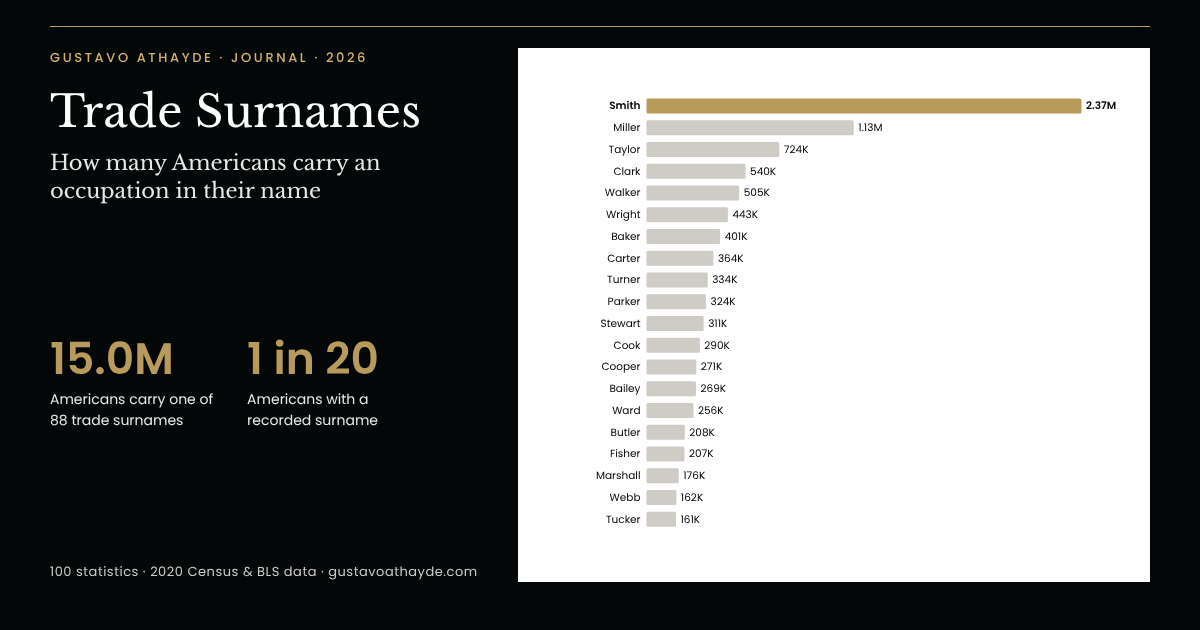
Trade surnames are everywhere in America. Our analysis of the 2020 Census finds that 88 of the nation’s 1,000 most common surnames began as the name of a trade or an office, and they are carried by 15,022,421 people, about 1 in 20 Americans. Smith, Miller and Taylor lead the list, yet the more surprising finding runs the other way: the country now has more carpenter jobs than Carpenters and more cook jobs than Cooks.
Below are 100 trade surnames statistics: our Trade Surname Index of all 88 names, the families of work they come from, their forms in other languages, a comparison with jobs in each trade today, and the history behind them.
At a glance
Key takeaways
- 15,022,421 Americans carry one of the 88 trade or office surnames in the 2020 Census top 1,000.
- About 1 in 20 Americans with a recorded last name has a trade surname.
- Smith leads with 2,369,644 bearers, 15.8% of the whole index.
- Miller is the only other trade name with more than a million bearers (1,129,186).
- Metal and the forge is the largest family of work, with 2.8 million bearers; cloth and clothing is second.
- 21 German trade names, such as Snyder, Wagner and Schmidt, are in the top 1,000.
- 7.2 carpenter jobs exist for every person named Carpenter, while Barber is nearly one-for-one.
- About 266 Smiths share the name for every job in the forging category that includes blacksmiths.
- Shah, the Gujarati merchant’s name, rose 160 places between 2010 and 2020, the fastest climb in the index.
The Trade Surname Index: every trade name in the top 1,000
Our index lists every surname among the 1,000 most common in the 2020 Census whose first origin, in the Dictionary of American Family Names, is a trade, a craft or an office. There are 88 of them, and together they are carried by 15,022,421 Americans.
The 20 largest trade surnames
SHARE THIS CHART
Copy the code below to embed this chart on your site:
Trade surnames statistics at a glance
- 1.
88 of the 1,000 most common surnames in the 2020 Census are occupational or office names, according to the Dictionary of American Family Names, and together they are carried by 15,022,421 Americans.
— Gustavo Athayde analysis of Census Bureau and DAFN data
- 2.
About 1 in 20 Americans with a recorded last name, or 5.0%, carries one of these 88 trade and office surnames, according to the 2020 Census.
— Gustavo Athayde analysis of Census Bureau and DAFN data
- 3.
12.7% of the people who carry one of the nation’s 1,000 most common surnames carry a trade or office name, in other words roughly one in eight in 2020.
— Gustavo Athayde analysis of Census Bureau and DAFN data
- 4.
Smith alone, moreover, accounts for 15.8% of all trade-surname bearers: its 2,369,644 holders in 2020 outnumber the 42 smallest names in the index combined.
— Gustavo Athayde analysis of Census Bureau and DAFN data
- 5.
The ten largest trade names, from Smith to Parker, cover 7,133,187 people, or 47.5% of the index in 2020.
— Gustavo Athayde analysis of Census Bureau and DAFN data
Where trade names rank
- 6.
Two of the ten most common surnames in America are trade names (Smith, 1st, and Miller, 7th); in addition, trade names hold 8 of the top 50 places, 15 of the top 100 and 60 of the top 500 in the 2020 Census.
— Gustavo Athayde analysis of Census Bureau and DAFN data
- 7.
Thirteen more surnames, among them Foster, Dean, Hoffman and Warner, have an occupational meaning as one of several origins; counting them as well would raise the 2020 total to 16,046,929.
— Gustavo Athayde analysis of Census Bureau and DAFN data
- 8.
Faulkner, the falconer’s name, is the last trade surname inside the 2020 top 1,000: it ranks 998th, with 34,330 bearers.
— Gustavo Athayde analysis of Census Bureau and DAFN data
- 9.
21 of the 88 names came to America from German, including Snyder, Wagner, Meyer, Schmidt and Zimmerman, and they were carried by 1,712,965 people in 2020.
— Gustavo Athayde analysis of Census Bureau and DAFN data
- 10.
Stewart, the estate steward’s name, is the most common of the household and estate office names, with 311,429 bearers in 2020, ahead of Bailey (269,092).
— Gustavo Athayde analysis of Census Bureau and DAFN data
The index, 1 to 22
# Surname U.S. rank, 2020 Bearers, 2020 Trade or office named U.S. rank, 2010 1 Smith 1 2,369,644 metalworker 1 2 Miller 7 1,129,186 miller 7 3 Taylor 17 723,758 tailor 17 4 Clark 28 539,661 clerk 27 5 Walker 32 504,833 fuller 31 6 Wright 37 443,210 craftsman 35 7 Baker 45 401,148 baker 44 8 Carter 50 364,355 carter 49 9 Turner 57 333,512 turner 54 10 Parker 58 323,880 park-keeper 56 11 Stewart 61 311,429 steward 61 12 Cook 66 290,386 cook 65 13 Cooper 72 271,453 cooper 70 14 Bailey 73 269,092 steward 72 15 Ward 79 255,767 watchman 79 16 Butler 112 208,167 wine steward 108 17 Fisher 115 206,799 fisherman 112 18 Marshall 142 175,713 farrier 139 19 Webb 158 162,492 weaver 152 20 Tucker 160 160,581 tucker 153 21 Porter 165 156,720 gatekeeper 159 22 Hunter 168 155,740 huntsman 160
The index, 23 to 44
# Surname U.S. rank, 2020 Bearers, 2020 Trade or office named U.S. rank, 2010 23 Mason 171 153,847 stonemason 166 24 Snyder 172 152,979 tailor 165 25 Hunt 173 152,764 hunter 169 26 Wagner 181 149,267 carter 173 27 Meyer 183 147,096 steward 183 28 Schmidt 193 142,290 blacksmith 185 29 Weaver 195 140,670 weaver 192 30 Gardner 202 137,379 gardener 194 31 Spencer 208 135,510 dispenser of provisions 199 32 Knight 212 132,682 retainer 209 33 Carpenter 247 124,364 carpenter 231 34 Chapman 249 122,597 merchant 236 35 Wheeler 254 119,866 wheelwright 243 36 Harper 255 119,191 harper 245 37 Weber 290 106,260 weaver 283 38 Fuller 293 105,864 fuller 281 39 Bowman 309 100,205 archer 296 40 Schultz 311 99,932 village headman 297 41 Fowler 312 99,260 bird catcher 299 42 Brewer 313 98,650 brewer 303 43 Schneider 320 97,428 tailor 312 44 Keller 329 94,168 cellarman 317
The index, 45 to 66
# Surname U.S. rank, 2020 Bearers, 2020 Trade or office named U.S. rank, 2010 45 Chambers 334 91,795 chamber official 326 46 Cohen 355 86,401 priest 351 47 Becker 367 84,525 baker 357 48 Barker 369 83,987 tanner 360 49 Zimmerman 382 82,459 carpenter 379 50 Fletcher 397 79,835 arrowsmith 382 51 Reeves 399 79,326 reeve 390 52 Page 400 79,314 young servant 383 53 Shah 413 76,855 merchant 573 54 Barber 430 75,161 barber 406 55 Chandler 440 73,879 candle maker 404 56 Fischer 460 70,511 fisherman 455 57 Webster 464 70,161 weaver 453 58 Potter 471 68,997 potter 457 59 Farmer 490 66,667 tax farmer 480 60 Sherman 493 66,346 shearman 469 61 Parsons 509 64,627 servant of a parson 498 62 Glover 512 64,341 glover 501 63 Tyler 528 62,380 tiler 509 64 Mueller 530 62,147 miller 523 65 Kramer 547 60,950 shopkeeper 526 66 Shepherd 552 59,896 shepherd 557
The index, 67 to 88
# Surname U.S. rank, 2020 Bearers, 2020 Trade or office named U.S. rank, 2010 67 Decker 597 55,000 roofer 597 68 Collier 604 54,282 charcoal burner 599 69 Skinner 637 51,876 skinner 627 70 Boyer 690 48,281 herdsman 676 71 Koch 703 47,453 cook 698 72 Baxter 712 47,095 baker 706 73 Sawyer 718 46,929 sawyer of wood 707 74 Tanner 728 46,437 tanner 709 75 Dyer 731 46,255 dyer of cloth 742 76 Sexton 831 40,756 sexton 804 77 Sellers 834 40,541 saddler 814 78 Knapp 847 39,888 servant 825 79 Schaefer 857 39,427 shepherd 841 80 Shepard 928 36,770 shepherd 882 81 Moyer 963 35,709 via Meyer 935 82 Booker 965 35,648 scholar 941 83 Krueger 968 35,568 maker 946 84 Sheppard 977 35,274 shepherd 938 85 Woodward 978 35,266 forester 944 86 Schmitt 988 34,747 blacksmith 967 87 Stuart 993 34,534 steward 951 88 Faulkner 998 34,330 falconer 952
Trade or office as given by the Dictionary of American Family Names (first origin listed). Ranks and counts from the Census Bureau’s 2020 and 2010 surname files.
Smith, Miller and Taylor: the great trade names
The village smith, the miller and the tailor gave America three of its most enduring family names. Moreover, the smith’s name hides inside dozens of others, from Goldsmith to Klingensmith.
Smith, the nation’s first name
- 11.
Smith has been the most common surname in the 2000, 2010 and 2020 Census lists: 2,376,206 bearers in 2000, 2,442,977 in 2010 and 2,369,644 in 2020.
— Gustavo Athayde analysis of Census Bureau and DAFN data
- 12.
About 1 in 126 Americans with a recorded surname is a Smith, or 792.8 per 100,000 people, in the 2020 Census.
— Gustavo Athayde analysis of Census Bureau and DAFN data
- 13.
Miller ranks 7th, with 1,129,186 bearers in 2020; in fact, it is the only trade surname other than Smith carried by more than one million Americans.
— Gustavo Athayde analysis of Census Bureau and DAFN data
- 14.
Taylor, the tailor’s name, is the third-largest trade surname, with 723,758 bearers, and it has held 17th place in both 2010 and 2020.
— Gustavo Athayde analysis of Census Bureau and DAFN data
- 15.
Clark, from the medieval clerk or scribe, is, meanwhile, the largest name from the world of letters, with 539,661 bearers in 2020.
— Gustavo Athayde analysis of Census Bureau and DAFN data
Since the first Census
- 16.
Four of the 15 most common surnames of 1790 were trade names (Smith, Miller, Taylor and Clark); by 2020, Smith (1st) and Miller (7th) were still in the top 15.
- 17.
Eight of the 15 most common surnames of 1790 were still in the 2020 top 15, despite a more than 84-fold increase in the population.
- 18.
The top five last names (Smith, Johnson, Williams, Brown and Jones) were the same in the 2000, 2010 and 2020 Censuses.
Smiths, wrights and makers
- 19.
71 different surnames end in “smith” in the 2020 file, including Goldsmith (15,580), Highsmith (4,147) and Klingensmith (3,089); together with Smith they are carried by 2,422,268 people.
— Gustavo Athayde analysis of Census Bureau and DAFN data
- 20.
24 surnames end in “wright,” the medieval word for a maker, and they were carried by 485,949 people in 2020; besides Wright, they include Cartwright (21,099), Boatwright (6,831) and Wainwright (6,593).
— Gustavo Athayde analysis of Census Bureau and DAFN data
- 21.
51 surnames end in “maker” in the 2020 file, led by Shoemaker with 29,407 bearers, while Shumaker and Schoonmaker follow with 8,009 and 2,621.
— Gustavo Athayde analysis of Census Bureau and DAFN data
Trade surnames by family of work
Grouped by the work they describe, the 88 names read like the roll of a medieval town: forge and mill, loom and tannery, field and household.
Nine families of work
The largest families
- 22.
Metal and the forge is the largest family of trade names in 2020, with 2,802,229 bearers across 5 names, thanks above all to Smith.
— Gustavo Athayde analysis of Census Bureau and DAFN data
- 23.
Cloth and clothing ranks second, with 2,401,968 bearers in 2020 in 13 names, from Taylor and Walker to Glover and Dyer.
— Gustavo Athayde analysis of Census Bureau and DAFN data
- 24.
The mill, bakehouse and kitchen account for 2,254,758 bearers (2020), led by Miller, Baker and Cook.
— Gustavo Athayde analysis of Census Bureau and DAFN data
- 25.
Household and estate offices such as steward, bailiff, butler and page also account for 2,020,446 bearers in 15 names in 2020.
— Gustavo Athayde analysis of Census Bureau and DAFN data
- 26.
Wood, stone and building names (Wright, Turner, Cooper, Mason and Carpenter among them) are carried by 1,693,020 people, according to the 2020 Census.
— Gustavo Athayde analysis of Census Bureau and DAFN data
Fields, markets and the church
- 27.
Field, flock and forest has, by contrast, the most names of any family in 2020, 16, from Parker and Fisher to Shepherd and Woodward, with 1,556,526 bearers.
— Gustavo Athayde analysis of Census Bureau and DAFN data
- 28.
Carts, trade and markets (Carter, Porter, Wagner, Chapman, Chandler, Potter and others) account for 1,109,188 bearers in 2020.
— Gustavo Athayde analysis of Census Bureau and DAFN data
- 29.
Church, letters and service names, among them Clark, Harper, Barber and Cohen, are carried by 961,445 people, also as of 2020.
— Gustavo Athayde analysis of Census Bureau and DAFN data
- 30.
Hides and leather is the smallest family, however: in 2020, Tanner, Skinner, Barker and Sellers share 222,841 bearers.
— Gustavo Athayde analysis of Census Bureau and DAFN data
One trade, many names
- 31.
One trade, three names: the medieval fuller survives as Walker, Fuller and Tucker, which together were carried by 771,278 Americans in 2020.
— Gustavo Athayde analysis of Census Bureau and DAFN data
- 32.
The weaver lives on in four names, Weaver, Webb, Webster and Weber, which together were carried by 479,583 people in 2020.
— Gustavo Athayde analysis of Census Bureau and DAFN data
- 33.
Farmer, carried by 66,667 Americans in 2020, first named a collector of taxes and revenues, a “farmer” of rents, and only later a tenant who worked the land.
- 34.
Marshall began as the farrier who shod horses before it became a title of high office; 175,713 Americans carried it in 2020.
What this means for families. A trade surname is a small piece of heraldry already: it names what an ancestor made or kept. A family crest or a custom coat of arms can carry that story in an emblem, much as the old guild arms carried the hammer, the wheat sheaf or the shears.
One trade, many languages
Immigrants brought their own trade names to America, and many of them kept those names, while others translated them. As a result, the same craft often survives in several spellings.
Trade families across languages
The smith in every language
- 35.
The smith’s family across languages (English Smith, German Schmidt and Schmitt, Italian Ferraro and Ferrari, French Lefebvre and Lefevre, Hungarian Kovacs) numbered 2,586,898 Americans in 2020.
— Gustavo Athayde analysis of Census Bureau and DAFN data
- 36.
Schmidt, the German smith, ranks 193rd in America, with 142,290 bearers, while its southern German spelling Schmitt adds 34,747 (2020).
— Gustavo Athayde analysis of Census Bureau and DAFN data
- 37.
Miller and Mueller together were carried by 1,191,333 people in 2020; besides, the Dictionary of American Family Names notes that Miller also absorbed many German Müllers.
— Gustavo Athayde analysis of Census Bureau and DAFN data
- 38.
Taylor, Snyder and Schneider, the tailor’s name in English and German, were carried by 974,165 Americans in 2020, since Snyder is an Americanized form of Schneider.
— Gustavo Athayde analysis of Census Bureau and DAFN data
From German to Gujarati
- 39.
Baker, Becker and Baxter, three words for the baker, were likewise carried by 532,768 people in 2020.
— Gustavo Athayde analysis of Census Bureau and DAFN data
- 40.
Zimmerman, the German carpenter, adds 82,459 bearers to the 124,364 Carpenters, for 206,823 in all in 2020.
— Gustavo Athayde analysis of Census Bureau and DAFN data
- 41.
Shah, from the Gujarati word for merchant, is the fastest-rising trade name in the index: it climbed from 573rd place in 2010 to 413th in 2020, with 76,855 bearers.
— Gustavo Athayde analysis of Census Bureau and DAFN data
- 42.
Herrera and Molina recall the forge and the mill, but the Dictionary of American Family Names classes them as place names; so, despite 186,848 and 97,649 bearers in 2020, they sit outside our index.
— Gustavo Athayde analysis of Census Bureau and DAFN data
Trade names abroad
- 43.
Kowalski, Poland’s second most common surname, is held by 69,240 women and 68,061 men as Kowalska and Kowalski; Nowak is first, with 203,120 (2021).
- 44.
Four of the ten most common surnames in the Netherlands were trade or office names in 2003 (Bakker, Visser, Smit and Meijer), according to the Meertens Instituut; this is the latest ranking we found.
- 45.
Smith had more than 400,000 bearers in Britain in 1881 and about 500,000 in 2016, according to the Oxford Dictionary of Family Names project.
— ITV News
Then and now: the name and the trade today
Some trades have outgrown the surnames they left behind, while others have shrunk. Our comparison sets each surname from the 2020 Census beside the nearest modern federal job category in 2025.
Surnames and jobs
Trades that outgrew the name
- 46.
America has 7.2 carpenter jobs for every person named Carpenter: 889,700 carpenter jobs in 2025, compared with 124,364 Carpenters in the 2020 Census.
— Gustavo Athayde analysis of Census Bureau and BLS data
- 47.
There are more Bakers than bakers: 401,148 people carry the surname, about 1.5 for each of the nation’s 262,400 baker jobs in 2025.
— Gustavo Athayde analysis of Census Bureau and BLS data
- 48.
Barber is nearly one-for-one: 75,161 Americans are named Barber, and the nation counted 75,800 barber jobs in 2025.
— Gustavo Athayde analysis of Census Bureau and BLS data
- 49.
Sawyer comes close as well: 46,929 Sawyers, compared with 41,200 wood sawing machine operator jobs in 2025.
— Gustavo Athayde analysis of Census Bureau and BLS data
- 50.
About 266 Smiths share the name for every forging machine job, the federal category that lists blacksmith among its titles (8,900 jobs in 2025).
— Gustavo Athayde analysis of Census Bureau and BLS data
- 51.
About 42 Millers share the name for each job in the federal category that lists miller among its titles (26,600 jobs in 2025).
— Gustavo Athayde analysis of Census Bureau and BLS data
Names that outlived the trade
- 52.
About 22 Taylors share the name for each of the nation’s 33,200 tailor, dressmaker and custom sewer jobs (2025).
— Gustavo Athayde analysis of Census Bureau and BLS data
- 53.
The kitchen has outgrown the name: the nation counted 2,705,800 cook jobs in 2025, about 9 for every person named Cook.
— Gustavo Athayde analysis of Census Bureau and BLS data
- 54.
The carter’s successor, the truck driver, held 2,221,200 jobs in 2025, about 6 for every American named Carter.
— Gustavo Athayde analysis of Census Bureau and BLS data
- 55.
Landscaping and groundskeeping workers held 1,188,600 jobs in 2025, compared with 137,379 people named Gardner.
— Gustavo Athayde analysis of Census Bureau and BLS data
- 56.
There are about 12 farmer and rancher jobs for every person named Farmer: 788,700 jobs in 2025 against 66,667 Farmers.
— Gustavo Athayde analysis of Census Bureau and BLS data
- 57.
Masonry workers held 277,700 jobs in 2025, compared with 153,847 people named Mason.
— Gustavo Athayde analysis of Census Bureau and BLS data
- 58.
About 10 Weavers share the name for each of the nation’s 13,900 textile weaving and knitting machine jobs (2025).
— Gustavo Athayde analysis of Census Bureau and BLS data
Surnames and jobs, side by side
Surname Bearers, 2020 Nearest modern federal category Jobs, 2025 Jobs per bearer Farmer 66,667 Farmer and rancher 788,700 11.83 Cook 290,386 Cook 2,705,800 9.32 Gardner 137,379 Landscaping worker 1,188,600 8.65 Carpenter 124,364 Carpenter 889,700 7.15 Carter 364,355 Heavy truck driver 2,221,200 6.10 Mason 153,847 Masonry worker 277,700 1.81 Barber 75,161 Barber 75,800 1.01 Sawyer 46,929 Wood sawing machine operator 41,200 0.88 Baker 401,148 Baker 262,400 0.65 Weaver 140,670 Textile weaving machine operator 13,900 0.10 Taylor 723,758 Tailor and dressmaker 33,200 0.05 Miller 1,129,186 Crushing and grinding machine operator 26,600 0.02 Smith 2,369,644 Forging machine setter 8,900 0.00
Jobs from the BLS Employment Projections program (Occupational Outlook Handbook or O*NET), 2025, including self-employed workers. The categories are the nearest modern equivalents, not the same medieval trades.
What this means for craftsmen. More Americans work as carpenters today than carry the name. For a workshop or a family firm, a brand monogram can honor the trade behind the name with the restraint of an old maker’s mark.
Rising and falling trade surnames, 2000–2020
Trade names have held their ground in absolute numbers, but America’s surnames have grown more varied. Consequently, the classic English trade names now make up a slightly smaller share of the whole.
Who climbed and who slipped
Trade names since 2010
- 59.
78 of the 88 trade names slipped in the national ranking between 2010 and 2020, while 7 held their place (among them Smith, Miller, Taylor and Stewart) and 3 rose: Shah, Shepherd and Dyer.
— Gustavo Athayde analysis of Census Bureau and DAFN data
- 60.
13.8% in 2000, 12.9% in 2010, 12.7% in 2020: the share of top-1,000 surname bearers who carry one of the 88 names has edged down while the nation’s surnames have grown more varied.
— Gustavo Athayde analysis of Census Bureau and DAFN data
A more varied nation
- 61.
258 last names were needed to cover one-quarter of the U.S. population in 2020, compared with 239 in 2010.
- 62.
The ten most common last names accounted for 4.7% of the population in 2020, compared with 4.9% in 2010.
- 63.
7.8 million different last names were reported in the 2020 Census after editing, from about 9.4 million unique entries before editing.
- 64.
98% of last names, more than 7 million, were reported fewer than 100 times in 2020.
- 65.
More than 156,000 last names occurred 100 or more times in the 2020 Census and are published in the Bureau’s public file.
- 66.
About 299 million people had a last name recorded in the 2020 Census, or 90.2% of the enumerated population.
- 67.
Rodriguez was the only one of the 15 most common last names to change place between 2010 and 2020, moving up to 8th.
The skilled trades today
The trades behind the surnames are very much alive. Federal data show millions of Americans in construction, production and craft work, and they also show strong demand for new hands.
Pay and openings
- 68.
$60,580 was the median pay of a carpenter in May 2025, above the $50,980 median for all occupations.
— BLS
- 69.
About 62,800 openings for carpenters are projected each year over the decade to 2035 (projection).
— BLS
- 70.
Baker employment is projected to grow 6% between 2025 and 2035, faster than average, with about 36,500 openings a year (projection).
— BLS
- 71.
7,492,900 jobs were in construction and extraction occupations in 2025, with a median wage of $59,540.
— BLS
The modern craftsmen
- 72.
8,780,500 jobs were in production occupations in 2025, the broad federal group that includes bakers, machinists, tailors and woodworkers.
— BLS
- 73.
Plumbers, pipefitters and steamfitters held 510,600 jobs in 2025, with a median pay of $63,800.
— BLS
- 74.
Welders, cutters, solderers and brazers, the modern metalworkers, held 437,700 jobs in 2025, with a median pay of $53,750.
— BLS
- 75.
Roofers, the successors of the thatcher and the tiler, held 166,900 jobs in 2025, with a median pay of $55,440.
— BLS
- 76.
Jewelers and precious stone and metal workers held 32,800 jobs in 2025, with a median pay of $52,540.
— BLS
Demand for skilled workers
- 77.
1,178,000 people were employed as carpenters in 2025, by the count of the household survey, which also tallies self-employed and part-time workers.
— BLS
- 78.
Two-thirds (67%) of farmers, ranchers and agricultural managers were self-employed in 2025, the highest share of any occupation in this article.
— BLS
- 79.
349,000 net new workers must join the construction industry in 2026, and 456,000 new workers in 2027, to meet demand, Associated Builders and Contractors estimates (projection).
- 80.
Up to 3.8 million new manufacturing workers could be needed between 2024 and 2033, and 1.9 million of those jobs could go unfilled (projection).
- 81.
29% of small-business owners had openings for skilled workers in April 2026.
— NFIB
Enterprise and apprenticeship
- 82.
Enrollment at vocational-focused public two-year colleges grew almost 20% between spring 2020 and spring 2025, to 871,000 students.
- 83.
70% of Americans had a great deal or quite a lot of confidence in small business in 2025, compared with 15% for big business (June 2025, 1,402 adults).
— Gallup
- 84.
27.3% of U.S. employer firms were family-owned in 2021, and family businesses accounted for 34.1% of employment.
- 85.
One million new active apprentices is the goal set by Executive Order 14278 of April 2025, on skilled trade jobs.
What this means for the next generation. The family trade can still be the family business. Our guide to the signet design shows how a single mark, worn or pressed in wax, has long served as a craftsman’s signature.
Where trade surnames came from
Most English trade surnames were fixed between the 12th and 15th centuries, when a man’s work was the plainest way to tell him from his neighbor. Labor Day, meanwhile, was born among carpenters and machinists.
Medieval origins
- 86.
Before 1066, almost everyone in England had only a single given name.
- 87.
Hereditary surnames were adopted in England mainly between the late 12th and the 15th centuries, and by the end of the 14th century they were the norm in most of southern and midland England, that is, by 1400.
- 88.
45,600 family names, the most frequent in Britain and Ireland, are explained in the Oxford Dictionary of Family Names, published in 2016 after a four-year study.
- 89.
About 8% of the main entries in the Oxford Dictionary of Family Names in Britain and Ireland are occupational or status names, such as Tanner, Webster and Franklin (2016); the figure counts names, not bearers.
— ITV News
Immigrants and their names
- 90.
Passenger lists were not created at Ellis Island: they were drawn up abroad when the immigrant bought a ticket, so the familiar story of names changed on arrival does not hold; naturalization procedures have required documentation of name changes only since 1906.
- 91.
The first Labor Day, by contrast, was celebrated on Tuesday, September 5, 1882, in New York City.
Labor Day and the trades
- 92.
A carpenter and a machinist are credited with founding Labor Day: Peter J. McGuire of the Brotherhood of Carpenters and Joiners, or, as many believe, machinist Matthew Maguire, in 1882.
- 93.
On June 28, 1894, Congress made the first Monday in September a legal holiday; by then, 23 more states had adopted it, following Oregon’s first law in 1887.
Family history and the meaning of a name
Interest in ancestry keeps growing, and a surname is usually the first clue. In fact, record collections now run into the tens of billions.
Records and family trees
- 94.
More than 70 billion records and over 3.8 million subscribers, Ancestry reported for 2025; its DNA network reached over 29 million people.
— Ancestry
- 95.
Over 4 billion new records were added to Ancestry’s collections in 2025 alone.
— Ancestry
- 96.
More than 163 million people were added in 2025 to the FamilySearch family tree, which FamilySearch calls the world’s largest online family tree.
- 97.
More than 297 million visits were made to the FamilySearch website in 2025.
- 98.
21% of Americans had taken a DNA test in 2025, and 59% of those who have taken or would take one cite ancestry and heritage as the reason (1,164 U.S. adult citizens).
— YouGov
- 99.
31% of Americans said in 2025 that they would like to know a great deal about their family’s ancestry or heritage.
— YouGov
- 100.
69% of married women say their current last name is the one they took at marriage (YouGov, April 2025, 1,162 U.S. adult citizens).
— YouGov
What this means for heirlooms. A name that once described a day’s work now describes a family. A custom wax seal or a bespoke monogram turns that name into something to keep and pass down.
Methodology
Our index starts from the Census Bureau’s 2020 file of 156,621 last names reported at least 100 times (Names2020_LastNames_RaceHispanic.xlsx, released in April 2026); we used only the counts and ranks. Each of the 1,000 most common names that could plausibly carry an occupational meaning was checked against its entry in the Dictionary of American Family Names (Patrick Hanks, Oxford University Press), as reproduced on FamilySearch.
How we classified the names
A name entered the index only when the first origin the dictionary gives is a trade, a craft, an office or a role of service; names with an occupational meaning only as a secondary origin (13 of them) are mentioned but not counted, and place names such as Herrera and Molina are excluded. Names in the top 1,000 that we did not check are treated as non-occupational, so the totals are a floor rather than a ceiling.
Shares use the Census figure of 298,898,231 people with a recorded last name. Comparisons with 2010 and 2000 use the earlier Census surname files; because 2020 coverage was slightly lower and the 2020 data include privacy noise, we compare ranks and shares rather than raw counts. Job figures come from the BLS Employment Projections program for 2025 and refer to the nearest modern federal category; all comparisons are descriptive.
About the author

Gustavo Athayde — Founder & Creative Director, GUSTAVO ATHAYDE
Gustavo Athayde is the founder and creative director of GUSTAVO ATHAYDE, a bespoke monogram atelier based in Sioux Falls, South Dakota. A graphic designer by training, he creates monograms, personal and family crests, heraldic emblems, signet designs and wax seals for individuals, families, couples and brands across the United States. Every commission is refined line by line into a symbol meant to be kept, used and passed down.
Follow the atelier on Instagram · Request a private consultation
Frequently asked questions
- How many Americans have a trade surname?
- At least 15,022,421, or about 1 in 20 people with a recorded last name, carry one of the 88 trade or office surnames in the 2020 Census top 1,000.
- What is the most common occupational surname in America?
- Smith, the name of the metalworker, with 2,369,644 bearers in the 2020 Census. Miller is second and Taylor third.
- What does the surname Walker mean?
- It is an occupational name for a fuller, who cleaned and thickened cloth by treading it; Tucker and Fuller name the same trade.
More about trade surnames
- Are there more people named Carpenter or working carpenters?
- Working carpenters, by far: BLS counted 889,700 carpenter jobs in 2025, while 124,364 people carried the surname in 2020.
- Were immigrant names changed at Ellis Island?
- No. According to the USCIS History Office, passenger lists were drawn up abroad, and immigrants who changed their names usually did so themselves within a few years of arrival.
- Is Stewart a trade name?
- Yes, in the sense of an office: Stewart began as the title of the steward who ran an estate, and it is the most common household and estate office name in America.
Cite this page
Source: Gustavo Athayde, "Trade Surnames: How Many Americans Carry an Occupation in Their Name", https://gustavoathayde.com/trade-surnames/Feel free to use these statistics and charts — we just ask for a link back to this page.
Sources
- Bakers, Occupational Outlook Handbook (Bureau of Labor Statistics)
- Barbers, Hairstylists, and Cosmetologists, Occupational Outlook Handbook (Bureau of Labor Statistics)
- Carpenters, Occupational Outlook Handbook (Bureau of Labor Statistics)
- Characteristics of family-owned businesses, fact sheet (SBA Office of Advocacy, 2024)
- Confidence in Institutions, 2025 topline (Gallup)
- Construction workforce shortage (Associated Builders and Contractors, 2026)
- Cooks, Occupational Outlook Handbook (Bureau of Labor Statistics)
- Crushing, Grinding, and Polishing Machine Setters, Operators, and Tenders, 51-9021.00 (O*NET OnLine)
- De frequentste achternamen, citing the Meertens Instituut (Onze Taal)
- Dictionary of American Family Names (Hanks, Oxford University Press), surname entries via FamilySearch
- Employment Projections: employment by major occupational group, 2025 and projected 2035 (Bureau of Labor Statistics)
- Executive Order 14278: Preparing Americans for High-Paying Skilled Trade Jobs of the Future (2025)
- FamilySearch 2025 genealogy highlights (FamilySearch Newsroom)
- Farmer, surname entry, Dictionary of American Family Names (via FamilySearch)
- Farmers, Ranchers, and Other Agricultural Managers, Occupational Outlook Handbook (Bureau of Labor Statistics)
Census and name references
- For Generations to Come: Ancestry publishes 2025 Impact Report (Ancestry, 2026)
- Forging Machine Setters, Operators, and Tenders, 51-4022.00 (O*NET OnLine)
- Frequently Occurring First and Last Names in the 2020 Census, C2020BR-14 (U.S. Census Bureau, 2026)
- Frequently Occurring Last Names in the 2020 Census, Names2020_LastNames_RaceHispanic.xlsx (U.S. Census Bureau, 2026)
- Grounds Maintenance Workers, Occupational Outlook Handbook (Bureau of Labor Statistics)
- Heavy and Tractor-trailer Truck Drivers, Occupational Outlook Handbook (Bureau of Labor Statistics)
- History of Labor Day (U.S. Department of Labor)
- Immigrant name changes (USCIS History and Genealogy)
- Introducing family names (surnames) in Britain and Ireland (SNSBI)
- Jewelers and Precious Stone and Metal Workers, Occupational Outlook Handbook (Bureau of Labor Statistics)
- Labor Force Statistics from the Current Population Survey, Table 11, 2025 annual averages (Bureau of Labor Statistics)
- Manufacturers need as many as 3.8 million new employees by 2033 (The Manufacturing Institute and Deloitte, 2024)
- Marshall, surname entry, Dictionary of American Family Names (via FamilySearch)
- Masonry Workers, Occupational Outlook Handbook (Bureau of Labor Statistics)
- Most common last names, 1790 and 2020: Then and Now (U.S. Census Bureau, 2026)
Labor and trades sources
- Most common surnames in Britain and Ireland revealed (ITV News, 2016)
- Most married women change their last name after the wedding (YouGov, 2025)
- NFIB Jobs Report, May 2026 (National Federation of Independent Business)
- Nowak znowu pierwszy (Ministry of Digital Affairs, Poland, 2021)
- Plumbers, Pipefitters, and Steamfitters, Occupational Outlook Handbook (Bureau of Labor Statistics)
- Roofers, Occupational Outlook Handbook (Bureau of Labor Statistics)
- Tailors, Dressmakers, and Custom Sewers, 51-6052.00 (O*NET OnLine)
- Textile Knitting and Weaving Machine Setters, Operators, and Tenders, 51-6063.00 (O*NET OnLine)
- UK's largest ever study reveals origins of 45,600 surnames (UWE Bristol, 2016)
- Vocational-focused public two-years lead enrollment rise (National Student Clearinghouse Research Center, 2025)
- Welders, Cutters, Solderers, and Brazers, Occupational Outlook Handbook (Bureau of Labor Statistics)
- What Americans think about home DNA tests (YouGov, 2025)
- What's in a name? 2020 Census names data (U.S. Census Bureau, America Counts, 2026)
- Woodworkers, Occupational Outlook Handbook (Bureau of Labor Statistics)