
Bespoke Family Crests, Designed to Outlast a Name
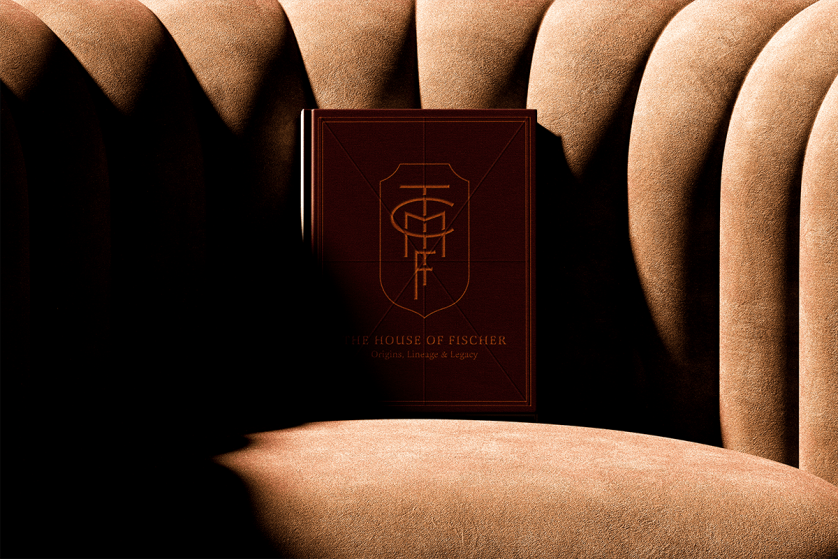
The Art of Monograms · GUSTAVO ATHAYDE Atelier
The Luxury Family Crest: An Heirloom Drawn in Line and Proportion
A surname is inherited without any ceremony at all.
A luxury family crest is the ceremony a surname never received.
It takes what a family already carries and gives that weight a permanent visual form.
This publication considers what that undertaking actually requires.
The Art of Monograms
What a Luxury Family Crest Actually Is
Every family already possesses a story worth telling in more than words.
A luxury family crest exists to give that story a form that survives the people who first told it.
It is not an ordinary monogram enlarged for the occasion of a family rather than a person.
Nor is it a costume borrowed from a lineage no one in the family can actually document.
It occupies a considered middle register, built from documented history and disciplined design.
The word luxury, applied honestly, describes restraint rather than ornament in this context.
A crest crowded with unearned charges and unnecessary flourish is not luxurious; it is merely loud.
A luxury family crest says less, with greater confidence, than a decorated one ever could.
This distinction separates a mark built to endure from one built only to impress on delivery day.
I am asked, more often than any other question, what actually separates a family crest from a monogram.
The honest answer begins with scope rather than with decoration.
A personal monogram speaks for one bearer, however elegantly it is composed.
A luxury family crest speaks for a household across every generation that will ever carry the name.
That difference in scope changes nearly every decision made once a commission begins.
A mark meant for one lifetime can afford a certain intimacy in its detail.
A mark meant to outlive its commissioner cannot; it must be legible to people not yet born.
This is precisely the discipline heraldry perfected centuries before graphic design existed as a formal practice. A related hybrid form, built for a single bearer rather than a household, follows a version of this same discipline.
A shield had to be understood at a glance, often under circumstances where confusion carried real consequence.
A luxury family crest inherits that same discipline, even though the stakes today are entirely different.
It borrows the logic of instant, dignified recognition and applies it to a household rather than a battlefield.
No family commissioning this work is entitled to a coat of arms in the formal, granted sense.
Few actually want one, once the distinction between formal heraldry and private commission is properly explained.
What most families want instead is a mark with equivalent gravity, built honestly from their own history.
A luxury family crest invented from nothing carries no false claim to a lineage it does not possess.
It simply borrows the visual grammar of permanence and directs that grammar toward a family’s own future.
In this sense, every luxury family crest is new, even when its logic draws on centuries of precedent.
The oldest personal marks were never decorative in their first intended use.
They identified a bearer at a distance, in circumstances where confusion carried genuine consequence.
That discipline of instant recognition has not left the craft, even though the battlefield has long since disappeared.
Today the mark is read on a gate, a piece of silver, or a formal document, rather than a shield.
The distance has shrunk considerably, but the requirement for immediate recognition has not changed at all.
A luxury family crest that requires explanation has already failed at its primary task.
The best marks are understood before they are ever formally analyzed by the person encountering them.
A well-composed family crest becomes shorthand for an entire household, rather than a mere decoration.
It replaces a great deal of explanation with a single, considered symbol placed exactly where it belongs.
This is a more efficient form of communication than most families realize when they first begin the process.
Clients new to bespoke identity design often ask which register their own family history actually warrants.
A modest, well-documented history rarely calls for an elaborate composition, and the atelier says so plainly.
An eventful, layered history can support more complexity, though never more than the story itself justifies.
This honesty at the outset prevents a family from commissioning a mark that overstates its own history.
It also prevents the opposite failure, a mark too timid to carry the weight a family’s story actually deserves.
Calibrating this balance correctly is, in many respects, the single hardest judgment the atelier makes on any commission.
Legacy & Family Heritage
The Family Device Through History
Ancient World
The Struck Seal
Rulers and city-states pressed personal marks into coin and clay as instruments of trusted recognition.
Medieval Europe
The Family Shield
Households formalized visual identity under heraldic law, distinguishing one lineage from another across a crowded field.
Renaissance
The Merchant Dynasty
Trading families adopted crests and marks to authenticate agreements and goods across unfamiliar territories.
17th–18th Century
Formal Convention
Tincture, charge, and proportion were codified across the courts and households of Europe.
19th Century
The Domestic Fixture
The family crest became a fixture of silver, gates, and stationery throughout refined domestic life.
Present Day
The Commissioned Heirloom
A luxury family crest continues as a deliberate, private expression of a household’s documented story.
Legacy & Family Heritage
Where the Tradition Begins
Every family symbol began as a practical answer to a practical problem.
A household needed a way to mark its property, its correspondence, and its word in a world without photographs.
The earliest family marks were carved into stone, pressed into wax, or engraved directly onto a signet ring.
A single symbol served as proof of identity when few people encountered could read an entire document.
Scholars of European heraldry trace the earliest family devices to manuscript margins and carved lintels alike.
Those marks were never incidental additions; they were the household’s signature before signatures existed as we know them.
A luxury family crest today descends from that same instinct, refined across centuries into a considered discipline.
It was never meant to explain itself to a stranger encountering it for the first time.
It was meant to be recognized the way a face is recognized, before a single word is spoken.
That instinct has not weakened in the centuries since it first appeared on a household’s sealed correspondence.
The formal grammar of heraldry, developed to prevent one family’s mark from being confused with another’s, still governs serious work in this field.
On the Word Luxury
Applied to a family crest, luxury means restraint earned through discipline, never ornament added for its own sake.
Independent scholarship devoted to the preservation of that grammar, documented and studied at length by dedicated societies, continues to record its rules with real precision.
On Formal Heraldry
A private commission borrows the grammar of formal heraldry without ever claiming its legal authority.
That record remains a valuable reference for any atelier committed to historical accuracy rather than invented tradition.
It is easy to design a crest that merely looks attractive to a passing eye.
It is considerably more difficult to design one that honors the grammar it has inherited from that record.
This is the difference between a luxury family crest that feels timeless and one that feels merely fashionable.
The former draws on centuries of established, documented convention.
The latter draws only on the preferences of the present moment, which rarely age particularly well.
A well-trained eye can often identify a crest’s era simply by how loosely it follows heraldic grammar.
The most enduring designs tend to sit closer to the disciplined end of that particular spectrum.
On Recognition
A luxury family crest is built to be understood in a single glance, the way a face is recognized before a word is spoken.
This does not mean a contemporary family crest cannot feel genuinely fresh to the family commissioning it.
It means that any freshness must be achieved within the grammar, through proportion, rather than by abandoning it outright.
A crest that ignores this grammar entirely rarely reads as innovative; more often, it simply reads as unfinished.
This is precisely why the atelier studies the original grammar closely enough to use it correctly.
A family that understands this history tends to make better decisions during their own commission.
Knowing the rules, in other words, is what makes departing from them thoughtfully possible in the first place.
This grammar traveled well beyond the British Isles, adopted with regional variation across the European continent.
Households in Scandinavia, the Iberian peninsula, and the German states each developed their own dialect of the same discipline.
What remained constant across every regional variation was the underlying seriousness of the exercise itself.
A crest was never treated as casual decoration in any of these traditions, regardless of the household’s actual rank.
It was treated as a record, and records were expected to be accurate, consistent, and built to outlast their authors.
American families who commission a luxury family crest often arrive with a different history than their European counterparts.
Rather than inheriting a device across many centuries, many households are establishing one for the first time.
This absence of an inherited starting point is not a limitation; it is, in many respects, a rare freedom.
Royal Traditions
Royal Precedent for the Luxury Family Crest
No institution in European history applied the family device with more discipline than the royal houses of the continent.
A monarch’s arms, quartered and amended across generations, served as a visual record of marriage, conquest, and inheritance at once.
It appeared on state documents, on regimental colors, and on gates few outside the household were ever permitted to approach.
The royal device was never intended as ornament alone, however elaborate its final and considered rendering.
It functioned as an instrument of continuity, recognizable across an entire kingdom without a single word of explanation.
The institution long responsible for regulating English heraldic identity has preserved centuries of precedent on how such a mark should be composed to convey legitimacy rather than passing preference.
A royal collection documenting centuries of ceremonial regalia offers extraordinary detail on how proportion, tincture, and hierarchy were governed at the highest level of craft.
What is striking about these historical marks is how rarely they relied on excess to communicate belonging.
Grandeur, in the finest surviving examples, was achieved through proportion rather than through accumulation of detail.
The devices found on royal linens, porcelain, and stationery followed strict conventions of scale, weight, and placement.
Those conventions were never arbitrary, however decorative they might appear to an untrained eye today.
They ensured a family’s mark remained legible and dignified whether viewed on a ring seal or across a ceremonial gate.
A luxury family crest drawing on this tradition inherits more than a passing aesthetic preference.
The finest family marks were never designed to be impressive. They were designed to be correct.
It inherits a discipline: the understanding that a family mark must be built to last, never simply to please.
This is the same discipline applied to every commission developed within this atelier, regardless of the materials it will inhabit.
A royal arms was never designed for a single audience alone, however private its most intimate applications.
It had to remain dignified whether examined closely on a document or observed from a distance across a facade.
That dual requirement, intimacy and grandeur achieved through the same restrained form, remains the central challenge today.
A private family rarely requires anything so elaborate as a full royal achievement, but the underlying discipline still applies in full.
Every element included in a luxury family crest should still be able to justify its own presence within the composition.
Royal households also demonstrated remarkable restraint in their use of color and material across an entire reign.
A small, fixed palette, used consistently, reads as considerably more authoritative than a wide and varied one ever could.
This is a lesson the atelier applies directly to every family commission it undertakes, regardless of scale or occasion.
A family willing to apply this same discipline at a private scale inherits an authority no advertising expenditure could purchase.
This is the argument, at its core, for commissioning a luxury family crest rather than assembling one from a template.
A well-composed family device becomes shorthand for an entire household, rather than a mere decoration on a document.
Royal households also understood the family device as a tool of continuity across successive generations.
A family’s core arrangement might persist even as individual heirs added or amended small details to mark their own era.
This layered approach to identity, honoring the past while making room for the present, offers a useful model for families today.
A luxury family crest commissioned for a contemporary household can draw on ancestral elements while still reflecting its living members.
The result is a mark that feels inherited rather than invented, even when it is entirely new.
Working within this tradition requires genuine study, not merely aesthetic borrowing from images encountered online.
The atelier encourages every family drawn to this register to spend time with primary visual sources before a single decision is made.
The nuances of historical composition reward close looking in a way that photographs alone rarely capture.
Royal heraldry also demonstrates the enduring value of a limited, disciplined visual vocabulary.
Certain forms, colors, and arrangements were reserved for specific ranks and purposes across the court.
This scarcity is precisely what gave those marks their enduring authority across so many centuries.
A luxury family crest benefits from a similar discipline, even without formal rank standing behind it.
Restricting the visual vocabulary of a crest often strengthens rather than limits its overall impact.
There is a lesson here for any family tempted to add just one more decorative flourish to the design.
The strongest historical marks nearly always resisted that particular temptation, whatever the era in question.
Their makers understood that restraint, not addition, was the harder and more valuable skill to practice consistently.
A household considering the fuller heraldic register often arrives at this same underlying question first.
What, precisely, does a family’s name deserve to carry once it finally receives the attention it has long warranted.
The answer is rarely obvious at the first conversation, and the atelier does not pretend otherwise.
It tends to emerge gradually, through careful listening rather than through a single decisive insight.
This is precisely why the first conversation is treated as consultation rather than as a mere intake form.
A family that feels rushed through this stage rarely arrives at a crest they trust completely.
The Atelier Journal
Crest, Monogram, or Both: Choosing the Right Mark
Three Related Marks, Compared
| Consideration | Luxury Family Crest | Classic Monogram | Crest Monogram |
|---|---|---|---|
| Represents | An entire household across generations | A single individual | One bearer, elevated by a chosen charge |
| Origin | Formal heraldic grammar, privately applied | Centuries of typographic proportion | A hybrid of letter and symbol |
| Typical Use | Architecture, formal documents, heirlooms | Correspondence, luggage, daily accessories | Signet rings, formal stationery |
| Longevity | Designed to remain legible for generations | Designed to remain legible for a lifetime | Designed for decades of formal use |
| Exclusivity | Singular to one house | Singular once personalized | Singular to one bearer |
Luxury Identity
Personalization as a Luxury Discipline
Luxury has often been mistaken for abundance, and that mistake shapes a great deal of ordinary design.
In truth, the most enduring luxury communicates through absence rather than excess.
A luxury family crest succeeds when it says less, not more, about the household it represents.
Every unnecessary flourish is an opportunity for the mark to age poorly within a decade.
This is the same philosophy that governs a well-considered bespoke commission of any kind at this atelier.
The discipline required to remove rather than add is often underestimated by first-time clients.
It is far easier to add a charge to a shield than to justify why that charge belongs there at all.
Families sometimes arrive expecting elaborate detail and leave appreciating quiet precision instead.
This shift in expectation is, in many ways, the atelier’s most important service to any new family.
It teaches a family to recognize the difference between decoration and genuine distinction.
On Restraint
The most convincing luxury signal is rarely more ornament, but the confidence to include only what a family’s story actually earns.
A luxury family crest, done correctly, requires very little explanation once it is complete.
It simply looks correct, the way a well-tailored garment simply fits without alteration.
That sense of rightness cannot be rushed, and it cannot be manufactured cheaply at any price point.
It is earned through careful proportion, patient revision, and disciplined restraint applied consistently.
The atelier often tells families that the best compliment a crest can receive is silence.
No one should need to ask what it is, or why it looks the way it does.
A crest overloaded with charges reads as insecure rather than distinguished, whatever its formal ambition.
The atelier resists that temptation regardless of how enthusiastically a family initially requests more detail.
Restraint, understood this way, is less a stylistic preference than a working design constraint the atelier honors.
Every proposed addition to a composition is tested against a simple question before it is ever accepted.
Does this charge earn its place, or does it merely fill space that could otherwise breathe freely.
This question applies equally to a family device leaning toward heraldic gravity or classic restraint.
The same restraint underlies the broader philosophy of the private, singular monogram the atelier applies to every commission.
A closer look at how a personal monogram is composed as a companion to an existing family device deepens this same argument from a related angle.
Luxury, understood this way, is less a category of object than a way of deciding what to keep.
A luxury family crest is simply one expression of that broader, quieter discipline applied to a household’s own name.
This restraint applies equally whether a family’s history leans toward documented heraldic precedent or something more modest.
A crest overloaded with unearned charges reads as insecure rather than distinguished, whatever its formal ambition.
A crest reduced to a single confident element often reads as more authoritative than one crowded with detail.
The atelier resists both temptations equally, regardless of which tendency a particular family initially leans toward.
A viewer’s eye can hold only so much information in a single glance before it stops reading as a coherent mark.
Every proposed addition to a composition is tested against a simple question before it is ever accepted into the final design.
Luxury Identity
Where a Luxury Family Crest Lives
Correspondence
Engraved or embossed onto formal stationery, a household’s crest anchors correspondence across generations.
Signet & Jewelry
Reduced to the scale of a ring, the crest must hold its integrity without a single line lost.
Architecture
Worked into a gate, a mantel, or a stair rail, the crest roots a residence in visible continuity.
Archive & Heirloom
Recorded formally, the crest becomes a reference document a family can extend for generations to come.
The Atelier Journal
The Anatomy of a Luxury Family Crest
Beneath the surface of any luxury family crest lies a set of principles rarely discussed outside the atelier.
These principles are not stylistic preferences; they are structural requirements for a mark meant to endure.
Field and division determine how the composition is organized before a single charge is ever placed.
Charge selection determines what the family has chosen to represent, drawn from documented history rather than decoration.
Tincture, the formal language of heraldic color, governs contrast, hierarchy, and legibility at every scale.
Proportion determines whether a composition feels resolved or simply assembled from adjacent parts.
Hierarchy determines which element carries the composition and which elements offer quiet support.
Scalability determines whether a crest performs equally well on a ring and on a building facade.
Field & Division
How the shield’s surface is organized before any charge is placed upon it.
Each of these elements is considered independently before they are ever combined into a single mark.
A crest that skips any one of these principles tends to fail quietly, over years, rather than immediately.
This is why the atelier treats all six as inseparable requirements rather than optional considerations.
A family with a documented history offers more material, though not necessarily an easier design problem.
Every additional fact increases the number of decisions that must be individually weighed and tested.
A skilled hand recognizes which details carry natural authority and which must earn it through proportion.
Some family histories resolve almost effortlessly, and others resist every obvious treatment applied to them at first.
This resistance is not a failure of the family’s story; it is simply a signal that more care is required.
Tincture
The formal language of heraldic color, governing contrast and hierarchy at every scale.
The atelier treats a resistant history as an invitation to work more slowly, never as a reason to compromise.
When these principles align, a luxury family crest becomes legible in a single glance.
That immediacy is the quiet signature of a mark that has been properly resolved from the outset.
A design unaware of these principles often repeats mistakes long since resolved by earlier craftsmen.
Charge
The specific symbol chosen to represent a family’s own documented history, never selected at random.
A design composed with awareness of them tends to feel settled from its very first presentation.
None of this discipline is visible in the finished artifact itself, yet all of it is felt over time.
A mark built without it may look identical to one built with it, at least initially upon delivery.
The difference reveals itself only with time, which is precisely why the discipline cannot be skipped.
A luxury family crest does not exist in isolation; it exists as a mark applied to material.
The intelligence of its design must account for every surface it will eventually inhabit, from paper to stone.
A composition that reads beautifully in ink on cream stationery may lose definition entirely when engraved into silver.
A design with subtle hairline detail may disappear when translated into single-color embroidery or a compressed digital format.
These are not problems that can be resolved after the fact; they must be anticipated from the very first sketch.
The decorative arts holdings of a major encyclopedic museum preserve extraordinary examples of how family devices have functioned across centuries and civilizations.
What emerges from any sustained engagement with this material is a consistent principle worth repeating here.
The finest family marks were never designed to be impressive; they were designed to be correct.
A signet ring, a set of stationery, and an engraved gate together form a more convincing narrative than any single object.
Families who commission thoughtfully at the outset rarely need to reconsider the mark again in later years.
Families who commission hastily often return within a few years, dissatisfied with an earlier, rushed decision.
Patience at the outset saves considerable expense and disappointment later in a family’s ownership of the crest.
On paper, whether correspondence stock or heavier formal sheets, the mark must perform with genuine typographic precision.
On stone and metal, cut into a gate or engraved into a signet, it must hold its integrity at every scale.
On fabric, whether embroidered onto linen or the lining of a family archive box, it must simplify without losing character.
A luxury family crest that satisfies each of these material tests was designed by someone who understood the full system from the outset.
The Atelier Journal
How a Commission Proceeds
01
Discovery
A private conversation establishes the family’s documented history, values, and long-term intention.
02
Research
Heraldic and typographic precedent relevant to the family’s specific story is studied in depth.
03
Composition
Early concepts explore field, charge, and proportion before a single direction is chosen.
04
Refinement
The favored direction is tested at every scale the family is likely to require.
05
Delivery
A complete luxury family crest is prepared for engraving, stationery, and architectural application.
Legacy & Family Heritage
Passing the Crest Forward with Care
A luxury family crest is easy to commission and, if handled carelessly, just as easy to dilute over time.
The most common mistake a family makes is treating the crest as a finished product rather than a living responsibility.
Once delivered, a crest requires no further design work, but it does require a small measure of ongoing discipline.
The mark should be reproduced identically each time it appears, using the same proportions and weight without variation.
A crest rendered slightly differently on a gate than on formal stationery begins to lose the authority that consistency provides.
Families are encouraged to keep a simple internal record of the crest’s correct specifications for future reference.
This is not bureaucracy practiced for its own sake, however formal the record might sound in description.
It is the same discipline that has allowed the world’s oldest family identities to remain recognizable across many decades.
On Stewardship
A crest requires no further design work once delivered, only the discipline of consistent, unvaried use.
Introducing the crest to children early, and explaining its meaning rather than simply displaying it, helps ensure genuine inheritance.
A child who understands why a particular charge was chosen treats the mark very differently than one who has not been told.
This pairing of narrative and symbol tends to produce the most durable result of all, across every commission the atelier has undertaken.
A symbol without its story eventually becomes merely decorative, while a story without its symbol becomes difficult to visualize.
Together, they reinforce one another across time in a way neither could sustain entirely alone.
Families occasionally ask whether a crest can be amended for a new chapter, perhaps to mark a marriage.
This is possible, but it should be approached with the same care and restraint that shaped the original design.
A mark that changes too frequently forfeits the very permanence that makes it valuable in the first place.
On Inheritance
A symbol without its story becomes decorative; a story without its symbol becomes difficult to visualize.
A crest is not designed for the family that commissions it alone; it is designed for whoever will one day inherit it.
When an amendment is warranted, it should feel like a considered addition rather than an outright redesign.
The goal, always, is a mark that future generations recognize as unmistakably a family’s own, without needing it explained.
Some families formalize this stewardship by naming an informal keeper of the crest within each new generation.
This is not a legal role, but a practical one, ensuring someone remains available to answer questions as time passes.
A family that senses this consistency in the process tends to trust the resulting mark more completely.
That trust, once established, tends to outlast the original commission itself by a considerable margin.
A closer look at how a private cipher is built to travel across a lifetime of use offers a related account of the same underlying discipline.
The finest family crests, like the finest private ciphers, are finished not when nothing more could be added, but when nothing more could be removed.
A house can be sold, and a fortune can shift considerably with the market over a single lifetime.
A luxury family crest, properly maintained, does not depreciate in the same way at all.
Its value is entirely symbolic, which paradoxically makes it more durable than almost anything with measurable financial worth.
Few decisions a family makes carry consequences this far into the future.
Fewer still require so little maintenance once the initial care has been taken at the outset.
A luxury family crest, designed with patience and used with consistency, continues to work on a household’s behalf for as long as it is honored.
That is, in the end, the entire promise of the form.
A name, rendered well, does not fade with time; it simply becomes more itself, year after year.
Nothing about a luxury family crest demands that a family already be certain of its own history before beginning.
The commissioning process itself is frequently where that certainty is first discovered by the family involved.
A family that begins the conversation curious rather than certain often ends it more clearly defined than expected.
This clarity, once reached, tends to outlast the original occasion that prompted the commission by a considerable margin.
It becomes, instead, simply how a family understands its own name from that point forward.
This is the quiet, cumulative work a luxury family crest is built to perform across every generation that inherits it.
The Atelier Journal
Craft in Numbers
3–6
Design directions explored per family commission
5
Material contexts a finished crest is tested against
100+
Years a well-proportioned crest can remain legible on stone or silver
Generations
The intended lifespan of a properly commissioned family crest
Bespoke Weddings
The Luxury Family Crest at Life’s Threshold Moments
A luxury family crest is not exclusive to long-established households, though many assume otherwise.
A wedding is, in practice, one of the most common occasions that prompts a family to commission its first crest.
Two individual histories are, quite literally, being asked to become the foundation of one household’s future.
This is a different commission than a wedding monogram, though the two are frequently discussed side by side.
A wedding monogram represents a union; a luxury family crest represents the household that union is founding.
Both marks can share a family of proportion and restraint without becoming visually identical to one another.
This coordination requires the same discipline the atelier applies whenever a personal mark must sit beside an existing device.
Neither mark should compete with the other; each should support the other’s presence in shared applications.
A crest founded at a wedding often outlives the ceremony itself by decades, never merely by a single season.
This expectation has not diminished with time; if anything, couples today take it more seriously than ever.
A family crest born from a wedding appears first on an invitation, and that is only its earliest appearance.
It later appears on correspondence, on architecture, and eventually on the everyday objects of a shared home.
Children born into that household inherit the crest before they inherit almost anything else that belongs to the family.
This is precisely why a founding crest deserves more deliberation than the single ceremony that first prompted it.
A hurried decision made under the pressure of a wedding timeline rarely produces work built to genuinely last.
The atelier asks every couple to begin this conversation well before the invitations themselves are actually due.
The strongest family crests balance two histories without erasing either one in the resulting composition.
This requires genuine listening, not merely a stylistic preference, from the very first conversation onward.
A crest that favors one partner’s history over the other rarely satisfies either side for very long.
Fairness, in this particular context, is not a sentiment; it is a working design constraint the atelier honors.
Some families favor a single dominant charge, chosen jointly to represent the new household’s shared intention.
Others favor a quartered composition, where two family histories resolve into one considered form.
Neither approach is more correct than the other; both carry long and entirely legitimate precedent behind them.
Cultural tradition shapes this process considerably, and no two couples approach it in quite the same way.
A milestone commission of this kind often outlives the occasion that first prompted the conversation.
Anniversaries, correspondence, and objects passed to children all extend a crest’s life well beyond its origin.
A crest too closely tied to a single date or celebration reads as dated once that date has passed.
A crest composed with the longer horizon in mind continues to feel appropriate for decades afterward.
Milestones of other kinds prompt this same commission just as often as weddings do.
A professional milestone, a family founding, or simply a considered arrival at adulthood all qualify equally.
Luxury Identity
The Measure of Restraint
Consultation & Listening — 20%
Historical Research — 20%
Composition & Refinement — 45%
Delivery & Handoff — 15%
The Atelier Journal
Voices of Distinction
“Our family had always spoken of a crest without ever actually possessing one. What was delivered felt less like a purchase and more like something finally written down.”
The Calloway Family · Family Crest Commission · Charleston, South Carolina
“I run a fourth-generation citrus operation, and I wanted a mark that acknowledged that history without turning it into a logo. This crest achieves exactly that balance.”
R. Beaumont · Family-Owned Agribusiness · Winter Park, Florida
“We commissioned this for our daughters, long before either of them will fully understand what it represents. I trust they will, in time, and that was the entire point.”
Dr. M. Whitfield · Private Client · Greenwich, Connecticut
“What struck me most was how little persuasion the process required. Every proposal already felt like something our family had simply never gotten around to writing down.”
The Ashworth-Lane Family · Family Crest Commission · Aspen, Colorado
Luxury Identity