
Grandparents in America 2026: 100 Statistics on Family, Care and Legacy
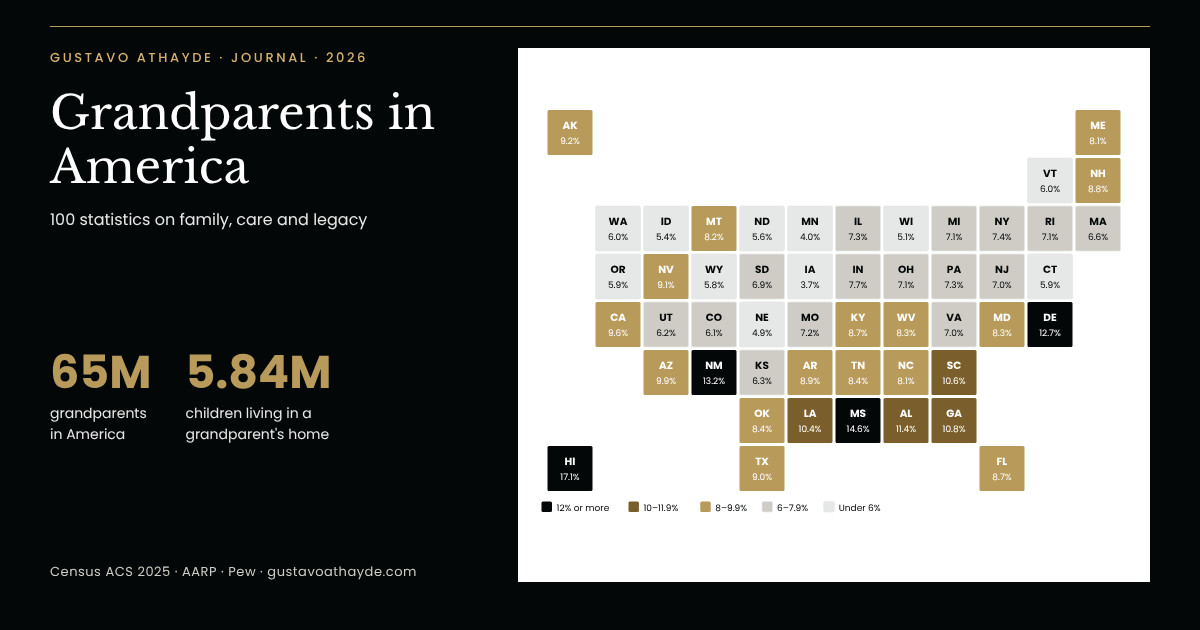
About 65 million Americans are grandparents, and 5.84 million children now live in a home headed by one, 8.2% of the nation’s children and a statistically significant rise since 2021. These 100 grandparents statistics gather the newest figures from the Census Bureau, AARP, Pew Research Center and federal agencies on who grandparents are, how they help and what they pass down.
One finding runs against the usual story. Grandparents raising grandchildren have declined by roughly a quarter in a decade, yet the commitments that remain run longer: half have lasted five years or more. The atelier’s own state ranking, built on 2025 Census data, shows where grandparents are most present in daily family life.
At a glance
Key takeaways
- About 65 million Americans are grandparents; the average grandparent is 68, and the first grandchild arrives at about 50.
- 8.2% of children live in a grandparent’s home, up from 7.9% in 2021.
- Hawaii (17.1%) and Mississippi (14.6%) are statistically tied for the highest share; Iowa and Minnesota are lowest.
- 2.0 million grandparents are responsible for grandchildren, 24% fewer than in 2014, but half have been for five years or more.
- Grandparents give an average of $2,654 a year; those 80 and older give $5,316.
- AARP values grandparents’ unpaid care at $731 billion a year, part of a $903 billion grandparent economy.
- 61% of Americans learned family history from their grandparents, and 48% learned about faith.
- 18% of grandparents are also great-grandparents, and the number of great-grandparents rose 33% between 1996 and 2012.
Grandparents statistics: how many grandparents are there?
America has fewer grandparents than it did a decade ago, yet those it has are older, longer-lived and more present in family life. These figures trace who they are.
- 1.
About 65 million Americans are grandparents, according to AARP’s 2025 estimate.
- 2.
That count is down from roughly 70 million in AARP’s 2018 survey (2018–2025).
- 3.
Half of Americans 50 and older (50%) were grandparents in 2023, as were one in three adults 35 and older (35%).
- 4.
The share of adults 50 and older who are grandparents fell from 58% to 50% between 2014 and 2023.
Grandparenthood by age
- 5.
Two-thirds of Americans 65 and older were grandparents in 2024.
- 6.
27% of adults in their 50s and 51% of those in their 60s were grandparents in 2024.
- 7.
74% of Americans ages 80 to 90 were grandparents in 2024, the highest share of any age group Pew reported.
- 8.
The average American grandparent was 68 years old in 2024.
- 9.
Americans become grandparents at 50, on average, according to AARP’s 2025 survey of nearly 3,300 grandparents.
- 10.
Women make up 58% of American grandparents, and most grandparents (64%) are between 60 and 79 (2025).
Grandparents’ home ranking: where children live with grandparents
To see where grandparents are most woven into daily family life, the atelier ranked every state by the share of children who live in a home headed by a grandparent, using the newest Census data and its margins of error.
SHARE THIS CHART
Copy the code below to embed this chart on your site:
The ranking: states 1 to 25
# State Children in a grandparent’s home Grandchildren Raising grandchildren per 1,000 adults 30+ 5+ years 1 Hawaii 17.1% ±2.3 47,761 10.6 67% 2 Mississippi 14.6% ±1.3 94,996 20.4 47% 3 New Mexico 13.2% ±1.3 57,437 15.2 59% 4 Delaware 12.7% ±2.2 26,531 11.3 47% 5 Alabama 11.4% ±1.0 126,201 16.5 55% 6 Georgia 10.8% ±0.7 268,805 12.7 52% 7 South Carolina 10.6% ±0.8 120,614 14.3 51% 8 Louisiana 10.4% ±0.8 108,203 14.7 46% 9 Arizona 9.9% ±0.9 156,512 10.8 46% 10 California 9.6% ±0.4 779,633 8.0 49% 11 Alaska 9.2% ±1.2 15,733 15.6 61% 12 Nevada 9.1% ±1.1 61,224 9.5 54% 13 Texas 9.0% ±0.4 679,411 12.8 48% 14 Arkansas 8.9% ±1.0 61,158 14.0 51% 15 New Hampshire 8.8% ±1.6 21,359 5.7 50% 16 Florida 8.7% ±0.5 384,175 7.1 49% 17 Kentucky 8.7% ±0.7 87,357 14.4 62% 18 Tennessee 8.4% ±0.6 130,705 13.2 58% 19 Oklahoma 8.4% ±0.6 79,449 14.3 52% 20 West Virginia 8.3% ±1.2 28,030 11.3 70% 21 Maryland 8.3% ±0.8 110,393 10.7 46% 22 Montana 8.2% ±1.3 18,737 9.4 60% 23 North Carolina 8.1% ±0.5 190,417 9.9 50% 24 Maine 8.1% ±1.3 19,403 6.2 44% 25 Indiana 7.7% ±0.6 120,270 10.2 52%
The ranking: states 26 to 50
# State Children in a grandparent’s home Grandchildren Raising grandchildren per 1,000 adults 30+ 5+ years 26 New York 7.4% ±0.4 287,952 6.6 55% 27 Illinois 7.3% ±0.5 189,673 7.5 45% 28 Pennsylvania 7.3% ±0.4 185,576 8.9 53% 29 Missouri 7.2% ±0.6 96,300 9.5 53% 30 Rhode Island 7.1% ±1.6 13,712 5.1 65% 31 Michigan 7.1% ±0.5 145,130 6.9 47% 32 Ohio 7.1% ±0.4 177,578 9.7 53% 33 Virginia 7.0% ±0.5 129,183 8.8 57% 34 New Jersey 7.0% ±0.5 139,003 6.3 50% 35 South Dakota 6.9% ±1.5 14,896 15.0 56% 36 Massachusetts 6.6% ±0.7 86,982 5.9 54% 37 Kansas 6.3% ±0.7 42,487 11.4 45% 38 Utah 6.2% ±0.7 57,048 6.8 41% 39 Colorado 6.1% ±0.8 74,211 7.1 46% 40 Washington 6.0% ±0.6 97,133 6.5 53% 41 Vermont 6.0% ±1.4 6,345 5.6 70% 42 Connecticut 5.9% ±0.8 42,187 5.5 57% 43 Oregon 5.9% ±0.6 47,522 6.9 43% 44 Wyoming 5.8% ±2.0 7,065 9.0 39% 45 North Dakota 5.6% ±1.8 9,820 10.6 67% 46 Idaho 5.4% ±0.8 25,555 7.0 37% 47 Wisconsin 5.1% ±0.6 61,525 5.2 51% 48 Nebraska 4.9% ±0.9 22,878 5.5 43% 49 Minnesota 4.0% ±0.4 50,460 4.5 53% 50 Iowa 3.7% ±0.5 26,500 6.5 39% — District of Columbia 5.2% ±1.9 6,482 3.7 33% — United States 8.2% ±0.1 5,837,717 9.3 51%
Source: U.S. Census Bureau, ACS 2025 1-year (B09018, B10050); Gustavo Athayde analysis. Margins of error at 90% confidence. States whose ranges overlap are statistically tied: Hawaii and Mississippi share first place, Iowa and Minnesota share last. The District of Columbia is shown without a rank.
What the ranking shows
- 11.
Hawaii (17.1%) and Mississippi (14.6%) have the highest shares of children living in a home headed by a grandparent, statistically tied for first place in 2025.
- 12.
New Mexico ranks third at 13.2%, followed by Delaware (12.7%) and Alabama (11.4%) (2025).
- 13.
Nationally, 8.2% of children in households live in a grandparent’s home, and 22 states sit above that share, 11 of them by a statistically significant margin (2025).
- 14.
Six of the 10 highest-ranking states are in the South: Mississippi, Delaware, Alabama, Georgia, South Carolina and Louisiana (2025).
- 15.
Iowa (3.7%) and Minnesota (4.0%) have the lowest shares, statistically tied at the bottom; with Wisconsin and Nebraska close behind across the Upper Midwest (2025).
- 16.
California (779,633) and Texas (679,411) are home to the most grandchildren living in a grandparent’s home, and five states (California, Texas, Florida, New York and Georgia) account for 41% of the national total (2025).
Counts, commitments and change since 2021
- 17.
Mississippi has 20.4 grandparents raising their grandchildren for every 1,000 adults 30 and older, more than twice the national rate of 9.3 and the highest of any state (2025).
- 18.
Texas has the most grandparents responsible for grandchildren, 238,711, ahead of California with 198,715 (2025).
- 19.
In West Virginia and Vermont, 70% of grandparents raising grandchildren have done so for five years or longer, the longest commitments in the country (2025).
- 20.
In South Dakota, 36.7% of the grandchildren living in a grandparent’s home have no parent in the household, the highest share in the nation; North Dakota (33.8%) and West Virginia (33.3%) follow (2025).
- 21.
Delaware (+2.9 points), Mississippi (+2.6), New Hampshire (+2.3), Maine (+2.2) and Nevada (+1.6) posted the largest statistically significant increases in the share of children in grandparents’ homes between 2021 and 2025.
— U.S. Census Bureau, ACS 2025 · U.S. Census Bureau, ACS 2021
- 22.
West Virginia (−3.4 points), Idaho (−1.7) and Tennessee (−1.1) saw statistically significant declines between 2021 and 2025, though West Virginia still ranks in the top half (2021–2025).
— U.S. Census Bureau, ACS 2025 · U.S. Census Bureau, ACS 2021
What this means. For families: where grandparents share the home, the family crest or monogram often belongs to three generations at once. A family crest designed around the grandparents’ initials gives that household a single emblem to keep.
Grandchildren under a grandparent’s roof
Sharing a roof across three generations is an old American habit, and the national numbers show how steady it has remained.
- 23.
6.66 million Americans 30 and older lived with their own grandchildren under 18 in 2025, or 3.1% of adults in that age group.
- 24.
The habit is remarkably steady: 3.3% of adults 30 and older lived with grandchildren in 2021, almost the same as the 3.4% recorded in 1970.
- 25.
5.84 million children lived in a household headed by a grandparent in 2025, 8.2% of children in households, up from 7.9% in 2021 (a statistically significant increase).
— U.S. Census Bureau, ACS 2025 · U.S. Census Bureau, ACS 2021
- 26.
37.6% of the grandchildren living in a grandparent’s home are under 6, the years when daily care matters most (2025).
- 27.
4.84 million households, or 3.6% of all U.S. households, included grandparents living with their grandchildren in 2025.
Who shares the home
- 28.
Nearly half of the children living with a grandparent (48%) shared the home with two married grandparents in 2024.
- 29.
Grandparents living with grandchildren declined 7.9% over a decade, from 7.24 million in 2014 to 6.66 million in 2025.
— U.S. Census Bureau, ACS 2025 · U.S. Census Bureau, ACS 2014
- 30.
One in three grandparents living with grandchildren (33.3%) was born abroad, and 37.7% speak a language other than English at home, carrying family languages to the next generation (2025).
- 31.
11% of grandparents live with a grandchild today, and 28% have done so at some point in the past year (2025).
- 32.
Two in five Americans (40%) say they lived in the same household as a grandparent at some point in their lives (2023).
— YouGov
What this means. For families: households that now span three generations are a reminder that a home’s identity can be shared. Our study of multigenerational households by state follows the same trend from the household side.
Grandparents raising grandchildren
For two million grandparents, the role goes further: they are responsible for most of a grandchild’s daily needs, often for years.
- 33.
2.00 million grandparents were responsible for most of the basic needs of the grandchildren living with them in 2025, 30.0% of grandparents in the home.
- 34.
Half of them (50.8%) have been responsible for five years or longer, 1.01 million grandparents in all (2025).
- 35.
Commitments have lengthened: 49.3% of responsible grandparents had cared for their grandchildren for five years or more in 2021, up from 39.3% in 2012.
- 36.
The number of grandparents raising grandchildren fell 24.2% in a decade, from 2.63 million in 2014 to 2.00 million in 2025.
— U.S. Census Bureau, ACS 2025 · U.S. Census Bureau, ACS 2014
- 37.
55.5% of grandparents raising grandchildren are 60 or older, up from 51.3% in 2021 (2025).
— U.S. Census Bureau, ACS 2025 · U.S. Census Bureau, ACS 2021
A profile of grandparents raising grandchildren
- 38.
Grandmothers make up 64.5% of the grandparents responsible for grandchildren (2025).
- 39.
54.8% of grandparents raising grandchildren are in the labor force, working or looking for work (2025).
- 40.
746,371 grandparents (37.4% of those responsible) are raising grandchildren in their own home with no parent present (2025).
- 41.
17.3% of grandparents raising grandchildren had incomes below the poverty line in 2025, down from 18.4% in 2021.
— U.S. Census Bureau, ACS 2025 · U.S. Census Bureau, ACS 2021
- 42.
Families in which grandparents care for grandchildren with no parent present had a median income of $52,896, compared with $77,231 for all families with a responsible grandparent (2025).
- 43.
39% of children in foster care (128,120 of 331,747) were living with relatives or kin on September 30, 2025, according to preliminary federal data.
- 44.
Grandparents and other relatives raising children save taxpayers at least $10.5 billion a year by keeping children out of foster care, according to Generations United (2025).
Grandparents raising grandchildren, 2021 and 2025
Grandparents raising grandchildren 2021 2025 Grandparents responsible for grandchildren 2,085,527 1,995,947 Responsible for 5 years or more 49.3% 50.8% Age 60 or older 51.3% 55.5% Grandmothers 63.4% 64.5% Married 67.0% 65.7% In the labor force 54.2% 54.8% No parent of the grandchildren in the home 38.8% 37.4% Income below the poverty line 18.4% 17.3% Born outside the U.S. 18.9% 20.2%
Source: U.S. Census Bureau, ACS 1-year 2021 and 2025 (B10050–B10059); Gustavo Athayde analysis. Grandparents 30 and older responsible for most of the basic needs of coresident grandchildren under 18.
How long the commitment lasts
Care, time and well-being
Most grandparents give their time well before any formal arrangement, and most say the work restores them.
- 45.
69% of grandparents care for their grandchildren at least once a year, averaging more than 500 hours, the equivalent of 12.5 weeks of full-time work (2025).
- 46.
Grandparents provide an estimated $731 billion a year in unpaid care for their grandchildren, valued at an average national rate of $22.15 an hour for child-care services (2025).
- 47.
One in ten grandparents (10%) is a primary caregiver with formal custodial responsibility for a grandchild (2025).
- 48.
59% of grandparents say caregiving energizes them, while 13% say it is physically taxing (2025).
Child care and daily life
- 49.
49% of grandparents 50 and older with grandchildren under 18 provide care at least once every few months (2024).
- 50.
21% of grandparents (or their spouses) spent 100 hours or more caring for a grandchild or great-grandchild over a two-year period (2022–23).
- 51.
Among employed parents of children under 5 who rely on relatives for care, 80% turn to grandparents (2022).
- 52.
19.1% of Americans 65 and older were in the labor force in 2025, up from 12.9% in 2000, so many grandparents balance work and family.
- 53.
72% of grandparents 50 and older say they hardly ever feel isolated, compared with 62% of older adults without grandchildren (2024).
The grandparent economy: gifts, support and wealth
Grandparents are also among the family’s most dependable patrons, from birthday gifts to school supplies and the family home.
- 54.
Grandparents spend an average of $2,654 a year on all their grandchildren combined, and nine in ten gave financial support in the past year (2025).
- 55.
Giving has eased in real terms: the 2018 average of $2,562 would equal about $3,240 in 2025 dollars, above today’s $2,654.
- 56.
Direct gifts and support total more than $172 billion a year, and with unpaid care the “grandparent economy” reaches $903 billion (2025).
- 57.
Grandparents 80 and older spend $5,316 a year on grandchildren, about three times the $1,815 spent by grandparents in their 50s (2025).
- 58.
Among living arrangements, grandparents who live long-term with a grandchild spend the most, $4,398 a year (2025).
Where the money goes
- 59.
85% of grandparents spend on special occasions such as gifts, celebrations and treats (2025).
- 60.
41% of grandparents buy everyday essentials such as diapers, clothing, shoes and school supplies, and 23% help with education and activities (2025).
- 61.
70% of grandparents say helping their grandchildren required no sacrifice or financial strain; 14% say it did (2025).
— AARP
- 62.
A grandparent can give each grandchild up to $19,000 in 2026 without using any lifetime gift-tax exemption.
— IRS
- 63.
$124 trillion is projected to pass between generations through 2048, including $105 trillion to heirs; Cerulli expects nearly $100 trillion of it to come from baby boomers and older Americans (projection).
What this means. For grandparents: the most lasting gifts are often the simplest to keep. A signet design or wax seal for family letters is a gift that is used for decades.
Staying close across the miles
Distance has become less of a barrier: today’s grandparents keep in touch by text and video as readily as by visit.
- 64.
Seven in ten grandparents 65 and older (70%) are in touch with their grandchildren at least a few times a month, 41% a few times a week and 15% daily (2025).
- 65.
76% of grandparents say texting and video calls are a primary way they stay connected with grandchildren (2025).
- 66.
Half of grandparents 80 and older (50%) text with their grandchildren (2025).
- 67.
Smartphone ownership among adults 50 and older rose from 55% in 2016 to 90% in 2025.
- 68.
83% of grandparents report high levels of joy in grandparenting, and 80% report a strong sense of fulfillment (2025).
Joy, closeness and travel
- 69.
36% of grandparents 50 and older baked or cooked with their grandchildren in the past month (2024).
- 70.
69% of Americans say a close grandparent-grandchild relationship is very important, rising to 83% among those who say religion is very important to them (2023).
— YouGov
- 71.
72% of Americans say their grandparents were very (39%) or somewhat (33%) influential in their lives (2023).
— YouGov
- 72.
26% of family trips taken by Americans 50 and older involve three generations, and 76% say the main reason is to strengthen family bonds (2026 outlook).
Heritage, faith and legacy
Grandparents remain the keepers of family memory, faith and the objects that carry both.
- 73.
61% of Americans say their grandparents taught them about family history, 51% about cultural traditions and 48% about religion or spirituality (2023).
— YouGov
- 74.
85% of adults 50 and older say grandparents help usher younger generations into adulthood by teaching family values (2025).
- 75.
63% of grandparents have not yet recorded their life stories, and just 9% do so regularly (2025).
- 76.
More than a third of grandparents (36%) plan to record their stories, and 73% would use technology to capture them if it were available (2025).
Stories, recipes and keepsakes
- 77.
16% of grandparents are “Selective Tradition Sharers” focused on passing down family stories and values, and another 11% are “Legacy Leaders,” in AARP’s 2025 typology.
- 78.
55% of Americans have a treasured family recipe that has been handed down, and 37% of those cooking one for the holidays are excited to teach it to their children or grandchildren (2025).
- 79.
58% of Americans have received a sentimental item passed down from a family member (2025).
- 80.
51% of Americans would rather inherit a few meaningful items than everything a loved one owns; only 20% would choose everything (2026).
- 81.
Two-thirds of Americans in their 70s (66%) have a will, and about eight in ten of those in their 80s or older have both a will and a living will or advance directive (2025).
- 82.
77% of Americans have celebrated holidays with their grandparents, and 48% say they met all four of them (2023).
— YouGov
What this means. For families: stories fade faster than objects. A custom coat of arms or engraved heirloom gives the family’s history a form that can be handed down, as our family heirloom statistics show.
Names, traditions and National Grandparents Day
What a family calls its grandparents is a small tradition of its own, and the nation set aside a day to honor them more than four decades ago.
- 83.
“Grandma” is the most common name for a grandmother: 35% of Americans use it for their maternal grandmother and 31% for their paternal grandmother (2023).
— YouGov
- 84.
“Grandpa” leads for grandfathers, used by 29% for a maternal grandfather and 23% for a paternal grandfather (2023).
— YouGov
- 85.
“Nana” was the most popular grandmother nickname after “Grandma” in 12 states, and “Papa” led grandfather nicknames after “Grandpa” in 13, in a 2023 survey of 1,500 Americans.
— Preply
- 86.
Nearly three in four parents of babies 6 months or younger say the grandparents chose their own nicknames (2024).
- 87.
18% of Americans say a grandparent served as their primary legal guardian at some point (2023).
— YouGov
The origins of Grandparents Day
- 88.
Congress designated National Grandparents Day in 1978 through Public Law 95-325, approved July 28, 1978.
- 89.
The first National Grandparents Day was Sunday, September 10, 1978, proclaimed by President Carter, who wrote that the elders of each family have the responsibility for setting its moral tone (1978).
- 90.
Federal law sets National Grandparents Day on the first Sunday after Labor Day each year; it fell on September 13 in 2026 and will fall on September 12 in 2027.
- 91.
Marian McQuade began the campaign for a national grandparents’ day in 1970; the holiday’s official flower is the forget-me-not.
What this means. For grandchildren and gift-givers: a grandparent’s chosen name, or their initials joined with the grandchildren’s in a personal monogram, makes a Grandparents Day gift that outlasts the day.
Longer lives, more generations
Longer lives mean more years shared between generations, and a growing number of families with four of them alive at once.
- 92.
Americans who reach 65 can expect to live 19.7 more years, 20.8 for women and 18.4 for men (2024).
— CDC/NCHS
- 93.
- 94.
Grandparents have six grandchildren on average; 43% have three to six and 14% have more than 10 (2022–23). AARP, which also counts younger grandparents, puts the average at 4.9.
- 95.
27% of grandparents 50 and older have five or more grandchildren (2024).
Great-grandparents and years together
- 96.
18% of American grandparents are also great-grandparents, with 3.7 great-grandchildren on average (2025).
- 97.
The number of great-grandparents rose 33%, from 15.3 million in 1996 to 20.4 million in 2012, according to research published in 2026.
- 98.
About two-thirds of Americans 90 and older are great-grandparents, compared with 11% of those ages 60 to 64 (2012 data, published 2026).
- 99.
American women could expect to spend 25.4 years as grandmothers and men 21.5 years as grandfathers, up from 23 and 18.5 years in 1992 (2010, latest estimate).
- 100.
The 65-and-older population grew 16.2% between 2020 and 2025, to 64.6 million, so the pool of potential grandparents and great-grandparents keeps widening.
Methodology
This article compiles 100 statistics from government agencies, academic research, AARP, Pew Research Center and other survey organizations. Every figure links to the page that publishes it, and each item states the year of its data. Commissioned polls name their sponsor; figures reported by a secondary source are attributed to it, and one projection is labeled as such.
Items marked ATELIER ANALYSIS are Gustavo Athayde calculations from the U.S. Census Bureau’s American Community Survey 1-year Summary Files for 2025 and 2021 (tables B09018, B10001, B10002, B10010 and B10050 to B10063), plus table B10050 for 2014 and 2019. The state ranking divides grandchildren of the householder (B09018_006) by all children under 18 in households (B09018_001).
Margins of error for percentages follow the Census Bureau’s formula for derived proportions at 90% confidence. States are called statistically tied when the difference between them is smaller than the square root of the sum of their squared margins, and changes since 2021 are reported only when they pass the same test. The comparisons are descriptive and do not imply cause.
About the author

Gustavo Athayde — Founder & Creative Director, GUSTAVO ATHAYDE
Gustavo Athayde is the founder and creative director of GUSTAVO ATHAYDE, a bespoke monogram atelier based in Sioux Falls, South Dakota. A graphic designer by training, he creates monograms, personal and family crests, heraldic emblems, signet designs and wax seals for individuals, families, couples and brands across the United States. Every commission is refined line by line into a symbol meant to be kept, used and passed down.
Follow the atelier on Instagram · Request a private consultation
Frequently asked questions
- How many grandparents are there in the United States?
- AARP estimates about 65 million grandparents in 2025, down from roughly 70 million in its 2018 survey. Two-thirds of Americans 65 and older are grandparents, according to Pew Research Center.
- How many grandparents are raising their grandchildren?
- About 2.0 million grandparents were responsible for most of the basic needs of grandchildren living with them in 2025, according to the Census Bureau. Half had carried that responsibility for five years or longer.
- Which state has the most children living with grandparents?
- Hawaii (17.1%) and Mississippi (14.6%) have the highest shares of children living in a grandparent-headed home and are statistically tied. By number, California and Texas have the most such children.
Gifts, ages and Grandparents Day
- At what age do Americans become grandparents?
- On average, Americans have their first grandchild at 50, according to AARP. The average grandparent is 68 years old.
- How much do grandparents spend on their grandchildren?
- AARP found that grandparents spend an average of $2,654 a year on all their grandchildren combined, and those 80 and older spend $5,316.
- When is National Grandparents Day?
- Federal law places it on the first Sunday after Labor Day. In 2027 it falls on Sunday, September 12.
Cite this page
Source: Gustavo Athayde, "Grandparents in America 2026: 100 Statistics", https://gustavoathayde.com/grandparents-statistics/Feel free to use these statistics and charts — we just ask for a link back to this page.
Sources
- 36 U.S. Code § 125, National Grandparents Day
- American Presidency Project, Proclamation 4580: National Grandparents Day, 1978
- Births: Final Data for 2024 (CDC/NCHS, NVSR 75-2)
- Grandparents and their coresident grandchildren, press release (U.S. Census Bureau, 2024)
- HHS Administration for Children and Families, AFCARS Dashboard, preliminary FFY 2025
- IRS, Tax inflation adjustments for tax year 2026 (IR-2025-103)
- Mean Age of Mother, 1970–2000 (CDC/NCHS, NVSR 51-1)
- Mortality in the United States, 2024 (CDC/NCHS Data Brief 548)
- U.S. Bureau of Labor Statistics, Nearly one in five older Americans in the labor force in 2025
- U.S. Census Bureau, ACS 2014 1-year, table B10050
- U.S. Census Bureau, American Community Survey 2021 1-year Summary File
- U.S. Census Bureau, American Community Survey 2025 1-year Summary File (tables B09018, B10001, B10002, B10010, B10050–B10063)
- U.S. Congress, Public Law 95-325 (92 Stat. 398), 1978
- Vintage 2025 population estimates (U.S. Census Bureau)
Research organizations, surveys and media
- A Closer Look at Grandparents (AARP Research, 2026)
- AgeTech Collaborative from AARP, 2026 Travel Trends summary
- Axios, Grandma names: Nana, Mimi, Gigi (2024)
- Bipartisan Policy Center, What keeps employed parents out of the child care system (2022)
- Bowling Green State University NCFMR, Grandparenthood in the U.S. (FP-24-21)
- Cerulli Associates, $124 trillion in wealth will transfer through 2048
- Connections and Relationships among Grandparents (AARP Research, 2026)
- Experiences with estate planning (Pew Research Center, 2025)
- Family recipes bind generations together (Talker Research for Jennie-O, 2025)
- Generations United, State of Grandfamilies 2025 press release
- Grandparent Economy (AARP Research, 2026)
- Grandparents Report 2026: financial help to grandchildren (AARP)
- Legacy and love take priority for aging Americans (Talker Research for Ethos, 2025)
- Margolis & Verdery, A Profile of Great-Grandparenthood in the United States, Demography (2026)
- N-IUSSP, Healthy grandparenthood: how long is it and how has it changed? (Margolis & Wright)
- Nearly half of Americans would rather inherit nothing (Talker Research for 1-800-GOT-JUNK?, 2026)
- Pew Research Center, 6 facts about grandparents in the U.S. (2026)
- Preply, Popular grandparent nicknames survey (2023)
- Role and Legacy of Grandparents (AARP Research, 2025)
- Technology Trends Among Older Adults, 2026 (AARP Research)
- The Essential Role of Grandparents (AARP Research, 2026)
- The Old Farmer's Almanac, When Is Grandparents Day?
- University of Michigan National Poll on Healthy Aging, grandparents (2024)
- YouGov, American grandparent-grandchild relationships (2023)