The Wedding Crest: A Union Rendered in Heraldic Form
The Wedding Crest: A Union Rendered in Heraldic Form
BESPOKE WEDDINGS
A wedding crest is not an ornament borrowed from a stationery catalogue.
It is a small act of heraldry, composed for two families becoming one.
Long before couples exchanged rings before witnesses, they exchanged marks before neighbors.
A shield quietly reimagined, a motto newly written, a single emblem meant to outlast the celebration that introduced it.
This has always been the quiet ambition behind a well-considered wedding identity.
In this reflection, I want to explore what a wedding crest actually is, where the idea comes from, and why the finest examples resemble heirlooms rather than decorations.
I want to consider what separates a mark that fades into a drawer from one that is inherited, engraved, and remembered.
And I want to make the case that a wedding crest, chosen with care, becomes something closer to family property than party favor.
Couples exploring this path often arrive already familiar with the more contemporary wedding monogram, and wonder how a crest differs from it.
The distinction matters, and it shapes everything that follows.
What a Wedding Crest Truly Represents
A wedding crest is often mistaken for a passing flourish, assembled quickly to satisfy an invitation deadline.
In truth, it belongs to a far older tradition than the modern wedding industry would suggest.
Its lineage runs through family seals, merchant marks, and the shields once reserved for noble houses.
What distinguishes a wedding crest from ordinary decoration is intention.
It is not selected from a gallery of pre-made shapes; it is composed, element by element, until it feels inevitable.
A well-designed wedding crest carries the weight of two family histories folded into a single, considered mark.
It should read as though it always existed, waiting only to be discovered by the couple it belongs to.
A wedding crest, properly considered, becomes a private language between two people and everyone who loves them.
It appears on the invitation, yes, but it also appears on linens passed to grandchildren.
It is engraved, embossed, and eventually inherited.
This permanence is precisely why the design process cannot be rushed.
A wedding crest differs from a brand mark in one essential way: it is designed to be loved, not merely recognized.
Consider, for a moment, how differently we regard a symbol we chose ourselves versus one selected for us.
A wedding crest belongs to the first category, which is precisely what gives it emotional gravity.
Every charge, every tincture, every decision about proportion becomes a decision about how a marriage wishes to present itself to the world.
This is not vanity; it is stewardship of a moment that will not repeat itself.
A crest also carries a discipline that pure decoration does not, since every heraldic element must justify its presence.
This discipline is what separates a wedding crest worth inheriting from a shield assembled only to look impressive for a single afternoon.
A wedding crest also functions as a kind of quiet contract between two families, an agreement about what the marriage intends to carry forward.
That agreement is rarely written down, yet it is felt every time the mark is used.
Couples sometimes underestimate how much a well-composed crest can clarify their own sense of what the marriage represents.
The act of choosing which charges to include forces a conversation that many couples never have in quite this way before.
What emerges from that conversation is often more valuable than the finished artwork itself.
Wedding Crest, Monogram, or Cipher
The vocabulary surrounding personal symbols is often used loosely, and clarity serves a couple well before any commission begins.
A monogram, in its classical sense, interlaces initials into a single decorative unit.
A cipher is a more ornamental interlacing of letters, chosen for visual elegance rather than symbolic depth.
A wedding crest, by comparison, borrows the pictorial grammar of heraldry rather than relying on letterforms alone.
It may include a shield, a charge drawn from each family’s history, and a motto distilled into a single phrase.
Where a monogram speaks through initials, a crest speaks through symbol, and that shift changes what the mark is able to communicate.
A couple drawn to more interlaced, ornamental letterforms often finds a natural home in the cipher monogram tradition instead.
A couple drawn to pictorial symbolism, mottoes, and inherited visual language tends to find the wedding crest the more resonant choice.
Neither form is superior to the other; each answers a different instinct about how a marriage wishes to be remembered.
Understanding this distinction shapes the brief a couple ultimately brings to their designer.
A couple who wants a wedding crest is not simply asking for a prettier version of their initials.
They are asking for a symbolic system capable of carrying family history, values, and permanence all at once.
This is a different discipline from casual stationery design, closer in spirit to heraldic commission than to decorative art.
It requires the same rigor a noble house would once have applied to a formal grant of arms, softened for the intimacy of a wedding.
| Mark | Represents | Typical Use |
|---|---|---|
| Wedding Crest | A union expressed through heraldic symbol | Stationery, seals, architectural keepsakes |
| Wedding Monogram | Two names distilled into a single composition | Invitations, linens, digital identity |
| Decorative Cipher | Ornamental interlacing of initials | Wedding stationery, event design |
| Family Crest | An entire lineage across generations | Heirlooms, correspondence, architecture |
The best wedding crests borrow the discipline of heraldry and the sentiment of a wedding, and belong fully to neither tradition alone.
The History Behind the Wedding Crest
Long before logos became commonplace, the most enduring marks of distinction belonged not to companies, but to families and unions.
Interlaced shields appear on manuscripts, on silver, and on the seals used to close private correspondence centuries ago.
Noble households refined this practice into a formal art with its own grammar of color, charge, and proportion.
Certain royal archival collections preserve gowns, jewels, and correspondence bearing marks designed specifically for a single union, evidence that the idea of a bespoke wedding emblem is far from a modern invention.
These objects were rarely anonymous; they were commissioned, considered, and passed down with the same care given to jewelry.
What we now call a wedding crest is, in many ways, the direct descendant of these commissioned marks.
The technology has changed, but the impulse has not.
Couples still want a symbol that feels chosen rather than assigned, personal rather than generic.
Medieval Period
Noble families adopt combined arms upon marriage, uniting two heraldic lines into one shield.
Renaissance Courts
Marital shields appear on textiles, silver, and architectural detailing across European households.
Nineteenth Century
Monogrammed and crested linens become a hallmark of established households on both sides of the Atlantic.
Twentieth Century
Wedding stationery begins to incorporate custom crests as a formal, though increasingly rare, tradition.
Present Day
The wedding crest re-emerges as a considered alternative to the ubiquitous initial monogram.
Few couples today will have their wedding remembered on the scale of a royal ceremony, yet the underlying instinct is identical.
A wedding crest, however modest its audience, deserves to be treated as though it, too, might be preserved.
Wedding Crests Across Cultural Traditions
A wedding crest does not belong to a single culture or ceremony style.
Couples arrive from an enormous range of traditions, and each brings its own visual vocabulary worth honoring.
A couple planning a ceremony rooted in Southern hospitality may want a mark that feels warm and slightly more ornamental than a minimalist coastal wedding would call for.
A couple honoring Latin American heritage may wish to incorporate charges or colors drawn from their family’s country of origin.
A couple blending two distinct cultural backgrounds within a single marriage faces perhaps the most interesting design challenge of all.
In these commissions, the crest must hold two visual languages in balance without allowing either to overwhelm the other.
This is delicate work, closer to diplomacy than decoration.
It requires genuine curiosity about both traditions, not a superficial gesture toward one while defaulting entirely to the other.
Religious and ceremonial context also shapes these decisions considerably.
A wedding crest intended for use alongside formal religious stationery must respect the conventions of that setting, even while introducing something entirely new.
A more secular celebration allows for greater freedom, though freedom is not the same as license to abandon restraint.
Cultural sensitivity in a wedding crest is not about literal symbols borrowed from a tradition.
It is about understanding the spirit behind them.
This is why the earliest conversations in any commission ask about more than aesthetic preference.
They ask about heritage, upbringing, and the traditions each partner hopes to preserve or gently reinterpret.
A wedding crest built without this understanding may still be attractive, but it will rarely feel true.
A wedding crest built with this understanding tends to feel, almost immediately, like it could not have been designed any other way.
Some families bring charges from agricultural or maritime histories that predate any formal heraldic tradition, and these deserve equal respect within the design.
Other families bring nothing more than a shared color or symbol remembered from a grandparent’s home, and even this fragment can anchor an entire composition.
What matters most is that the finished crest feels earned rather than assembled from a generic reference library.
How a Wedding Crest Is Composed
Every wedding crest begins long before a pencil meets paper.
It begins with listening.
A couple’s names, their families’ histories, and the character of their celebration all inform the earliest sketches.
What follows is a deliberate sequence, refined rather than rushed.
Stage 1
Private consultation and narrative discovery across both families.
→
Stage 2
Heraldic research into charges, tinctures, and forms with genuine precedent.
→
Stage 3
Concept refinement, narrowing toward a single disciplined composition.
→
Stage 4
Formal application across stationery, seal, and architectural use.
→
Stage 5
Final delivery in every format the marriage will require.
Nothing about this sequence is arbitrary.
Rushing the research stage produces a crest that looks assembled rather than composed.
Skipping the application stage produces a mark that fails the moment it meets an actual seal, napkin, or engraved band.
This is why bespoke work resists the shortcuts often associated with template-based design tools.
A wedding crest is a small piece of architecture, and architecture rewards patience.
The difference between a passable wedding crest and a memorable one is rarely visible at first glance; it reveals itself over years of use.
Comparing Wedding Crest Styles
Not every couple wants the same visual language, and that is precisely as it should be.
What matters is choosing an approach that reflects the couple rather than a passing trend.
Classical Heraldic Shield
Formal charges and tinctures drawn directly from established heraldic grammar.
Quartered Union Crest
Two family shields divided and combined into a single quartered composition.
Contemporary Minimalist Crest
A restrained shield reduced to its essential lines, suited to modern architecture.
Botanical or Landscape Crest
Charges drawn from land, harvest, or coastline rather than classical armory.
None of these approaches is inherently superior to another.
The correct choice depends entirely on the couple’s history, the venue, and the feeling they wish their guests to carry home.
A designer’s role is not to impose a style but to recognize which one already belongs to the couple in front of them.
A wedding crest should never feel borrowed from a trend report; it should feel remembered from somewhere personal.
Many couples arrive with images gathered from other weddings, and this is a natural starting point.
Yet the finished mark should ultimately owe very little to any of those references.
Its job is to feel inevitable in hindsight, not familiar in comparison.
Where a Wedding Crest Travels
A wedding crest earns its place across an entire celebration, not merely a single invitation card.
Its versatility is part of what makes the investment in proper design worthwhile.
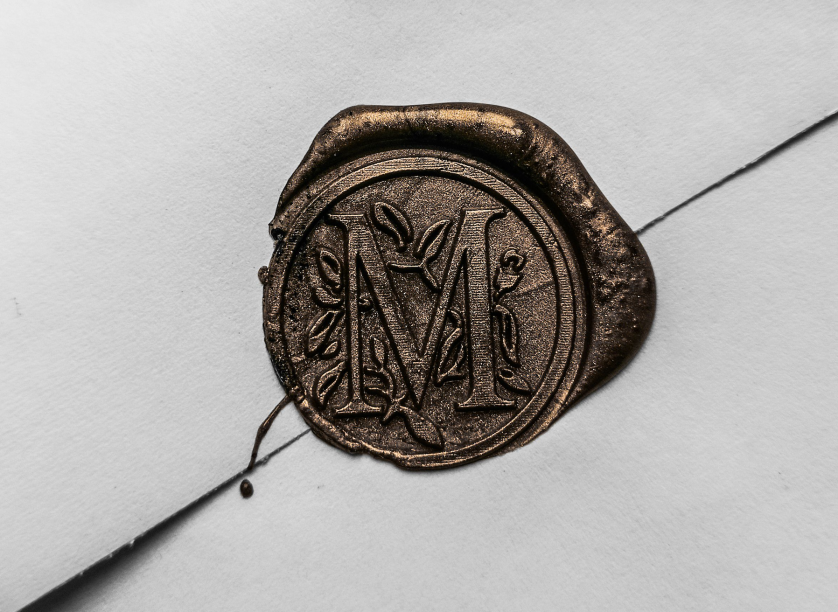
It must function on a wax seal and on a linen napkin with equal grace.
It must be legible at the scale of an engraved ring and dignified at the scale of a welcome sign.
These are not decorative concerns alone; they are structural design problems that require real craftsmanship to resolve.
A mark that only works at one scale has not yet been fully designed, however attractive the initial sketch may appear.
Many couples also commission a companion monogram for everyday stationery, reserving the fuller crest for the most formal applications.
This pairing allows a single celebration to carry both an intimate daily mark and a more formal heraldic one.
2
Family shields united into one composition
100+
Years a well-crafted crest can remain legible
1
Mark, built once, intended to last generations
5
Material applications typically prepared for a wedding crest
This progression, from ceremony to keepsake, is exactly why a wedding crest cannot be designed for a single application.
A wedding crest is successful when it feels equally at home on an invitation and on a christening gown a decade later.
Many of our clients return years after their wedding to ask that the same mark be adapted for a nursery or a family crest project.
This continuity is the clearest evidence that the original design succeeded.
The Wedding Crest in a Digital Age
Modern weddings unfold across far more surfaces than earlier generations ever anticipated.
A wedding crest today must perform not only on printed stationery but also across wedding websites, digital invitations, and social correspondence shared among guests.
This expanded role has not diminished the importance of craftsmanship; if anything, it has raised the stakes considerably.
A mark that appears slightly pixelated on a phone screen undermines the same sense of quality it was meant to convey on paper.
For this reason, every wedding crest produced within our atelier is delivered in formats suited to both physical production and digital display.
Vector files ensure the mark remains crisp regardless of scale, from a small favicon to a large-format welcome sign.
Digital delivery also allows couples to introduce their crest earlier in the planning process, often well before formal invitations are printed.
A wedding website bearing the couple’s crest from the very beginning creates a sense of continuity that guests notice, even if only subconsciously.
This early introduction also allows the mark to feel familiar by the time formal stationery arrives, rather than appearing for the first time alongside the invitation itself.
A wedding crest built only for print will eventually feel incomplete.
A wedding crest built for every surface a couple actually uses will feel inevitable.
None of this diminishes the romance of a well-crafted paper invitation or an engraved keepsake.
It simply acknowledges that a modern wedding identity must live comfortably in both worlds at once.
A designer who understands both the discipline of print production and the technical requirements of digital display is better positioned to protect a crest’s integrity across every context it will encounter.
Some couples also request a simplified version of their crest for smaller digital applications, such as a wedding hashtag graphic or a save-the-date video.
This simplified variant must still relate clearly to the primary mark, never feeling like a separate identity invented for convenience.
Maintaining that relationship across every scale and every medium is, in many ways, the quiet technical achievement behind a well-executed wedding crest.
Reflections on the Wedding Crest
Couples who commission a wedding crest often describe the experience in strikingly similar terms.
What follows are a handful of reflections shared with the atelier by past clients.
Our wedding crest now sits on our correspondence, on a set of glasses my mother gifted us, and eventually, we hope, on our children’s christening gowns.
A Bride
I come from a family of orchard growers, and I wanted our crest to feel like an extension of that work rather than a separate identity invented for one day.
A Groom
We were married in a converted barn, and the crest needed to feel as considered as the architecture around it.
A Bride
My family has carried an informal set of symbols for generations, and I was nervous about formalizing something new. What was designed for us honored both households without contradiction.
A Father of the Bride
These reflections share a common thread that extends beyond satisfaction with a finished product.
Each family describes the wedding crest as something that continued to matter well after the celebration ended.
This is the standard by which every commission undertaken through this atelier is measured.
What Royal Heraldry Teaches the Wedding Crest
In communities where legacy is valued as deeply as innovation, identity often extends beyond a name.
It becomes a symbol, one capable of representing a family, a celebration, or a personal story for generations.
Royal marriages have always understood this instinctively, combining two heraldic lines into a single quartered shield upon a union.
The institution historically responsible for granting and recording armorial bearings has spent centuries formalizing precisely this practice.
Nothing about a properly granted coat of arms is left to chance, from the tincture of the field to the charge placed upon it.
This level of institutional care is difficult to imagine in most areas of contemporary design, where originality is often treated as optional rather than essential.
A couple does not need a cathedral or a national holiday to justify treating their wedding crest with this same seriousness.
They need only recognize that the mark they choose will likely outlive the day it was created for.
History offers a useful check on this instinct as well.
Even modest surviving marriage seals from centuries past were composed with more deliberation than most modern couples give to their entire visual identity.
That deliberation is worth reviving, not out of nostalgia, but because it produces objects that continue to mean something long after fashion has moved elsewhere.
The finest symbols are rarely created to follow trends. They are created to outlive them.
This philosophy shapes every heritage-inspired commission undertaken within the atelier.
Couples drawing inspiration from noble tradition are not attempting to imitate royalty.
They are recognizing that some design instincts, refined over centuries, remain worth honoring.
Why Restraint Defines the Wedding Crest
Luxury has never depended on volume.
The most recognizable heraldic marks in history rely on a small number of elements, used consistently, rather than a crowded shield of competing charges.
A wedding crest benefits from the same discipline.
One well-considered shield, applied with consistency, communicates more confidence than an elaborate composition trying to say everything at once.
Compositional Restraint
96%
Symbolic Clarity
91%
Material Durability
94%
Cross-Generational Legibility
89%
This restraint is not a limitation; it is a discipline that produces clarity.
A wedding crest asked to do too much, carrying dates, locations, and ornamental flourishes all at once, quickly loses the quiet authority that makes a mark memorable.
The strongest examples resist this temptation entirely.
Luxury identity is not about adding more. It is about knowing precisely what to remove.
This principle guides every recommendation offered during the design process, even when a couple initially requests more elements than the shield can gracefully hold.
A house that understood this instinctively is remembered for a single mark repeated with total consistency, not for a rotating catalogue of variations.
The same discipline, applied at the scale of a private family, produces a crest that ages the way fine tailoring ages, quietly and without correction.
Where a Wedding Crest Meets Family Legacy
For some couples, a wedding crest is only the beginning of a much larger conversation about family identity.
Families with long histories in agriculture, finance, or trade often carry an informal visual language of their own, even without a formally documented crest.
A wedding crest can serve as the first deliberate step toward capturing that informal legacy in lasting visual form.
This is a different kind of commission than a purely decorative one.
It asks the designer to research family history with genuine curiosity, sometimes uncovering details the couple themselves had never fully considered.
Some couples arrive already holding an inherited family crest on one or both sides, and the wedding mark must honor that history rather than compete with it.
Continuity Over Novelty
A wedding crest is designed to remain legible and meaningful decades after its creation.
A Private Language
Every charge and tincture carries meaning understood primarily within the two families themselves.
Beyond the Couple
Unlike a personal monogram, a wedding crest represents two households joining as one.
A wedding crest can be the first chapter of a much longer family legacy project, formalized over time rather than all at once.
Some clients return years after their wedding to expand their original crest into a fuller family mark, incorporating children or milestones.
Others prefer to let the original wedding crest stand exactly as it was designed, unchanged for the rest of their lives together.
Both approaches honor the same underlying idea: that a family’s visual identity deserves the same care given to its financial or historical legacy.
A Wedding Crest That Continues to Serve
A wedding crest does not retire the day after the reception ends.
Its usefulness extends into the life the couple builds together.
Anniversaries
Reused annually on correspondence, gifts, and shared keepsakes.
Household Identity
Applied to linens, stationery, and correspondence throughout the marriage.
Family Milestones
Adapted for christenings and future generational celebrations.
This continued relevance is the clearest test of whether a wedding crest was designed correctly.
A mark created only to satisfy a single afternoon rarely survives contact with real life.
A mark created with restraint, proportion, and genuine meaning tends to follow a couple for decades.
A Private Reflection on Choosing a Wedding Crest
Almost every couple arrives at their first design conversation with a quiet uncertainty they rarely voice directly.
They wonder whether a wedding crest is truly necessary, or whether it might feel indulgent given everything else a wedding demands.
This uncertainty deserves a genuine answer rather than a reflexive reassurance.
A wedding crest is not necessary in the way a marriage license is necessary.
It is necessary only in the way that meaning is necessary to people who care about how they are remembered.
Not every couple needs one, and that is a perfectly reasonable conclusion to reach.
But for couples who sense that their families, their histories, or their celebration deserve a lasting visual expression, the instinct is worth trusting.
A second uncertainty often follows the first.
Couples worry that a bespoke crest will feel excessive, even ostentatious, to guests who may not fully appreciate the craftsmanship behind it.
This concern misunderstands what restraint actually accomplishes.
A well-designed wedding crest rarely announces itself loudly.
It is more often noticed the way fine tailoring is noticed, quietly, and only by those inclined to look closely.
Most guests will never consciously register the craftsmanship behind a well-designed mark.
They will simply feel that the celebration was considered, cohesive, and unmistakably personal, without knowing exactly why.
The couples who benefit most from a wedding crest are rarely those seeking attention.
They are those seeking permanence.
A third and final uncertainty tends to surface toward the end of the process, once a direction has been chosen.
Couples sometimes ask whether they will still love the crest in twenty years, long after the wedding itself has faded into memory.
This is, in many ways, the most important question of all, and it is answered not through reassurance but through the design process itself.
A mark built on trend rather than character rarely survives a decade gracefully.
A mark built on genuine restraint, proportion, and personal meaning tends to feel, if anything, more resonant with time rather than less.
On Craftsmanship and the Wedding Crest
Designing a wedding crest is, at its core, an exercise in editorial judgment.
Every couple arrives with more history than a single shield can hold, and part of the designer’s task is deciding what to leave out.
This process resembles editing a manuscript more than assembling a graphic.
Craftsmanship, in this context, is not about ornamentation.
It is about precision, patience, and a refusal to settle for the first acceptable draft.
A trained eye can recognize the difference between charges that merely fit together and charges that were built specifically to relate to one another.
This distinction is invisible to most observers and yet it is the entire reason bespoke design exists.
Templates can produce something serviceable.
Only genuine craftsmanship can produce something worth inheriting.
A wedding crest is not judged by how quickly it can be produced, but by how long it continues to feel correct.
This is why our process resists shortcuts, even when they would save considerable time.
A composition rushed to completion tends to reveal its haste years later, when the mark no longer feels as considered as the marriage it represents.
Patience, in this discipline, is simply another form of respect for the couple commissioning the work.
Editorial judgment also means knowing when a couple’s instincts should be trusted over a designer’s own preference.
The finest wedding crests are rarely the product of a single vision imposed from outside.
They emerge from a genuine collaboration, one where the designer’s craft serves the couple’s history rather than overshadowing it.
This balance is difficult to teach and even harder to fake, which is why so much of the work depends on experience rather than formula.
A designer who has made this mistake before learns to recognize the early signs of a composition trying to do too much.
Correcting course early, before a couple grows attached to an overcrowded concept, spares everyone a more difficult conversation later.
The Elements a Wedding Crest Depends On
A finished wedding crest depends on several elements working in balance.
None of these can be skipped without weakening the final result.
Heraldic Precedent
93%
Balance and Proportion
90%
Symbolic Meaning
95%
Application Versatility
88%
Heraldic precedent ensures every charge and tincture relates to genuine history rather than invented decoration.
Balance and proportion determine whether the shield feels settled or unresolved at first glance.
Symbolic meaning gives the composition a reason to exist beyond its surface appearance.
Application versatility ensures the mark performs as well engraved as it does printed.
A wedding crest that excels in only one of these areas will always feel unfinished, however attractive it first appears.
The Quiet Meaning Inside a Wedding Crest
Every element within a wedding crest can carry meaning, even when that meaning is never explained to a single guest.
A shared border might represent the joining of two households.
A single connecting charge between two family shields might represent continuity rather than separation.
Negative space, often overlooked, can hold as much significance as the charges themselves.
This is where the discipline of heraldry becomes genuinely instructive.
Independent organizations devoted to the study and preservation of heraldic tradition have spent generations documenting a visual language where every charge, tincture, and division carries specific meaning.
A wedding crest does not need to follow every formal rule to benefit from their underlying philosophy.
Symbols endure when they mean something, even privately, to the people who chose them.
A crest can be admired without being understood. A motto, once read, cannot be unread.
Couples are often encouraged, during the design process, to articulate what they hope their mark will represent before a single sketch is drawn.
This exercise alone frequently changes the direction of the entire composition.
A couple who wants their mark to represent resilience will make different choices than a couple who wants it to represent romance.
Neither instinct is incorrect, but both deserve to be honored deliberately rather than accidentally.
What ultimately matters is that the couple can look at their finished crest years later and still recognize the intention behind it.
That recognition, more than any single design choice, is what separates a meaningful wedding crest from a merely decorative one.
It is also what allows a crest to be explained, years later, to a child or a grandchild without the explanation feeling invented after the fact.
Color, Material, and the Life of a Wedding Crest
A wedding crest is rarely seen in only one medium.
It appears in gold foil on an invitation, in engraved metal on a signet, and in raised thread on a linen napkin.
Each of these materials behaves differently, and a mark that has not been tested across them will inevitably reveal weaknesses somewhere along the way.
A fine line that reads beautifully in digital form may disappear entirely when engraved into silver.
This is why material testing belongs inside the design process itself, not as an afterthought once the concept has already been approved.
Color carries similar weight within heraldic tradition.
Gold traditionally signifies generosity, silver signifies peace, and deep blue often signifies loyalty and truth.
Museum holdings dedicated to decorative arts and ceremonial craftsmanship include silverwork, textiles, and personal seals that reveal just how seriously earlier generations treated the visual signature of a marriage.
These objects were rarely anonymous; they were commissioned, considered, and passed down with the same care given to jewelry.
Restraint tends to serve a wedding crest well in this respect, echoing the same flat, considered palettes favored throughout formal design traditions.
Gradients and overly ornamental color transitions rarely age gracefully, particularly once a mark is engraved or embroidered rather than printed.
A flat, confident color choice, applied consistently, will almost always outperform a more elaborate palette over time.
Material honesty matters. A wedding crest should be designed for how it will actually be produced, not only for how it appears on a screen.
This principle extends to paper stock, thread weight, and even the finish of a wax seal.
Longevity, in the end, is not only about the concept behind a wedding crest.
It is also about whether the mark was built to survive the many physical forms it will eventually take.