The Custom Family Crest: A Lineage Made Visible
The Custom Family Crest: A Lineage Made Visible
Legacy & Family Heritage
A Name Made Visible
A surname is inherited long before anyone thinks to give it a form.
A custom family crest exists to give that inheritance a shape worth keeping.
It is not a decorative badge borrowed from a catalogue of ready-made shields.
It is a composition built, element by element, until it reads as though it had always belonged to the family.
Long before logos became commonplace, the most enduring marks of distinction belonged not to companies, but to families and the households they built.
A crest drawn for one family cannot be mistaken for a crest drawn for any other.
That specificity is the entire argument in favour of commissioning one rather than adopting a generic shield.
A stock coat of arms can be assigned to any surname in a matter of minutes.
A custom family crest can only ever belong to the family it was composed to serve.
This distinction sounds subtle until the two are placed side by side.
One feels assigned, however competently rendered.
The other feels inevitable, as though no other arrangement of charges could have represented the family half as well.
Families rarely arrive able to articulate this difference in advance.
They arrive, instead, with a sense that a name carries more weight than it has yet been given a way to show.
A custom family crest answers that instinct directly, without requiring the family to explain it in heraldic terms.
The process begins with a surname, a history, and an intention, never with a menu of pre-drawn shields.
Every subsequent decision, from shield form to tincture, is made in service of that specific history.
This is what separates a custom family crest from a crest merely printed against a surname after the fact.
The difference is not cosmetic; it governs the entire logic of the commission from its first sketch.
At GUSTAVO ATHAYDE, I approach this work as both a historical inheritance and a living craft, rooted in the same discipline that shapes every personalized monogram the atelier undertakes.
Every commission begins not with a shield shape, but with a question about what a family wishes to preserve.
The answer rarely arrives in words.
It arrives, more often, in the shape of a symbol a family did not realise it already carried.
On Origin
A custom family crest is not assigned to a surname; it is drawn from one.
Royal Traditions
A Living History of the Family Mark
The family crest did not begin in a design studio; it began on shields, seals, and cornerstones.
A knight in full armour needed a mark that could be recognised across a field, long before anyone described the practice as identity design.
Colours, charges, and divisions of the field were codified precisely so that no two houses could ever claim the same combination.
Out of that need for uniqueness, an entire visual grammar quietly emerged.
A crest, unlike a written name, could be understood at a glance by someone who had never learned to read.
It functioned as both signature and standing, closer to a personal emblem than to any form of typography.
Merchant families later adopted the same instinct, marking goods that travelled unfamiliar routes with a symbol of their own.
European courts refined the practice into a formal art governed by proportion rather than whim.
The institution long responsible for granting and recording armorial bearings in England continues to observe that principle of exclusivity to this day.
A system built to prevent confusion in combat proved equally useful centuries later, once armour gave way to correspondence and architecture.
Independent bodies devoted to the wider study of the discipline continue to document these precedents in remarkable detail.
Their scholarship makes it possible to build a modern crest that respects its lineage rather than merely borrowing its appearance.
This heritage is the quiet foundation beneath every custom family crest produced today.
Few families arrive aware of this lineage, though nearly all recognise it once it has been explained.
The instinct to compress a family’s identity into a single mark is, in this sense, far older than any individual client.
It is a human instinct, not a marketing invention arriving with the twentieth century.
What follows is a condensed account of that lineage, offered as context rather than as decoration.
Medieval Battlefields
Knights adopt unique combinations of colour and charge so that no two houses can be confused across a field.
Merchant Renaissance
Trading families mark goods and correspondence with personal shields to authenticate their standing across distant routes.
The Formal Grant
European heraldic authorities codify the granting of arms, binding a family’s mark to documented lineage and law.
Georgian & Victorian Households
The family crest becomes a fixture of established homes, engraved onto silver, linen, and stationery alike.
The American Adoption
Families without noble title adopt the grammar of heraldry to mark continuity built on their own terms.
Present Day
The custom family crest re-emerges as a considered alternative to the anonymous, catalogue-assigned coat of arms.
Each era refined the same underlying principle, namely that a family distilled into a mark can carry authority across generations.
A crest unaware of this lineage tends to feel merely fashionable rather than genuinely founded.
A crest composed with awareness of it tends to feel inevitable, as though it could not have been arranged any other way.
Major museum holdings of engraved silver and ceremonial objects, such as the decorative-arts collections of one of the world’s great encyclopedic museums, still preserve family marks belonging to monarchs and merchants alike.
Viewing these objects, whether in person or through scholarly documentation, offers a masterclass in restraint applied at the highest level of craft.
On Provenance
A crest inspired by heraldic tradition deserves genuine study, never mere aesthetic borrowing.
The Art of Monograms
What a Custom Family Crest Actually Is
A custom family crest is, at its simplest, a family’s history composed within the formal structure of a shield.
The charges carry the specificity of a family’s own story, while the shield carries the discipline of heraldic tradition.
Neither element is decorative in a well-resolved design.
The shield is not a frame borrowed for visual interest; it is the compositional field that governs every other decision.
The charges are not simply scattered within that field and left alone.
They are drawn to correspond with the shield’s proportions, so the whole composition reads as a single considered mark rather than several ideas placed side by side.
This is a far harder discipline than it first sounds.
A shield crowded with competing symbols loses the very authority a family commissioned it to provide.
Reconciling meaning and restraint takes a design vocabulary most decorative work never needs to develop.
A family commissioning this work is usually choosing it for a specific reason.
They want a mark personal enough to feel like their own, yet formal enough to feel inherited rather than invented.
A purely decorative badge, however elegant, reads as belonging to a single moment in a family’s history.
A custom family crest reads as belonging to the family itself, independent of who currently carries the name.
This distinction matters more than it may first appear.
An individual’s mark can retire gracefully once that individual is no longer its primary bearer.
A family’s crest does not retire in the same way, because it was never built around a single person to begin with.
It was built around a lineage, carried differently by each generation that inherits it.
This is also why a crest sits at a different register than a purely decorative cipher monogram, which is judged almost entirely on the grace of its interlace.
A custom family crest is judged on visual discipline too, but also on whether the shield around it earns its formal claim.
A poorly proportioned shield undermines the charges within it just as surely as clumsy charges undermine the shield.
The finished mark succeeds only when every element is treated with equal seriousness.
There is also a practical dimension to this that families discover only after living with the mark for some time.
A crest applied to a signet ring must remain legible at a scale far smaller than the one at which it was first designed.
The same composition, applied later to a study door or a piece of architecture, must scale upward without losing its original proportion.
Very few marks are asked to perform across that entire range, from a fingernail-sized engraving to a door-sized application.
This is precisely why the shield’s internal geometry is resolved with such care before any final approval is given.
On Scale
A crest that only works at one size has not yet been tested; a true family crest performs from a signet ring to a gate.
A Dual Grammar
The crest must satisfy the rules of symbolic meaning and the rules of heraldry at once, without letting either overwhelm the other.
Not Ornament
The form exists because a family needs both intimacy and permanence held together in a single, disciplined mark.
Built for Inheritance
Unlike a personal badge, the crest is designed to be carried by more than one generation of the same name.
On Standing
A family does not need a documented title to earn a crest; it needs only honesty about what it intends to carry forward.
The Art of Monograms
Crest, Crest Monogram, or Classic Monogram
Families new to bespoke identity design often arrive uncertain which form actually suits them.
A classic monogram is built purely from letterforms and speaks most naturally to an individual or a married couple.
A custom family crest is built from pictorial charges and speaks to an entire lineage, independent of any single set of initials.
A crest monogram sits between the two, carrying the personal specificity of initials within the institutional formality of a shield.
Choosing incorrectly among the three rarely produces a poor design; it more often produces a design quietly asked to do work it was never built for.
A classic monogram commissioned to represent an entire household across generations will eventually feel undersized for that purpose.
A full family crest commissioned to sit on a young couple’s everyday stationery can feel oversized for that same purpose.
A family drawn to the middle register can review the reasoning behind a monogram crest commission, where documented lineage and personal initials occupy the same shield.
The custom family crest is often the right answer for a family that wants the fullest expression of its history rather than a single set of initials.
It reads as personal enough for private correspondence, yet formal enough to appear on architecture without feeling borrowed.
That versatility is precisely why the form has found renewed interest among families who value continuity without requiring centuries of documented lineage to justify it.
A family only two generations old can commission a crest with exactly the same integrity as one tracing its history back centuries.
What matters is not how long the family has existed, but how honestly the mark reflects what it intends to carry forward.
A comparison is often the clearest way to understand where these traditions diverge, so I have set them side by side below.
| Mark | Represents | Typical Use |
|---|---|---|
| Custom Family Crest | An entire lineage, expressed through pictorial charges | Architecture, heirlooms, formal documents |
| Crest Monogram | A lineage carried through inherited initials | Signet rings, correspondence, study doors |
| Classic Monogram | An individual or a married couple | Linens, luggage, personal stationery |
| Decorative Cipher | Ornamental interlacing of letters | Wedding stationery, event design |
The table above is not a judgement on convenience; it is simply a description of four different intentions.
A custom family crest is commissioned by those for whom convenience was never the primary objective.
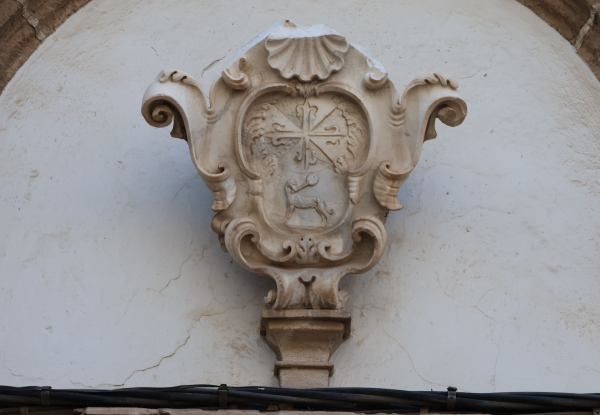
It is commissioned, instead, by those seeking a mark worth inheriting rather than a mark worth using briefly.
Some families ask whether they might eventually need more than one of these forms, and the honest answer is that many households do.
A couple might commission a decorative cipher for their wedding, a monogram for daily correspondence, and eventually a full family crest once their descendants are old enough to inherit it.
Each mark serves its own occasion without being asked to substitute for the others.
A crest is built to outlive trend cycles, often for a lineage rather than a lifetime.
Royal Traditions
Tincture, Charge, and the Layering of Meaning
Classical heraldry never treated colour as a matter of taste.
Gold traditionally signified generosity, silver signified peace, and deep blue signified loyalty carried across generations.
A custom family crest inherits this same discipline, even when its content is drawn from an entirely modern family history.
The tincture chosen for a field is not selected for how well it photographs.
It is selected for what it is understood to communicate, in a visual language older than the family commissioning the mark.
Charges follow the same logic, each one drawn from a documented detail of the family’s own story.
A ship might reference a maritime trade, an oak might reference land held across generations, and a compass might reference a family defined by long travel.
Each charge is kept deliberate and subordinate to the composition as a whole.
The moment a charge begins to compete with everything around it for attention, the composition has drifted from crest into clutter.
Archives held by one of the world’s most storied royal collections reveal centuries of monarchs and noble houses favouring restraint over crowded ornamentation.
Their holdings show a small number of confidently rendered elements chosen over a crowded field of competing symbols.
That same restraint, applied at a private and contemporary scale, is what separates a considered crest from an overworked one.
A family does not need centuries of documented nobility to apply this principle correctly.
It needs only the discipline to choose fewer elements and trust each one to carry more weight.
The relationship between tincture and charge also affects legibility in ways that are easy to overlook during early design review.
A pale charge on a pale field will read beautifully in a finished rendering but disappear entirely once engraved into silver or embossed into leather.
This is why every proposed tincture pairing is tested against its intended material application before it is finalised.
A composition intended primarily for engraving is developed differently than one intended primarily for printed stationery, even when the underlying shield remains identical.
Engraving relies on line and depth rather than colour, so a composition built around a bold contrast must be reconsidered entirely for that context.
A family that intends to use its crest across several materials should expect the design process to account for each application from the outset.
Colour as Language
Tincture is chosen for documented meaning, never for aesthetic preference alone.
A Charge, Not a Crowd
Every pictorial element must earn its place; the moment a charge competes rather than contributes, it is removed.
The Atelier Journal
The Architecture of a Crest
Every custom family crest commissioned at GUSTAVO ATHAYDE follows a disciplined sequence, refined over more than a decade of practice.
The process begins with listening rather than sketching.
A family’s surname is only the raw material; the meaning comes from what that name is understood to carry.
I ask about the history behind a family, the occasion prompting the commission, and the objects the crest will eventually inhabit.
A crest destined for a study door behaves differently than one destined for a signet ring or a family archive.
Scale, material, and viewing distance all shape the earliest structural decisions.
Only once that context is understood does symbolic research begin in earnest.
This stage draws on historical heraldic reference to ensure the proposed shield, tincture, and charges have genuine precedent.
Nothing is invented arbitrarily, and nothing is borrowed carelessly from an already documented design.
A period of refinement follows, during which several early directions are narrowed toward a single disciplined composition.
This stage typically takes longer than any other, since restraint requires far more judgement than addition.
A family is shown fewer options as the process advances, not more, as the design converges toward its final form.
Once the composition is resolved, the final mark is prepared for every application the family is likely to need.
This includes engraving specifications, stationery proofs, and a simple record of the mark’s correct proportions and colours.
That record matters more than it may initially seem.
A crest rendered slightly differently on a ring than on stationery begins to lose the authority that consistency provides.
1
Listen
Understand the history, standing, and occasion behind the commission.
→
2
Research
Identify a shield form, tincture, and charges with genuine historical precedent.
→
3
Refine
Narrow toward a single composition, favouring restraint over addition at every stage.
→
4
Test
Confirm legibility across every intended scale and material application.
→
5
Deliver
Prepare final files for engraving, embroidery, print, and archive.
The consultation stage often takes longer than families expect, and this is by design rather than by inefficiency.
A family’s charges are, in most cases, fixed once a composition has been finalised and produced.
This permanence justifies a slower pace than most commercial design projects allow, since the cost of an early mistake compounds across every future application.
Symbolic research frequently surfaces family history that had not been discussed in years, sometimes not since a grandparent’s own lifetime.
Families are occasionally surprised by what emerges, discovering a trade, a landholding, or a professional distinction they had not thought to mention at the outset.
This is one of the unplanned rewards of the process, entirely separate from the finished mark itself.
On Research
Nothing in a crest is invented arbitrarily; every charge and tincture is anchored to genuine, documented precedent.
On Pace
A crest completed too quickly rarely receives the scrutiny that produces a mark worth keeping for decades.
Legacy & Family Heritage
A Crest Across Generations
Few commissions carry more emotional weight than a crest designed to represent a family across generations.
A family crest is rarely built in a single sitting; it accumulates meaning the way a home accumulates memory.
Some families arrive with an existing mark, perhaps inherited from a grandparent, seeking refinement rather than replacement.
Others begin with nothing more than a surname and a wish to establish something their descendants might one day inherit.
Both starting points deserve equal care, though the design conversations differ considerably.
When refining an inherited crest, my first task is archival rather than creative.
I study whatever historical examples exist, whether engraved silver, an old seal, or a faded photograph of embroidered linen.
The goal is never to erase what came before, but to understand its logic well enough to extend it faithfully.
A family’s original crest may have been rendered under very different technical constraints than exist today.
Modern reproduction methods allow for a level of precision earlier engravers could only approximate by hand.
This means a refined family crest can honour its ancestral form while gaining a clarity the original may never have possessed.
When building an entirely new crest, the conversation instead centres on what the family hopes future generations will recognise.
This is a surprisingly difficult question for many families, precisely because it asks them to imagine descendants they will never meet.
I encourage families to think less about their present preferences and more about what will remain legible and dignified decades from now.
Trends fade quickly; a crest built to chase a current aesthetic will feel dated far sooner than one built on classical proportion.
This is why family commissions almost always favour restraint over novelty, even when a family initially requests something bolder.
A family crest typically finds its way onto items intended for daily and ceremonial use alike.
Stationery, linens, signet jewellery, and architectural details such as gates or door surrounds are common applications.
Each places different demands on the design, and a well-built crest must perform gracefully across all of them.
I often present families with a visual timeline showing how their crest might appear across a lifetime of use.
Seeing this continuity laid out tends to clarify, more than any explanation could, why restraint in the initial design matters so much.
First Generation
A founding household formalises its history into a single considered shield, engraved for the first time into silver.
Second Generation
The same composition is quietly refined, preserving proportion while gaining new clarity through modern craft.
A Marriage
The family crest is joined, gracefully, with the history of a new household entering the line.
Present Day
Descendants carry the mark forward, onto stationery, jewellery, architecture, and a family’s own archive.
A crest that can travel gracefully from a christening gift to a study door to a fiftieth-anniversary commission has succeeded at its deepest purpose.
It has become, in the truest sense, a family’s own private language of identity.
On Longevity
A crest that can travel from a nursery to a study door has succeeded at its deepest purpose.
On Inheritance
Refining an inherited crest begins with study, never with erasure of what came before.
Bespoke Weddings
When Two Families Become One Crest
A marriage remains one of the most meaningful occasions for commissioning or extending a family crest.
Two family histories are, quite literally, being asked to become one visual form.
This is a design challenge unlike any other in the atelier’s practice, because it must honour two separate lineages at once.
The technical question of composition becomes, in a marital crest, also a question of balance between families.
Neither family’s history should visually dominate the other, regardless of which name the household ultimately carries.
Achieving this balance requires careful attention to how the shield is divided and how each family’s charges are weighted within it.
A quartered composition, dividing the shield between two family traditions, is one of the oldest solutions to this exact problem.
It allows each family’s visual language to remain legible rather than blended into an indistinct middle ground.
Not every pairing calls for a literal quartering, however, and forcing the technique where it does not belong can feel mechanical rather than considered.
Sometimes the more honest solution is a single new charge that speaks to both families at once.
Deciding between these approaches is one of the more consequential judgements made early in the commission.
Couples exploring this path often arrive already familiar with the more contemporary wedding crest, and wonder how a lasting family mark differs from it.
The distinction matters, and it shapes everything that follows.
Many couples come to this process assuming their crest will only ever appear on their wedding stationery.
In practice, a well-designed marital crest tends to accompany a family for decades, appearing on anniversary gifts, home linens, and eventually a household’s own correspondence.
This long horizon is why I discourage overly trend-driven choices, even when a couple is drawn to a particular current style.
A crest chosen to feel current at the moment of a wedding often feels dated within a single decade.
A crest chosen for enduring proportion tends to feel just as appropriate at a fiftieth anniversary as it did on the day itself.
Families who have never formally documented their own visual history often discover, through this process, that they agree on more than they expected.
Others discover the opposite, and use the conversation as an opportunity for discussions long overdue between two households joining as one.
On Balance
In a marital crest, neither family’s history should dominate; balance is as much a matter of diplomacy as of design.
On the Union
Two family histories, distilled into a single composition, remain among the oldest luxury traditions still commissioned today.
2
Family histories united within a single composition
40+
Composition variations typically explored per commission
5
Material applications prepared for a family crest
1
Mark, built once, intended to last generations
A marital crest is, in many respects, the first shared symbol two families will ever commission together.
It deserves the same patience and precision the atelier brings to a royal-inspired heritage commission, because for the family receiving it, the significance is every bit as great.
Legacy & Family Heritage
The Crest in the American Household
American families have never needed a European title to justify an interest in formal identity.
Old firms on the Eastern seaboard, ranching families across the Southwest, and academic dynasties in college towns from coast to coast have each developed their own habits of visual memory.
A custom family crest suits this particular American instinct especially well.
It borrows a European grammar without requiring a European pedigree to earn the right to use it.
What it requires instead is documented honesty about a family’s own history, regardless of how far that history extends.
A family two generations removed from its founding members can commission a crest with exactly the same seriousness as one with centuries behind it.
The mark does not measure a family’s age; it measures the care taken in representing what that family actually values.
Family-owned businesses across the United States have long understood the value of a mark that signals permanence rather than trend.
A crest applied to a family enterprise communicates continuity in a way a purely commercial logo rarely achieves.
It suggests the business is an extension of a household, not a venture built for quick exit.
This distinction matters enormously to families who think in terms of decades rather than fiscal quarters.
Philanthropic culture, too, has long made use of discreet family marks, particularly among those who prefer their giving to remain understated.
A crest engraved into a modest plaque, or embossed onto correspondence accompanying a gift, allows a family’s identity to be present without becoming the centre of attention.
This quality of quiet presence is, in many ways, the defining characteristic of the crest tradition as a whole.
Architectural applications also carry particular weight within American commissions, especially among families restoring or building historic residences.
A crest worked into a gate, a mantel, or a stair rail can root a newly built home in a sense of continuity it might otherwise lack.
Even a family with no centuries-old lineage can, through a thoughtfully designed crest, begin building the kind of visual legacy that future generations will inherit and extend.
This national interest is not confined to any single profession or region.
Families in medicine and law often cite the same reasoning: their work already depends on precedent, discipline, and a long view of reputation.
Families in academia cite a similar instinct, having spent careers around institutions that have protected their own seals for centuries without alteration.
Families newer to significant means, including many in technology and enterprise, commission the mark for a slightly different reason.
For them, a custom family crest often represents a deliberate choice to build permanence into a life that has, until that point, moved quickly and changed often.
Whatever the specific motivation, the underlying appeal is consistent across every region and profession represented in the atelier’s client history.
On First Crests
A family building its first crest carries no obligation to any prior version, only to its own considered intentions.
The Atelier Journal
Voices from the Atelier
Families rarely describe a crest commission in the language of graphic design.
They describe it, instead, in the language of memory and inheritance.
Working with GUSTAVO ATHAYDE felt less like commissioning a graphic and more like being interviewed for a small piece of family history worth preserving. The crest now sits above our front gate, where it has already outlasted the renovation that prompted it.
The Hollister Family
Charleston, South Carolina · Family Crest Commission
I was sceptical that heraldry could feel relevant to a family without any documented nobility behind it, and the process proved me entirely wrong. Our practice now carries the same mark on its stationery, its office door, and my daughter’s own correspondence.
Dr. R. Okafor
Denver, Colorado · Professional Heritage Crest
What struck me most was the restraint in the process itself; every proposal felt considered rather than decorative. Our crest took several months, and every one of those months is visible in the precision of the final result.
The Whitcombe-Larsen Family
Portland, Oregon · Generational Crest
We come from a family of orchard growers, and I wanted our crest to feel like an extension of that work rather than a separate identity invented for one occasion. Guests frequently assume the mark has existed for generations.
A. Reinholt
Minneapolis, Minnesota · Agricultural Heritage Crest
These reflections share a common thread that extends beyond satisfaction with a finished product.
Each family describes the crest as something that continued to matter well after the commission ended.
This is the standard by which every commission undertaken through the atelier is measured.
Luxury Identity
The Crest as an Instrument of Luxury Identity
Luxury identity, at its most refined, rarely announces itself through logos in the conventional sense.
The most enduring names in fine craft, hospitality, and personal service have long favoured symbols that reward proximity over symbols that demand attention from a distance.
A custom family crest fits naturally within this philosophy, precisely because its meaning deepens the closer one looks.
This is the opposite operating principle of most contemporary branding, which is built to be understood instantly, at minimal cognitive cost.
A crest asks something different of its audience: patience, and a willingness to look twice.
Those who take the time to notice its charges tend to be precisely the audience such a family hopes to reach.
This is not exclusivity for its own sake, but a form of honest signalling about the values the mark represents.
A crest communicates craftsmanship through its own construction, before a single word of explanation is ever offered.
The world’s most respected luxury houses were, in nearly every case, founded around a single family’s mark.
A founder’s identity, rendered within a disciplined formal field, became the visual anchor for everything the house would later produce.
What separates these identities from a passing trend is the discipline with which they were maintained, decade after decade, without unnecessary revision.
Consistency, not novelty, is what earns any mark the right to be remembered.
A family commissioning a crest is applying that identical principle at a private, domestic scale.
The mark is not meant to announce anything to strangers.
It is meant to preserve a standard the family has already set for itself, and to hold future generations gently accountable to it.
Application consistency matters as much as the design of the crest itself.
A family identity built around a crest should apply that mark with the same restraint across every surface, from correspondence to architecture.
Overuse dilutes the very quality that made the crest distinctive in the first place.
I generally counsel families toward fewer, more deliberate placements rather than saturating every available surface.
A crest that appears everywhere quickly loses the sense of quiet significance that made it worth commissioning at all.
Heraldic Fidelity
93%
Balance and Proportion
90%
Symbolic Meaning
95%
Cross-Generational Legibility
96%
These figures describe restraint rather than scale, which is precisely the underlying point of the exercise.
A custom family crest, like true luxury, is not measured by how frequently it changes over time.
On Application
A crest that appears everywhere quickly loses the quiet significance that made it worth commissioning at all.
The Atelier Journal
Craftsmanship, Restraint, and the Discipline of Less
Craftsmanship, in the context of crest design, is ultimately a discipline of subtraction.
Every commission begins with more possibilities than the final design will ever contain.
The work of the atelier is not to add complexity, but to identify which single arrangement of charges carries the intended meaning most clearly.
This is a philosophy borrowed, in part, from classical architecture and calligraphy, both traditions built on the conviction that proportion communicates more powerfully than ornament.
A well-trained eye can sense when a crest has one charge too many, even without being able to articulate precisely why.
Developing that eye takes years, and I continue to refine my own through constant study of historical examples across cultures and centuries.
Restraint, however, should never be mistaken for simplicity in the dismissive sense.