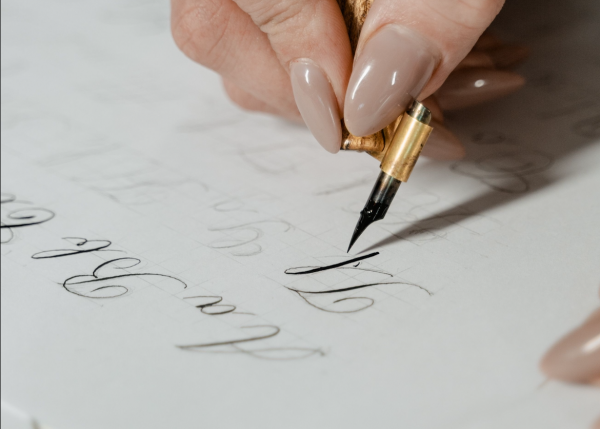
Personalized Wedding Monogram: A Union, Distilled
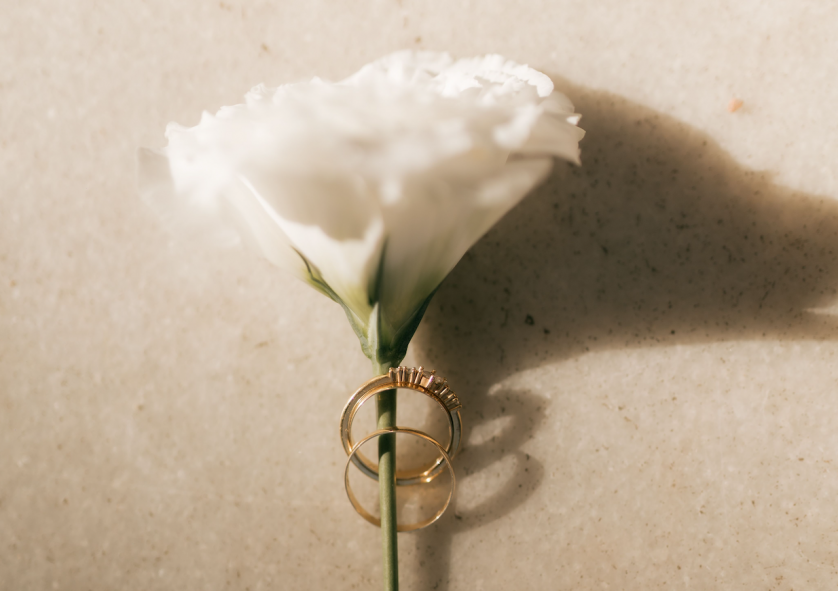
Personalized Wedding Monogram: Two Names, One Enduring Mark
THE ART OF MONOGRAMS
What a Personalized Wedding Monogram Actually Represents
A personalized wedding monogram is not a decorative flourish selected in the final week before a celebration.
It is a considered piece of visual language, composed for two names that are becoming one household.
Long before couples exchanged rings before witnesses, families exchanged marks before neighbors and courts alike.
A monogram quietly reconsidered, a proportion newly resolved, a single form meant to outlast the toasts that introduced it.
This has always been the quiet ambition behind a properly considered wedding identity.
In this reflection, I want to examine what a personalized wedding monogram truly is, and where its discipline originates.
I want to consider what separates a mark that fades into a drawer from one that is engraved, inherited, and remembered.
And I want to make the case that a personalized wedding monogram, composed with care, becomes closer to family property than party favor.
Couples exploring this path often arrive already familiar with the more contemporary custom couple monogram, and wonder how the two traditions relate.
That relationship matters, and it shapes nearly every decision that follows in the commissioning process.
A personalized wedding monogram is not simply two initials rendered in an attractive typeface.
It begins with two histories, not with a template awaiting a set of letters.
Every subsequent decision, from letterform to proportion, is made in service of those two specific histories.
This is the quality that separates a personalized wedding monogram from a generic interlace pulled from a catalogue.
The difference is rarely visible at first glance, though it becomes unmistakable with time.
A monogram assembled quickly tends to feel decorative, however attractive its initial presentation may appear.
A monogram composed slowly tends to feel inevitable, as though no other arrangement had ever been possible.
Most couples arrive at this distinction instinctively, long before they can articulate it in words of their own.
What they sense, without always naming it, is that a wedding monogram asks for a different kind of patience than ordinary lettering.
A classic monogram can succeed through elegant letterforms alone, resolved in a matter of weeks for a single name.
A personalized wedding monogram succeeds only once two names have been genuinely understood, which takes considerably longer to achieve well.
This is not a claim that one form is more valuable than the other, since both serve real and distinct purposes.
It is simply an acknowledgment that a wedding monogram carries a heavier symbolic load, and must be built to bear it.
Couples who choose this path are rarely seeking the fastest possible outcome for their stationery suite alone.
They are seeking a mark that will still feel correct at a fiftieth anniversary, long after the wedding itself has receded into memory.
That expectation shapes every conversation the atelier holds with a prospective couple from the very first meeting onward.
Some couples arrive already certain of what their monogram should say, having imagined it since the earliest days of the engagement.
Others arrive with only a feeling, unable yet to describe in words what that feeling should ultimately become.
Both starting points are equally valid, and neither produces a less considered outcome by the time the mark is finished.
The atelier’s task, in either case, is to listen before proposing a single direction to either partner.
A couple who feels rushed through this earliest listening stage rarely feels satisfied with what follows from it later.
This is why the initial conversation is treated with exactly the same care as the final refinement of the letterforms.
A personalized wedding monogram commissioned in haste tends to reveal that haste within a few short years of daily use.
One built with patience tends to feel, if anything, more resonant as the years pass and the marriage deepens.
That asymmetry, more than any single design principle, is what the atelier holds to on every commission it accepts.
ON INTENTION
A personalized wedding monogram is not chosen from a catalogue; it is composed from two names until it feels inevitable.
THE ART OF MONOGRAMS
Monogram, Cipher, or Crest: Choosing the Correct Form
The vocabulary surrounding wedding symbols is often used loosely, and clarity serves a couple well before any commission begins.
A classic monogram interlaces initials into a single, legible composition built for immediate recognition.
A cipher takes that interlacing further, favoring ornamental flourish and private legibility over instant clarity.
A crest, by comparison, borrows the pictorial grammar of heraldry rather than relying on letterforms alone.
A personalized wedding monogram sits closest to the first of these traditions, though it often borrows quietly from the other two.
Where a crest speaks through shield and charge, a wedding monogram speaks through the architecture of the letters themselves.
Couples drawn to a more restrained, single-name mark often find a natural home in the personalized monogram tradition instead.
That tradition answers a question of individual identity, distinct from the question a union asks of two names joined.
A wedding monogram, by contrast, must resolve two histories into one composition without diminishing either partner’s name.
This distinction shapes the entire brief a couple ultimately brings to their designer, whether they can articulate it or not.
Some couples arrive requesting one term while genuinely describing the needs of another entirely.
Part of the atelier’s first conversation with any couple is simply establishing which form the occasion actually calls for.
A couple seeking a formal heraldic statement is not asking the same question as a couple seeking a quiet personal mark.
Misreading this question at the outset is among the more common causes of an unsatisfying commission later on.
For this reason, the atelier treats the initial conversation with as much care as the design work itself.
A conversation that clarifies purpose early tends to shorten every stage that follows, rather than lengthen it.
Comparing Personal Mark Traditions
| Mark | Core Basis | Typical Use |
|---|---|---|
| Personalized Wedding Monogram | Two names resolved into one lasting composition | Invitations, linens, engraved keepsakes |
| Classic Monogram | A single name distilled to its essential letters | Correspondence, personal seals, stationery |
| Decorative Cipher | Ornamental interlacing favoring private legibility | Correspondence, keepsakes, wax seals |
| Family Crest | An entire lineage rendered through heraldic charge | Heirlooms, correspondence, architecture |
Understanding this table clarifies why a personalized wedding monogram is rarely a simple undertaking.
It draws on the permanence expected of a crest and the clarity expected of a monogram, all within one composition.
A mark with no formal grounding tends to feel decorative rather than considered by those who encounter it later.
A mark with too much heraldic weight can feel borrowed from a history the couple does not actually share.
The craft lies in finding the correct proportion between restraint and meaning for the two people involved.
Every couple’s names carry their own visual opportunities and constraints, discovered only through direct study of the letters themselves.
Some initials interlace beautifully on first attempt; others require a more architectural approach built around negative space.
This is why no two commissions at the atelier ever share a template, regardless of how similar two names might first appear.
Clarity of vocabulary also protects a couple from a common early mistake, namely commissioning the wrong form entirely for their occasion.
A couple who wants a formal heraldic statement should not settle for a monogram simply because the term is more familiar.
A couple who wants a quiet, legible mark should not be talked into a fuller crest simply because it photographs more dramatically.
The correct answer is rarely the more elaborate one; it is the one that actually matches the couple’s own intention.
This is a lesson the atelier repeats often, since elaborate work is not the same thing as considered work.
Restraint, applied correctly, is very often the more difficult craft to execute well across an entire commission.
ON VOCABULARY
Clarity about which form a couple actually wants, monogram, cipher, or crest, shapes every decision that follows in the commission.
ROYAL TRADITIONS
A Lineage Older Than the Modern Wedding
Long before logos became commonplace, the most enduring marks of distinction belonged not to companies, but to unions and houses.
Interlaced initials appear on coins, on manuscripts, and on the wax used to close private correspondence centuries ago.
European courts refined this instinct into a formal visual grammar, governed by proportion rather than momentary whim.
Records preserved by an institution devoted to the study of this formal design language continue to document how carefully personal marks were once composed and governed.
A royal cypher upon marriage was never merely decorative; it functioned as an instrument of governance and lasting record.
Two royal initials, once joined, appeared on state documents, on wedding china, and on the gates of royal residences alike.
A single royal marriage could occupy engravers and silversmiths for months, all working from one carefully approved cypher.
This heritage is the quiet foundation beneath every personalized wedding monogram produced today, whether a couple recognizes it or not.
Few couples arrive aware of this lineage, though nearly all recognize it once it has been gently explained to them.
The instinct to compress a union into a mark is, in this sense, far older than any individual client’s own occasion.
It is a human instinct, not a marketing invention arriving with the modern wedding industry.
What follows is a condensed account of that lineage, offered as context rather than as decoration.
The Wedding Monogram Across History
Antiquity
Rulers and merchant houses pressed personal initials into coins and seals as early instruments of authenticity.
Medieval Europe
Noble families wove joined initials into manuscripts and seals upon marriage, binding two lines into one visual record.
Renaissance
Merchant courts adopted paired ciphers to authenticate correspondence and goods exchanged between marrying households.
Georgian & Victorian Eras
The wedding monogram became a fixture of aristocratic life, engraved onto silver, linen, and formal stationery.
Twentieth Century
Luxury houses translated the personal cypher into a repeatable, recognizable identity beyond the household.
Present Day
The personalized wedding monogram re-emerges as a considered alternative to the ubiquitous template initial.
Each era refined the same underlying principle, namely that a union distilled into letters can carry authority across generations.
A design unaware of this lineage tends to feel merely fashionable rather than genuinely founded in precedent.
A design composed with awareness of it tends to feel inevitable, as though it could not have been arranged any other way.
This is precisely why the atelier studies precedent before beginning any new personalized wedding monogram commission.
History, treated this way, is not ornamental context; it is a working design tool applied to every new composition.
Records held by the institution formally responsible for granting personal arms in England still preserve this discipline under long-established law.
Nothing about a properly granted coat of arms is left to chance, from the tincture of a field to the charge it carries.
A couple does not require a cathedral or a national holiday to justify treating their own wedding monogram with this same seriousness.
They require only two names worth treating with the same care a court once applied to its own correspondence.
It is worth dwelling briefly on the specific technical constraints each era placed on a joined mark in turn.
Wax seals required forms bold enough to strike cleanly, while engraved silver rewarded far greater intricacy of line.
Textiles introduced their own constraints, since fine embroidery could not preserve the finest hairlines of a printed design.
A personalized wedding monogram today inherits every one of these historical constraints, whether a couple is aware of them or not.
This inheritance is not a burden; it is a body of accumulated knowledge about what actually survives across decades of daily use.
A designer who ignores this history is left reinventing solutions that earlier craftsmen had already resolved with great care.
A designer who studies it inherits centuries of trial, error, and refinement before a single letterform is ever drawn.
BESPOKE WEDDINGS
Two Names, One Composition
A wedding remains one of the most meaningful occasions for commissioning a personalized wedding monogram of genuine substance.
Two family names are, quite literally, being asked to become one visual form for the very first time.
This is a design challenge unlike most others in the atelier’s practice, because it must honor two separate histories at once.
The technical question of interlace becomes, in a wedding monogram, also a question of balance between two families.
Neither partner’s initial should visually dominate the other, regardless of alphabetical order or personal preference.
Achieving this balance requires careful attention to stroke weight, letter height, and the negative space each initial occupies.
Some pairings interlock naturally, their curves and counters meeting without any real resistance from the outset.
Others resist one another, requiring careful adjustment before the composition finally settles into place.
This resistance is not a design failure; it is simply the raw material the designer has been given to resolve.
The task is to reconcile that resistance without ever making the effort visible in the finished mark.
A monogram that looks labored has not yet been resolved, regardless of how many hours were spent composing it.
A monogram that looks effortless has usually taken far longer than a casual observer would ever guess.
Couples drawn instead to the fuller pictorial grammar of heraldry often find their answer in a custom wedding crest rather than a monogram alone.
That form borrows shield and charge; a wedding monogram, by comparison, works entirely through the architecture of two letters.
Neither approach is superior to the other, since each answers a different instinct about how a marriage wishes to be remembered.
Approaches to a Joined Composition
Symmetrical Pairing
Two initials of equal visual weight, mirrored around a shared center line.
Sequential Composition
Initials arranged in the order names are spoken, favoring clarity over strict symmetry.
Interlaced Glyph
Two letters merged into a single continuous form, demanding exceptional proportion.
Framed Composition
Initials unified within a wreath, ring, or border for added formality.
None of these approaches is inherently superior to another, and the correct choice depends entirely on the two names in question.
It depends on their history together, the character of their celebration, and the feeling they wish their guests to carry home.
A designer’s role is not to impose a preferred style, but to recognize which one already belongs to the couple at hand.
A personalized wedding monogram should never feel borrowed from a trend report, but remembered from somewhere deeply personal instead.
Many couples arrive with images gathered from other weddings, and this is a perfectly natural starting point for conversation.
Yet the finished mark should ultimately owe very little to any of those borrowed references by the time it is complete.
Its purpose is to feel inevitable in hindsight, not merely familiar in comparison to what came before it.
Some couples worry, early in the process, that a joined composition will feel excessive for their particular celebration.
This concern is worth taking seriously rather than dismissing outright, since restraint always remains the correct corrective.
A restrained monogram can feel entirely at home even at an intimate, understated wedding with a small guest list.
It is the ornamentation surrounding a mark, rather than the mark itself, that most often determines whether it feels appropriate.
This is a decision best made in conversation, rather than assumed in advance of understanding a couple’s actual celebration.
A designer attentive to this nuance can produce a monogram that feels correct regardless of a wedding’s formality or scale.
ON BALANCE
Neither partner’s initial should visually dominate the other; a personalized wedding monogram must honor two names without favoring either.
THE ATELIER JOURNAL
How a Personalized Wedding Monogram Is Composed
Every personalized wedding monogram begins long before a pencil meets paper for the very first time.
It begins with listening, carried out with the same patience a portrait painter brings to an early sitting.
A couple’s two histories, the character of their celebration, and the objects the mark will eventually inhabit all inform the earliest sketches.
What follows is a deliberate sequence, refined rather than rushed at any single stage of the commission.
Rushing the exploration stage produces a monogram that looks assembled rather than composed with intention.
Skipping the testing stage produces a mark that fails the moment it meets an actual seal, napkin, or engraved band.
This is why bespoke work resists the shortcuts so often associated with template-based design tools online.
A personalized wedding monogram is a small piece of architecture, and architecture rewards patience above nearly everything else.
The difference between a passable monogram and a memorable one is rarely visible at first glance to an untrained eye.
It reveals itself, instead, over years of continued use across correspondence, gifts, and quiet family occasions.
Every couple monogram commissioned at the atelier follows a disciplined sequence, refined over more than a decade of practice.
The process begins with listening rather than sketching, since a couple’s letters are only ever the raw material.
The meaning comes from what those letters are meant to carry forward, not from the letters themselves alone.
The Commissioning Sequence
STEP 01
Consultation
A private conversation establishes the history, context, and intention behind both names.
↓
STEP 02
Letterform Exploration
Multiple pairings are explored by hand before any digital tool enters the process.
↓
STEP 03
Refinement
The chosen direction is refined for proportion, negative space, and balance across every scale.
↓
STEP 04
Material Testing
The mark is tested across stationery, seal, ring, and architectural application.
↓
STEP 05
Delivery
The completed personalized wedding monogram is delivered in every format the marriage will require.
Nothing about this sequence is arbitrary, and each stage exists to remove a specific category of uncertainty from the process.
By the time delivery occurs, the outcome rarely feels like a surprise to the couple receiving their finished mark.
It feels, instead, like confirmation of something the couple already sensed was correct from the very beginning.
THE ATELIER JOURNAL
Craft in Numbers
Craftsmanship resists easy measurement, though certain figures still illuminate what a commission actually involves in practice.
A single personalized wedding monogram typically explores several distinct interlace directions before one is finally chosen.
This range exists because the correct solution for two specific names is rarely obvious immediately upon first sketch.
Multiple scales are tested for every finished mark, from a ring-sized engraving to a welcome-sign-sized print.
What a Commission Involves
2
Names distilled into one lasting mark
40+
Interlace variations typically explored
100+
Years a well-proportioned mark can remain legible
1
Mark, built once, intended to serve a marriage for life
These figures describe restraint rather than scale, which is precisely the underlying point of the exercise.
A personalized wedding monogram, like true luxury, is not measured by how frequently it changes over time.
It is measured, instead, by how rarely it ever needs to change at all once properly resolved.
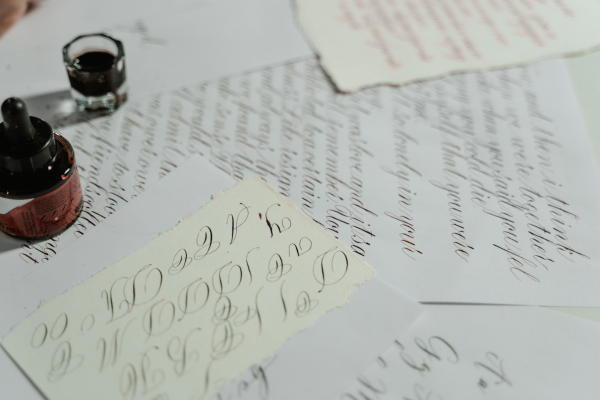
This is a difficult idea for many couples to absorb at the outset, since most modern design is built around iteration.
A personalized wedding monogram inverts that expectation entirely, favoring a single, correct resolution over a series of quick revisions.
The atelier’s own figures reflect this priority, weighting research and refinement far above rapid production of a finished file.
A commission that appears to move slowly in its early weeks is very often moving at exactly the correct pace.
Couples who trust that pace tend to receive a considerably more resolved mark than those who press for speed.
ON PACE
A commission that appears to move slowly in its early weeks is very often moving at exactly the correct pace.
LEGACY & FAMILY HERITAGE
Where a Personalized Wedding Monogram Meets Family Legacy
For some couples, a personalized wedding monogram is only the beginning of a much larger conversation about family identity.
Some begin this conversation with the more foundational language of a bespoke monogram before deciding a joined wedding mark better suits their occasion.
This is a different kind of commission than a purely decorative one, and it asks the designer to think in decades rather than seasons.
It asks the atelier to research family history with genuine curiosity, occasionally uncovering details the couple had never fully considered themselves.
Some couples arrive already holding an inherited family emblem on one or both sides of the marriage.
The wedding mark, in these cases, must honor that history rather than compete with it for attention.
Many couples also commission a companion monogram for everyday stationery, reserving a fuller mark for the most formal applications.
This pairing allows a single celebration to carry both an intimate daily mark and a more considered heritage piece.
Continuity over novelty is the underlying goal of nearly every legacy-minded commission undertaken within the atelier.
Every proportion and interlace decision within a personalized wedding monogram carries meaning understood primarily by the two families themselves.
A personalized wedding monogram represents two households joining as one, rather than a single individual standing alone.
A wedding monogram can become the first chapter of a much longer family legacy project, formalized over time rather than all at once.
Some clients return years after their wedding to expand their original mark into a fuller family emblem, incorporating children or milestones.
Others prefer to let the original monogram stand exactly as it was designed, unchanged for the rest of their lives together.
Both approaches honor the same underlying idea, namely that a family’s visual identity deserves the same care given to its financial legacy.
Families who have never formally documented their own visual history often discover, through this process, that they agree on more than they expected.
Others discover the opposite, and use the conversation as an opportunity to have discussions long overdue between two households joining as one.
A personalized wedding monogram, treated as a legacy object rather than a stationery accent, changes how a couple approaches nearly every decision about it.
It changes which materials they choose, which occasions they reserve it for, and which revisions they ultimately decline to make.
This shift in thinking rarely happens all at once; it tends to arrive gradually, across several conversations with the atelier.
By the time a couple reaches delivery, most have come to see their monogram less as a possession and more as a responsibility.
In communities where legacy is valued as deeply as innovation, identity often extends beyond a name. It becomes a symbol capable of representing a family, a celebration, or a personal story for generations.
ON INHERITANCE
A family emblem differs from an individual monogram chiefly in its intended audience, namely generations not yet born.
LUXURY IDENTITY
Where a Personalized Wedding Monogram Lives
A finished personalized wedding monogram earns its place across an entire celebration, not merely a single invitation card.
Its versatility is part of what makes the investment in proper design worthwhile over the course of a marriage.
It must function on a printed invitation and on an engraved band with equal grace and clarity.
It must be legible at the scale of a wax seal and dignified at the scale of a welcome sign.
These are not decorative concerns alone, but structural design problems that require genuine craftsmanship to resolve properly.
A mark that only performs at one scale has not yet been fully designed, however attractive its initial sketch may appear.
Stationery is the most obvious application, and often the first one couples imagine when the conversation begins.
Save-the-dates, invitations, and correspondence cards all benefit from a mark that ties an entire suite together.
The more interesting applications tend to emerge later in the planning process, once the mark itself has been finished.
A monogrammed wax seal closing an invitation envelope carries a weight no printed return address ever could achieve.
A discreet engraving inside two wedding bands turns a private object into a quiet record of the union itself.
A hand-embroidered detail on a linen napkin ages gracefully, gaining rather than losing character over time.
A cake server or a set of toasting glasses becomes a functional heirloom rather than a decorative one.
ON MATERIALS
The right material does not merely display a personalized wedding monogram; it participates in how the mark ages and is remembered.
Color carries particular weight within this tradition, and it deserves the same care given to letterform and proportion.
Gold traditionally signifies generosity, silver signifies peace, and deep blue often signifies loyalty within older heraldic convention.
Major museum holdings devoted to decorative arts and ceremonial craftsmanship include silverwork, textiles, and personal seals that reveal how seriously earlier generations treated a marriage’s visual signature.
These objects were rarely anonymous, and they were commissioned, considered, and passed down with the same care given to fine jewelry.
Restraint tends to serve a personalized wedding monogram well in this respect, echoing the flat, considered palettes favored throughout formal design traditions.
A flat, confident color choice, applied consistently, will almost always outperform a more elaborate palette over time.
Material honesty matters, since a wedding monogram should be designed for how it will actually be produced and used.
This principle extends to paper stock, thread weight, and even the finish of a wax seal itself.
Modern weddings unfold across far more surfaces than earlier generations ever anticipated when this tradition first took shape.
A personalized wedding monogram today must perform not only on printed stationery but across wedding websites and digital correspondence as well.
This expanded role has not diminished the importance of craftsmanship, and if anything, it has raised the stakes considerably.
A mark that appears slightly pixelated on a phone screen undermines the same sense of quality it was meant to convey on paper.
For this reason, every personalized wedding monogram produced within the atelier is delivered in formats suited to both physical and digital display.
Vector files ensure the mark remains crisp regardless of scale, from a small favicon to a large-format welcome sign.
Couples are often surprised by how long the list of eventual applications grows once the mark itself is finished.
A composition originally intended only for invitations frequently ends up requested for far more personal objects later on.
A leather passport holder, a set of monogrammed robes, a piece of stationery used years into the marriage.
None of these requests are unusual; they are, in fact, the most common outcome of a properly built mark.
Once a couple has a symbol they trust, they tend to look for reasons to use it across their shared life.
This is precisely the outcome the atelier designs toward from the very first sketch of the commission.
ON DIGITAL CONTEXTS
A personalized wedding monogram used as a small digital mark must remain legible even when reduced to a few pixels wide.
VOICES OF DISTINCTION
Voices of Distinction
The truest measure of a personalized wedding monogram is not how it looks on delivery, but how it ages afterward.
Clients rarely describe the process in technical terms when asked to reflect on the experience later.
They describe it, instead, in terms of recognition, permanence, and a certain quiet relief that the decision is settled.
The reflections below are drawn from couples who have commissioned this particular work with the atelier.
Names have been abbreviated throughout, to preserve the privacy each couple is rightfully owed.
What follows are a handful of reflections shared with the atelier by past clients across a range of celebrations.
Each account describes a different occasion, yet all of them return to the same underlying quality of quiet permanence.
“Our monogram arrived exactly as it should have, quiet, permanent, and unmistakably ours from the very first envelope it closed.”
Margaret & Everett H. · Newlyweds, Greenwich, Connecticut
“I come from a family of orchard growers, and I wanted our mark to feel like an extension of that history rather than a separate identity invented for one day.”
A Groom · Napa Valley, California
“What struck me most was the restraint in the process itself. Nothing was added to our monogram that did not need to be there.”
The Delacroix Family · Charleston, South Carolina
“Guests frequently assume our monogram has existed for generations, which is exactly the quiet permanence we had hoped for.”
Adaeze O., Physician · Aspen, Colorado
LUXURY IDENTITY
The Measure of Restraint
Luxury, properly understood, has very little to do with ornamentation for its own sake or its own display.
It has a great deal to do with discretion, precision, and quiet confidence in a design’s own presence.
A personalized wedding monogram embodies this principle more directly than almost any other object a couple might commission.
It does not need to shout, because its owners already know exactly what the mark represents between themselves.
This is the quality that separates genuinely luxurious design from design that is merely expensive to produce.
The progress above reflects how deliberately each stage of a personalized wedding monogram commission is weighted in practice.
Refinement consistently consumes the largest share of total effort, which surprises most first-time clients considerably.
This ratio is precisely inverted from how most people imagine the design process actually working before they begin.
A personalized wedding monogram asked to do too much, carrying dates, locations, and ornamental flourishes all at once, quickly loses its quiet authority.
The strongest examples resist this temptation entirely, from the very first proposed sketch through to final delivery.
Luxury identity is not about adding more, but about knowing precisely what to remove from a composition.
This principle guides every recommendation offered during the design process, even when a couple initially requests more elements than the mark can gracefully hold.
ON RESTRAINT
The most convincing luxury signal is rarely more ornament, but rather the confidence to include only what is necessary.
ROYAL TRADITIONS
What Royal Precedent Teaches the Wedding Monogram
No account of the personalized wedding monogram is complete without acknowledging its royal and ceremonial origins.
Royal marriages have always understood the underlying instinct, joining two initials into a single engraved cypher upon a union.
Certain collections that preserve centuries of ceremonial personal marks demonstrate how much a paired cypher can encode without a single written word.
Their archives reveal how carefully proportion, symmetry, and hierarchy were once governed by formal convention alone.