
Custom Coat of Arms: The Art of Being Remembered
The Custom Coat of Arms: A Shield Composed for a Living Name
A name can be spoken, written, or signed, and each of those acts leaves the name essentially unchanged.
A custom coat of arms does something different, because it converts a name into a form that can be inherited.
That conversion is not decorative, and it has never been casual.
It is the oldest deliberate attempt in Western culture to make identity outlive the person carrying it.
What follows is an account of how that attempt is made today, and why it still rewards patience.
Legacy & Family Heritage
What a Custom Coat of Arms Actually Is
A coat of arms is frequently mistaken for an ornament, and the mistake is entirely understandable.
Shields photograph well, and photography has a habit of flattening meaning into surface.
Yet the form was never conceived as ornament, and it has never behaved like one for long.
It was conceived as a statement, written in color and figure, declaring exactly who stood behind it.
That statement could be read across a field, across a hall, and across several centuries.
Nothing else in Western visual culture has carried personal identity with such stubborn precision.
The word custom, placed in front of the phrase, does a great deal of quiet work.
It signals that the arms were composed for one household rather than borrowed from a catalogue of surnames.
Surname-matching services will sell almost anyone a shield within minutes of a search.
What they sell is somebody else’s arms, attached to a name that happens to look similar.
A custom coat of arms begins from the opposite premise, namely that the household in question has its own history.
That history may be long and documented, or short and still forming, and either is a legitimate place to begin.
What matters is that the shield describes the household actually holding it.
I have spent more than a decade composing personal emblems, and this distinction decides nearly everything.
A borrowed shield can be rendered beautifully and still feel unclaimed by the family displaying it.
A composed shield can be rendered simply and still feel entirely settled.
The difference is not craft; the difference is provenance.
Composed, Not MatchedA custom coat of arms is built around one household’s documented history. It is never retrieved from a database keyed to a surname, because a surname is not a lineage and a coincidence is not an inheritance.
It helps to be precise about what the phrase covers, since the vocabulary has grown loose in ordinary use.
The arms proper are the shield and its contents, and everything else is arranged around that shield.
The crest is the device that historically sat above the helm, and it is only one part of the whole.
The full arrangement, shield and crest and mantling and motto together, is properly called an achievement.
Casual usage collapses all of these into a single phrase, which is harmless until precision begins to matter.
Precision begins to matter at the moment a family decides what it is actually commissioning.
Readers wishing to trace the broader lineage of the form will find a fuller study of the armorial tradition and its long survival elsewhere in this Journal.
This essay concerns the narrower question of composing new arms for a living name.
It is a narrower question, and in practice a considerably harder one.
A historical shield only has to be understood, while a new shield has to be justified.
Every element placed upon it must answer for its presence, because nobody inherited it and nobody can hide behind precedent.
Royal Traditions
From Battlefield Necessity to Inherited Grammar
The coat of arms was born on the twelfth-century battlefield, where being recognized was a practical matter of survival.
A man sealed inside a helm was anonymous, and anonymity in combat was dangerous in both directions at once.
Allies could not rally to someone they could not identify, and chroniclers could not credit deeds to an unnamed figure.
So knights painted bold devices onto their shields, chosen for legibility through dust and distance rather than for beauty.
A red chevron on gold, a silver lion on blue: forms that survived poor light and worse weather.
The surcoat worn over the armor carried the same device, and that garment gave the tradition its name.
A coat of arms was, quite literally, a coat, and the arms were the weapons it accompanied.
Within roughly two generations the device had become hereditary, and that single change altered everything about it.
A son bearing his father’s device was no longer describing himself; he was continuing someone.
The mark stopped functioning as a label and started functioning as an inheritance.
Labels identify, while inheritances oblige, and the distinction between the two is not a small one.
A knight carrying his grandfather’s arms carried his grandfather’s reputation onto the field with him.
Disgrace the arms and you disgraced every man who had borne them before you.
This is the moment the form acquired its moral weight, and it has never once set that weight down.
By the thirteenth century the system had grown crowded enough to require adjudication.
Two households claiming the same device was no longer an inconvenience but a genuine legal dispute.
Heralds, once merely announcers at tournaments, became the registrars and referees of the entire visual language.
They recorded who bore what, ruled on conflicts, and codified a grammar that outlived every court that used it.
That codification survives into the present in a form its founders would recognize immediately.
In England, the office that has granted and recorded armorial bearings since the fifteenth century still exercises the authority its medieval predecessors established.
Arms there are not designed so much as granted, following procedures older than the printing press.
Very few institutions anywhere have administered a single visual system with such unbroken continuity.
I find that continuity genuinely instructive, and not for sentimental reasons.
It demonstrates that a well-built system of identity can outlive every circumstance that produced it.
The battlefield disappeared, the tournament disappeared, the knight disappeared, and the shield remained.
It migrated onto seals, then silver, then bookplates, then gateposts, changing its surface without changing its logic.
That is the pattern every durable personal symbol follows, and it is worth stating plainly.
Surfaces change constantly, while structure, correctly resolved, changes almost never.
The chronology below compresses eight centuries into its essential movements.
Read it less as history than as evidence of how patiently a sound idea travels.
Twelfth CenturyRecognition Under a Closed HelmKnights paint bold devices onto shield and surcoat so that they can be identified through dust and distance. Legibility, not beauty, governs every early compositional decision.
Thirteenth CenturyThe Device Becomes HereditaryArms pass from father to son as a visual surname carried into every engagement. Heralds begin recording bearings, turning battlefield custom into an administered system.
Fourteenth & Fifteenth CenturiesThe Grammar Is CodifiedDisputes over identical arms reach the courts, and formal authorities emerge to settle them. Blazon matures into a language precise enough to rebuild any shield from words alone.
Sixteenth & Seventeenth CenturiesFrom Armor to Household ObjectThe shield migrates onto seals, silver, architecture, and the printed bookplate. Merchant and professional households petition for grants, extending the tradition well beyond the nobility.
Eighteenth & Nineteenth CenturiesThe Armorial HouseholdProsperous families across Europe and America adopt engraved crests for stationery, linen, and carriage doors. The shield becomes a fixture of considered domestic life rather than of war.
Present DayArms Composed Rather Than InheritedGranting bodies, family archives, and private ateliers carry the discipline forward. A custom coat of arms is now most often composed for a household that intends to begin its own record.
The Art of Monograms
Blazon and the Grammar That Makes a Shield Portable
Every coat of arms can be written down in words, and this fact surprises nearly everyone who first encounters it.
The words belong to a technical language called blazon, part Norman French and part pure geometry.
Azure, a lion rampant argent: three terms, and a trained reader reconstructs the shield exactly.
A blue field, a silver lion rearing upright, with no ambiguity and no room for improvisation.
Blazon is the reason armorial identity survived centuries in which no reliable method of copying images existed.
The picture did not need to travel, because the sentence travelled and the picture could be rebuilt anywhere.
I know of no other design tradition that achieved lossless transmission seven hundred years before the digital file.
This has a practical consequence for anyone commissioning arms today.
A custom coat of arms that cannot be blazoned cleanly is usually a shield carrying more than it can hold.
The discipline of describing a composition in words tends to expose whatever the composition has not resolved.
I write the blazon before I consider a drawing finished, precisely because the sentence refuses to flatter.
Vocabulary confusion is the most common obstacle in an early conversation, and it costs households real time.
A coat of arms, a crest, a personal monogram, and a classic monogram are four genuinely different instruments.
Each answers a different question, and asking one to perform another’s work produces predictable disappointment.
Arms represent a household across generations and are governed by the strictest conventions of the four.
A crest is a single element of that arrangement, though common usage has long treated it as a synonym for the whole.
A personal monogram represents one life, composed from letterform alone and free of any pictorial charge.
A classic monogram is that same letterform discipline held to its most conservative and most durable register.
Households frequently commission more than one of these, using each for the work it was designed to do.
The table below sets the distinctions out plainly, since a shared vocabulary shortens every conversation that follows.
| Instrument | What It Represents | Governing Discipline | Where It Belongs |
|---|---|---|---|
| Custom Coat of Arms | An entire household, carried forward without alteration | Blazon, the rule of tincture, and the conventions of difference | Gates, seals, bookplates, architecture, formal documents |
| The Crest | One element of a full achievement, often used alone | The same heraldic grammar, applied to a single device | Signet rings, silver, embossed covers, small applications |
| Personal Monogram | One individual life, composed from letters alone | Typographic proportion, hierarchy, and negative space | Correspondence, cuffs, cases, personal possessions |
| Classic Monogram | A name held in its most conservative register | The narrowest reading of that same letterform discipline | Linen, engraved objects, daily and repeated use |
Much of this grammar survives only because someone chose to record it with care and kept on recording it.
Today independent scholarship devoted to preserving armorial convention maintains that record, cataloguing distinctions that would otherwise have thinned considerably.
That body of work is a working reference rather than an antiquarian pleasure.
An atelier composing new arms consults it for the same reason an architect consults precedent.
Not in order to copy, but to avoid solving badly a problem that was solved well several centuries ago.
Knowing the conventions is also what makes departing from them a decision rather than an accident.
A shield that breaks a rule knowingly reads as confident, while one that breaks it unknowingly reads as careless.
Viewers rarely identify which rule was broken, and yet they register the difference immediately.
Legacy & Family Heritage
Choosing the Charges a Household Will Carry
The charges are the figures placed upon the field, and they are where a custom coat of arms becomes particular.
A lion, an oak, a compass rose, a sheaf of wheat: each carries centuries of accumulated association.
None should be selected because it looks well, although the finest choices very often do.
They should be selected because they are true of the household, in a way that could be defended aloud.
This is the most demanding conversation in the entire commission, and it rarely resolves in a single sitting.
Families arrive expecting to discuss shape and color and find themselves discussing what they actually value.
That conversation is frequently the most valuable part of the process, regardless of the shield it produces.
Some households discover they agree on their own character rather more than they had expected.
Others discover the opposite and use the occasion for a conversation long overdue.
Either outcome justifies the undertaking, and both improve whatever is eventually drawn.
Documented, Not DecorativeEvery charge on a commissioned shield should trace back to something the household has actually lived. A symbol chosen because it photographs well will read as costume within a single generation.
A household shaped by service tends to gravitate toward figures of duty rather than figures of ornament.
A household shaped by trade tends toward marks of exchange, voyage, and accumulated trust.
A household shaped by land tends toward growth, season, and stewardship held across a long horizon.
None of these instincts is superior, since each describes something lived rather than merely admired.
The atelier’s task in an early conversation is simply to notice which instinct is genuinely present.
Only afterward does the work of translating that instinct into field, charge, and tincture properly begin.
This sequence, listening before drawing, is not a courtesy extended to a client.
It is the only reliable method by which newly composed arms avoid feeling generic.
A designer who sketches before listening is designing for an imagined household rather than the actual one.
The resulting shield may be technically accomplished and still feel strangely unclaimed.
A family encountering such a shield senses, correctly, that a step was skipped somewhere in its making.
The FieldThe background of the shield, named first in every blazon. It is the ground on which all subsequent meaning is placed, and its tincture decides what may sit upon it.
The OrdinariesThe broad geometric bands that divide the field: the chevron, the fess, the bend, the cross. They give a shield its underlying structure before any figure is introduced.
The ChargesThe figures the household actually carries. Each must trace to documented history rather than to a symbol library, and each must earn the space it occupies.
The TincturesTwo metals and a small register of colors, governed by a rule that forbids weak contrast. Restraint here separates an authoritative shield from a merely busy one.
The MottoA brief phrase distilling a governing principle into words. The best are short enough to be remembered after a single reading and honest enough to be repeated.
The AchievementThe complete arrangement of shield, crest, mantling, and motto. It is the full sentence, and like any sentence it is weakened by every unnecessary clause.
The elements above are not a menu, and they should never be treated as one.
They are the working parts of a single sentence, and a sentence is weakened by every clause it does not need.
A crowded shield dilutes meaning exactly as a crowded room dilutes taste.
The discipline lies in choosing fewer figures and trusting each one to carry more.
Households with an existing device face a related question, since two marks in one family must never visually argue.
Those already holding an inherited device will find a companion account of the commissioned heraldic crest useful before proceeding further.
Where such a device exists, the new arms are composed to sit beside it rather than to compete with it.
Sometimes the resulting shield borrows a tincture or a proportion directly from the older mark.
More often it borrows only a sensibility, a shared restraint that allows both to occupy one household comfortably.
The Argument Against AbundanceA household may have several stories worth telling, yet a shield can hold only so many before it stops being read at all. Deciding which story matters most is usually the hardest hour of the commission.
The Atelier Journal
Tincture, Contrast, and the Oldest Rule in Design
Heraldry recognizes two metals, gold and silver, alongside a small register of rich colors.
Their governance is where the discipline of the tradition becomes most visible to a modern eye.
The rule of tincture forbids placing color upon color, or metal upon metal, within a single composition.
A blue charge may not sit on a black field, and a gold star may not sit upon silver.
The rule exists for exactly one reason, and that reason is contrast.
A shield had to be read instantly, in poor light, at a hostile distance, by someone with other concerns.
Low-contrast heraldry was not merely unattractive; it was useless, and its makers declined to produce it.
Eight centuries later I hold every emblem leaving the atelier to precisely that standard.
If a mark cannot be read at a glance, it has failed, whatever its other virtues may be.
The rule of tincture is, in this sense, the oldest accessibility guideline in Western visual culture.
Color also carries meaning, though that meaning is more conventional than mystical.
Gold has long signified generosity, silver has signified peace, and deep blue has signified loyalty and truth.
Red has signified fortitude, green has signified hope and durable growth, and black has signified constancy.
These associations are conventions rather than laws, and they vary somewhat between national traditions.
Their value lies in being shared, since a private symbolism understood by nobody communicates nothing at all.
A tincture chosen for personal reasons alone tends to require explanation, and explanation is what arms exist to avoid.
Restraint in the palette is what separates an authoritative shield from a busy one.
Two tinctures and one metal will carry almost any household, and most of the finest historical examples do exactly that.
A shield that must be explained has already failed. The rule of tincture is eight hundred years old and it still asks the only question that matters: can this be read at a glance, by someone who is not trying?
The physical evidence for all of this survives in remarkable quantity and rewards close attention.
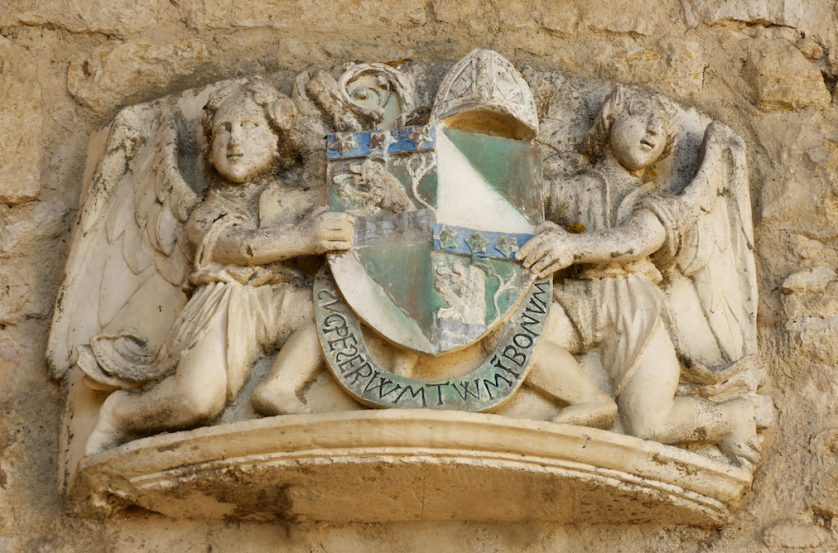
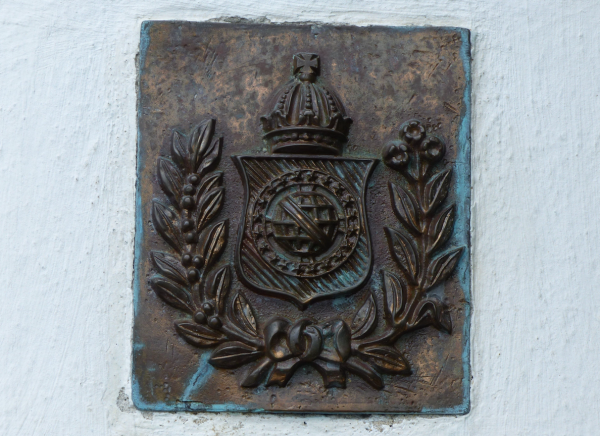
Within the assembled holdings of Europe’s longest-standing royal household one finds armorial devices applied to porcelain, silver, textile, and bound volume alike.
Studying that material, even at a distance, is a sustained lesson in restraint practised at the highest level.
What one notices first is how little the finest examples attempt.
A single dominant charge, two tinctures, and an arrangement resolved so completely that it appears obvious.
Obviousness of that kind is never accidental, and it is almost never achieved quickly.
It is the residue of many decisions, most of which involved removing something rather than adding it.
This is the hardest habit to teach and the easiest one to recognize in finished work.
The Art of Monograms
The Personal Monogram Beside the Shield
A custom coat of arms is not the only mark a household requires, and it was never intended to be.
Arms are formal instruments, suited to the gate, the seal, the bookplate, and the document that must carry weight.
Daily life asks for something lighter, and that lighter register is the province of the personal monogram.
A personal monogram represents one individual, composed from letters rather than from figures.
It appears on correspondence, on a shirt cuff, on a case, on the objects a single life quietly accumulates.
It is not a lesser form, and treating it as one tends to produce marks that feel apologetic.
It is simply a different instrument, tuned to a different range and a different audience.
The relationship between the two is the part most households find genuinely clarifying.
Arms speak for the household, while a personal monogram speaks for the person within it.
Arms are inherited unchanged, while a personal monogram belongs to one life and ends with it.
Neither can perform the other’s work without appearing either overbuilt or underbuilt.
A full shield engraved onto a fountain pen looks like a costume, however well it has been drawn.
A pair of initials carved above a gate looks like a label, however elegant the letterform.
Matching the instrument to the occasion is a great deal of what an atelier is actually for.
One Household, Several InstrumentsMost families end up holding more than one mark: arms for the formal register, a shared household emblem for the middle, and a personal monogram for daily life. Confusion between them is the commonest error.
Households sometimes want a shared mark that is neither a full achievement nor a single life’s initials.
That middle register genuinely exists, and a study of the household emblem composed for shared use treats it at length and on its own terms.
It borrows the shield’s respect for proportion without claiming the shield’s formal apparatus.
Many families end up holding all three, using each where it belongs and never confusing one for another.
Coherence across the three is what makes a household’s visual identity feel considered rather than assembled.
The marks need not resemble one another, though they should clearly have been made by the same judgment.
A shared proportion, a shared weight of line, a shared reluctance to decorate: these are usually enough.
When that coherence is present, a visitor senses it without being able to name what produced the impression.
When it is absent, a household’s objects feel like a collection rather than a family.
This is a quiet effect and an entirely real one.
The Atelier Journal
How a Custom Coat of Arms Is Commissioned
Commissioning arms resembles a private consultation far more than it resembles a transaction.
The process opens with conversation rather than with a questionnaire handed across a table.
Family history, professional context, and shared intention are discussed well before any drawing begins.
Only once that context is understood does the atelier explore particular directions for the shield.
Several directions are typically developed before a single one is presented for consideration.
Refinement continues until the composition performs correctly at every scale the household will encounter.
Delivery is never the end, since guidance on consistent application matters as much as the artwork itself.
This structure exists to protect a household from settling too early on the wrong direction.
01
ConsultationA private conversation establishes history, context, and what the household actually intends the arms to do. Nothing is drawn during this stage, and nothing needs to be.
02
ResearchHeraldic and typographic precedent is gathered for the specific household, including any inherited device that the new arms will need to live alongside.
03
Structural DrawingField, ordinaries, and principal charge are drafted in raw form. The blazon is written at the same time, since words expose whatever the drawing has not yet resolved.
04
RefinementProportion, line weight, and the balance between charge and field are resolved across several unhurried passes. Most of the commission’s hours are spent here.
05
Scale TestingThe composition is tested from signet size to architectural size, and across engraving, embossing, thread, and screen. Anything that fails a scale is revised, not excused.
06
Delivery and RecordFinished artwork is prepared for every intended application and archived with its written blazon, so the household can reproduce it identically for as long as it holds it.
Each stage exists to remove uncertainty before a household commits to a final composition.
By the time delivery arrives, the outcome rarely feels like a surprise to the family receiving it.
It feels instead like confirmation of something the household already suspected was correct.
Families are shown the reasoning behind each direction, not only the image at the end of it.
This transparency is deliberate, since a commissioned shield should be understood rather than merely accepted.
A household that understands the reasoning trusts the outcome more than one handed a finished result.
That trust, once established, makes every subsequent revision easier for both parties.
It also makes it considerably easier to abandon a direction that is simply not working.
Revision proceeds through incremental adjustment rather than wholesale replacement between drafts.
This measured pace allows small errors to be caught before they compound into larger ones.
Exploration is deliberately generous at this stage, because certainty cannot be hurried into existence.
Most directions drawn during exploration are set aside, and setting them aside is not wasted effort.
Each discarded treatment teaches something about what a particular household refuses to become.
By the time a direction is presented, it has survived every objection the atelier could raise against it.
What remains is not the cleverest option drawn, but the one that stopped asking to be revised.
Nothing reaches a household without having earned its place through repeated and unsentimental scrutiny.
The timeline for a full commission typically extends across several weeks of research and reconsideration.
Compressing it tends to produce shields that seem clever briefly and lack resonance afterward.
No one expects an heirloom desk to be finished within a single week.
A custom coat of arms deserves precisely the same expectation of unhurried care.
The Art of Monograms
The Classic Monogram as the Shield’s Daily Voice
A classic monogram is less a style than a discipline, tested and narrowed across many centuries of use.
It draws its authority from proportion rather than from the preferences of any particular decade.
That is precisely what allows a classic monogram to remain dignified across an entire lifetime.
Where a shield declares, a classic monogram simply confirms, and the difference in register is considerable.
Households holding both tend to use the monogram far more often, and to think about it far less.
Frequency of use is exactly why it must be resolved with the same rigor applied to the arms themselves.
A mark seen daily has no opportunity to hide behind ceremony.
The letterform discipline behind such a mark is the atelier’s foundational commission.
Readers may wish to consult the atelier’s account of the mark composed for a single private life alongside this one.
The two commissions differ in scope while sharing every underlying principle of proportion and restraint.
A dominant initial should anchor the composition without straining for attention.
Supporting initials should feel deliberately placed rather than merely accommodated.
Negative space should be composed with the same intention as the strokes surrounding it.
The whole should survive reduction to the size of a signet without losing its identity.
These are the same tests a shield must pass, applied to a considerably smaller surface.
A smaller surface is less forgiving rather than more, which many first-time clients find counterintuitive.
Where the effort in a commission actually goes is rarely where a household expects to find it.
The proportions above reflect how a commission is genuinely weighted rather than how it is imagined.
Refinement consistently consumes the largest share, which surprises nearly every household at the outset.
A composition that appears effortless has usually been revised a dozen quiet times before delivery.
None of that revision is visible in the finished mark, which is exactly the intended effect.
The most successful marks are read in one glance rather than deciphered in two.
That immediacy results from a careful resolution between richness and clarity, never from luck.
Families are sometimes disappointed to learn how little of the work is inspiration.
Inspiration supplies the first hour, and judgment supplies every hour after it.
This holds true of the shield, of the personal monogram, and of the classic monogram equally.
The Fingernail TestReduce the mark until it is barely larger than a fingernail and look again. Whatever survives that reduction is the mark itself; whatever disappears was decoration all along.
Luxury Identity
Arms Without a Crown: The American Question
A question arrives in nearly every American commission, usually within the first conversation.
It concerns whether a household without title or grant has any business bearing arms at all.
The question deserves a direct answer rather than a diplomatic one.
In the United States there is no governmental body that grants, regulates, or records armorial bearings.
Nothing prohibits a household from assuming arms, and nothing confers official standing upon them either.
What exists instead is a convention of good practice, observed by those who take the tradition seriously.
That convention holds that assumed arms should be original, unduplicated, and honestly described.
It holds that one does not adopt another household’s arms because a surname happens to coincide.
It holds that one does not claim a grant that was never made.
And it holds that arms, once assumed, should be used consistently rather than revised with fashion.
Observed carefully, these conventions produce something entirely legitimate and quietly dignified.
Ignored, they produce costume, and costume is recognized as costume rather quickly.
American households have assumed arms since the colonial period, and the practice is neither new nor eccentric.
Merchant families in the eastern seaports used armorial bookplates, seals, and engraved silver as ordinary equipment.
Those objects survive in quantity in American collections and are not the artifacts of an imported aristocracy.
They are the artifacts of households that expected to be corresponding with strangers for a very long time.
The instinct behind them has not disappeared, and in some respects it has intensified.
A household today corresponds with more strangers, across more channels, than any eighteenth-century merchant imagined.
What has thinned is not the need for a considered mark but the habit of commissioning one.
800+Years the armorial grammar has remained in continuous use
2Metals and a small register of colors, governing every composition
1Household to which a properly composed shield belongs
∞Generations a well-resolved coat of arms is built to serve
The figures above describe restraint rather than scale, which is precisely the point being made.
A custom coat of arms is not measured by how often it changes.
It is measured by how rarely it needs to change once it has been resolved properly.
Households sometimes ask whether an assumed shield can ever carry the weight of a granted one.
The honest answer is that weight accrues through use rather than through registration.
A shield used consistently for sixty years by a household that means it acquires an authority no certificate supplies.
A registered shield used carelessly acquires nothing at all.
This is not an argument against formal grant, which remains genuinely meaningful wherever it is available.
It is an argument that the discipline matters more than the paperwork, and always has.
Luxury Identity
Where a Custom Coat of Arms Lives
Arms do not exist in isolation; they exist as marks applied to material, and material has opinions.
The intelligence of a composition must account for every surface it will eventually inhabit.
This is not a secondary consideration but among the most demanding aspects of the entire commission.
A shield that reads beautifully in ink on cream stock may lose definition entirely when engraved into silver.
A composition carrying fine hairline detail may vanish when translated into single-color thread.
These are not problems to be solved afterward, and they must be anticipated from the first sketch.
On paper the arms must perform with typographic precision at correspondence scale.
On silver they must hold their integrity when engraved at the smallest useful size.
On leather they must read confidently as a blind impression, without any assistance from color.
On fabric they must simplify sufficiently for thread while retaining their essential character.
In digital form they must compress to a few hundred pixels without becoming a smudge.
Five Surfaces, One MarkPaper, silver, leather, fabric, and screen each impose their own discipline. A composition satisfying all five was designed by someone who understood they were building a system rather than an image.
Applications accumulate faster than households anticipate once the first object exists.
A seal becomes stationery, stationery becomes a bookplate, and a bookplate becomes an engraved case.
Each reinforces the others, producing an effect no single object could achieve on its own.
This quiet compounding is what a well-considered shield actually delivers across decades.
The historical record makes this argument better than any contemporary explanation could.
Within the decorative arts holdings of one of the world’s great encyclopedic museums one finds armorial marks belonging to monarchs and merchants preserved side by side.
What separates the finest examples is never complexity but coherence of a very particular kind.
Every line appears placed for a reason, and the whole speaks with a single unhurried voice.
Architecture deserves separate mention, since it is where arms are least forgiving of error.
A shield cut into stone cannot be revised, and it will be read by everyone who passes it.
Scale changes a composition’s behavior in ways that surprise households encountering it for the first time.
Detail reading as refined at correspondence size can read as fussy at the size of a lintel.
This is why architectural applications are tested at full size before anything is committed to material.
The test is inexpensive at the drawing stage and ruinous afterward.
Tested, Not AssumedA template is rarely tested beyond a single context, which is precisely where templated design fails. A commissioned shield is stress-tested against every application a household intends to use.
The Atelier Journal
Notes from Households Who Commissioned Their Arms
The truest measure of an atelier’s work is not the portfolio it displays.
It is the experience it creates for the households who commission it.
A custom coat of arms is by nature a deeply personal undertaking.
Arriving at one should feel like a collaboration from the first conversation to the final delivery.
Clients rarely describe the process in technical terms when asked to reflect on it afterward.
They describe it instead in terms of recognition, permanence, and a certain quiet relief.
Relief recurs more often than excitement, which I have come to regard as a good sign.
Excitement fades within a season, while relief tends to persist for years without commentary.
The accounts below have been abbreviated, and names shortened, to preserve the privacy each household is owed.
They are offered less as endorsement than as evidence of what the process actually feels like from inside it.
“My grandfather started the mill and none of us had ever thought to give the family a mark. What arrived felt less like a design than like something we had misplaced and finally found again.”R. Vandermeer · Fourth-Generation Family Business · Grand Rapids, Michigan
“We are two histories that met thirty years ago, and I expected a compromise. The shield does not read as a compromise at all. It reads as one household, which is what we actually became.”The Okafor-Lindqvist Family · Household Commission · Minneapolis, Minnesota
“I came in wanting something elaborate and left with something considerably quieter. Two years on, I understand why every suggestion I made was gently tested before it was set aside.”Dr. E. Castellanos · Professional Identity Commission · San Antonio, Texas
“What surprised me was how much talking preceded the first sketch. By the time I saw a drawing, I could already have described it. That is not a coincidence, and I no longer think it could be.”T. Beaumont-Hale · Family Arms Commission · Charleston, South Carolina
What recurs across these accounts is the length of the conversation preceding the first sketch.
Households consistently report that the talking mattered more than they had expected it to.
That has been my experience from the other side of the table as well.
The drawing is the part everyone remembers, and the listening is the part that made it possible.
Legacy & Family Heritage
Passing the Shield Forward with Care
A custom coat of arms is easy to commission and, handled carelessly, just as easy to dilute.
The most common error is treating the shield as a finished product rather than a continuing responsibility.
Once delivered it requires no further design work, though it does require a small and permanent discipline.
The arms should be reproduced identically each time, in the same proportions and the same weight of line.
A shield rendered differently on a signet than on stationery forfeits the authority that consistency provides.
Families are encouraged to keep a written record of the correct specifications and of the blazon itself.
This is not bureaucracy; it is the discipline that has kept the oldest household identities intact.
A blazon is the most durable form of that record, since words outlive every file format ever invented.
Introducing the arms to children early, and explaining rather than merely displaying them, matters considerably.
A child who understands why a charge was chosen treats the mark differently than one who was never told.
Some households formalize this by naming an informal keeper of the arms within each generation.
It is not a legal role but a practical one, ensuring someone can answer questions as time passes.
Small gestures of this kind have kept several long-standing households consistent across many decades.
Arms reproduced inconsistently forfeit the very authority that made them worth commissioning. Consistency is the only maintenance a shield ever genuinely asks of the household that holds it.
Families occasionally ask whether arms may be modified to reflect a marriage or a new chapter.
This is possible, and the tradition has formal mechanisms built for exactly that circumstance.
It should nevertheless be approached with the restraint that shaped the original composition.
A shield that changes frequently forfeits the permanence that made it worth commissioning at all.
When modification is warranted it should feel like a considered addition rather than a redesign.
The goal is a mark future generations recognize as unmistakably theirs without requiring any explanation.
Marriage raises a related question about how two armigerous households combine their marks.
The tradition addresses this through impalement and quartering, both of which have long-settled conventions.
Applied thoughtlessly they produce shields nobody can read, which defeats the purpose entirely.
Applied carefully they produce a record of alliance that remains legible generations later.
Restraint governs here exactly as it governs everywhere else in the tradition.
Consistency Is the Only MaintenanceRecord the blazon once, in writing, and keep it with the family papers. Reproduce the arms identically on every surface they touch. Explain them to the next generation before they are old enough to ignore them.
The Atelier Journal
Why This Work Refuses to Be Hurried
A custom coat of arms carries consequences that a typical design project simply does not.
It may be cut into stone, cast into a signet, or blocked into leather that outlasts its first owner.
That permanence demands a slower process than most commercial work is ever permitted.
Every proposed element is tested not for how it looks today but for how it will read in fifty years.
A charge that presents well in a single meeting but lacks lasting resonance is set aside.
This mirrors the standard historically upheld by the institutions responsible for armorial integrity.
It is a standard worth respecting even in a private commission far from any formal registry.
The finished arms should feel, on the day they are delivered, as though they had always existed.
That sense of inevitability cannot be hurried, and it cannot be simulated through presentation.
It is earned only through patient work applied to a household’s genuine story.
This is the same reason a well-made piece of furniture feels different from a manufactured one.
Time and attention leave a trace that is felt more often than it is seen.
Fifty Years, Not FiveEvery element is judged against how it will read half a century from now. A charge that presents well in one meeting and carries nothing afterward is set aside, however well it photographs.
Arms built without that time eventually reveal their shortcuts, usually at the moment it matters most.
Arms built with patience reveal their quality the same way, quietly and across a very long period.
The atelier therefore declines to compress the process even when an occasion is approaching.
A shield completed against a deadline rarely receives the scrutiny that one allowed its proper course receives.
Patience here is not a marketing position but a practical necessity dictated by permanence itself.
A custom coat of arms is finished not when nothing more can be added to it.
It is finished when nothing further can be removed without loss.
This standard applies whether a household’s documented history spans two generations or ten.
The discipline does not scale down for a modest commission or up for a grander one.
It remains constant, since permanence is not a quality that can be rationed by occasion.
Households that sense this consistency tend to trust the resulting shield more completely.
That trust outlasts the commission itself by a considerable margin.
Legacy & Family Heritage